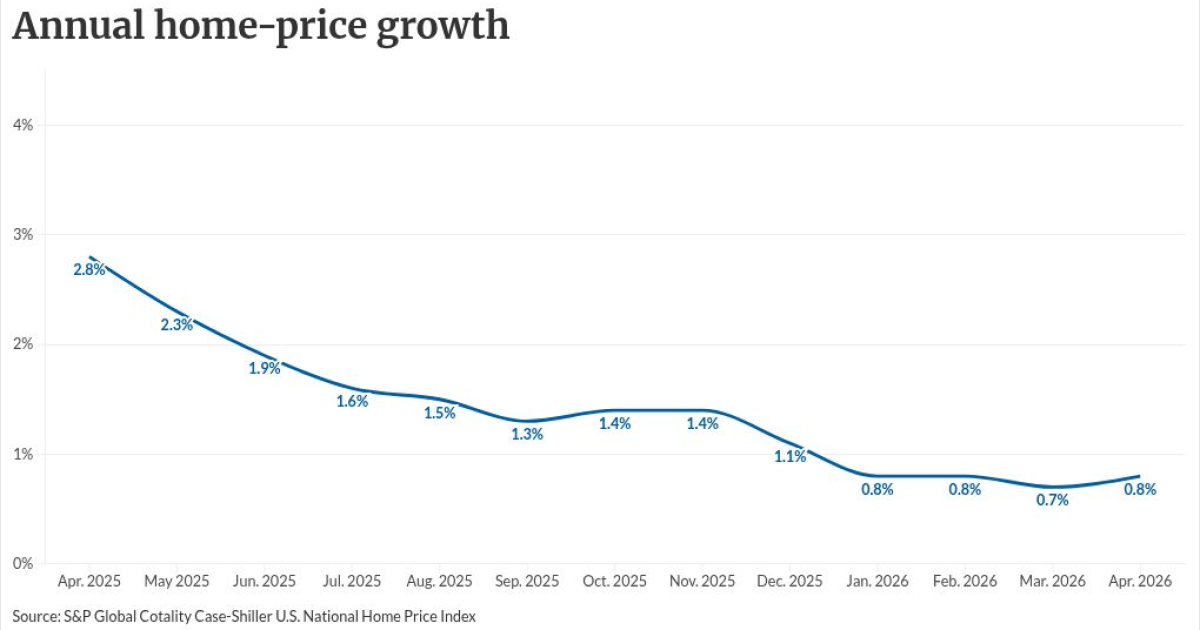
Home prices grew at a relatively flat rate in April, while inflation continued to surge, a new industry report found.
The S&P Cotality Case-Shiller home price index rose 0.8% year over year in April, up from a
"With inflation accelerating to 3.8% in April, U.S. home values have now declined in real terms for an 11th straight month, further eroding inflation-adjusted housing wealth," said Nicholas Godec, head of fixed income tradables and commodities at S&P Dow Jones Indices, in a press release Tuesday.
U.S. Federal Housing's House Price Index posted a 2% annual gain. Both indexes found prices fell 0.1% on a seasonally-adjusted monthly basis. On a nonseasonally adjusted basis, the Case-Shiller index rose 0.8% from March, reflecting typical spring gains.
"Monthly price movements show seasonal strength masking underlying softness," Godec said. "The latest six months saw a 1.35% national increase, offsetting a -0.5% decline in the prior six months. This represents a modest shift in direction, but remains limited in the context of rising costs."
Regionally, only four of the nine census divisions FHFA analyzed saw positive house price changes year over year, including the West North Central at 0.1%, West South Central at 0.1%, New England at 1% and Middle Atlantic at 0.4%. The Mountain division posted the largest decline at -0.8%. Over the last 12 months, all divisions posted gains, ranging from 0.2% in the Pacific division to 4.4% in the East North Central division.
"Geographic dispersion remains pronounced," Godec said. "Midwest and Northeast markets are still leading moderate growth, while many Sun Belt and Western metros see ongoing declines."
Case-Shiller's 10-city composite posted an annual jump of 1.8%, while the 20-city composite rose 1.1% year over year, both up from the 1.5% and 0.9% increases seen the previous month. Chicago was again the strongest market with a 6.5% annual gain in April, followed by New York at 3.8% and Cleveland at 3.2%. Seattle posted the lowest return in April, falling 2.3%, while Denver, Dallas and Phoenix were also notable droppers.
On a month-over-month basis, the preseasonally adjusted 10- and 20-city composites recorded increases of 1.1%, and 1%, respectively.
"The affordability pinch remains a key headwind," Godec said. "After dipping below 6% earlier this year, 30-year mortgage rates climbed back to
The 30-year rate has continued to rise since, now