- What's at Stake: Whether servicers can retain customers for future loans through digital engagement.
- Expert Quote: "Digital... is really the focal point." — Bruce Gehrke, JD Power
- Supporting Data: In both categories, banks have higher averages than mortgage-focused servicers.
Overview bullets generated by AI with editorial review.
Banks who service mortgages, possibly because they could have multiple relationships with their customer, have higher satisfaction scores than non-banks when it comes to views on friendliness of their websites and apps, JD Power said.
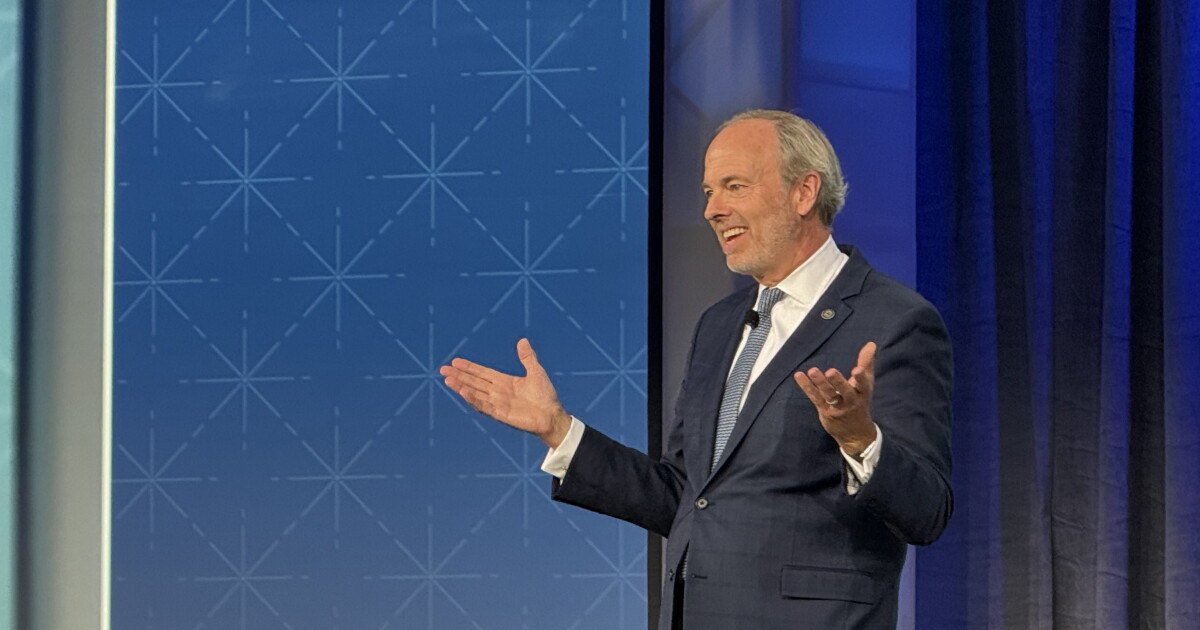
"Digital, when you're talking about providing a servicing experience, it is really the focal point," said Bruce Gehrke, senior director of wealth and lending intelligence at JD Power. "If you're not successful and not focused on your digital engagement with your customer, it is going to be difficult to really, really drive those great experiences."
Not only does it
"You have
This is a mind shift because for servicers, the largest share of their customers never interact with them besides making a payment.
"That digital touch point is one way where they can stay connected without having this heavy sort of involved interaction where they would normally talk to somebody," he said.
Still, when customers need to speak with a live person, those are really important in this experience when they're needed, and this is the key part, he added.
How did consumers rate the servicers for digital experience
In its second edition of the U.S. Mortgage Servicer Digital Experience Study, its lists are broken out by type of servicer and method of contact. But banks had the higher scores, no matter whether the contact was through an app or a website.
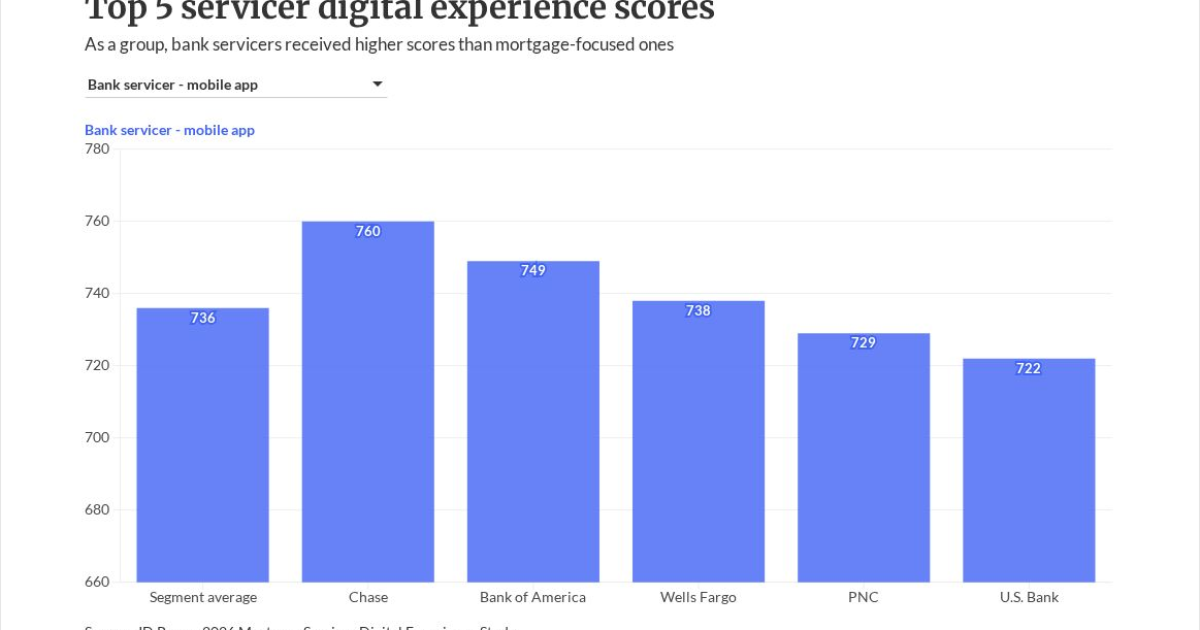
Chase has the highest score in the bank servicer - mobile app listing at 760, with a segment average of 736. But for bank servicer - website, the No. 1 rank goes to Bank of America and 766, with a segment average of 740.
Among mortgage-focused servicers, Rocket was on top of both lists, with a 719 score for mobile app and a 739 for website; segment averages were 680 and 704 respectively.
Last year's survey had Bank of America
After the initial study was done in 2025, in reviewing the feedback, "one of the things that came out of it when we looked at the data, there was a significant difference between, especially the big bank servicers, Chase, Wells, Bank of America, and everybody else," explained Gehrke.
Why did JD Power separate the two types of servicers
JD Power found the customer experiences between the banks and non-banks had distinctions, and it needed to consider the two as separate groups.
People are in their bank mobile apps practically every day and have a lot of familiarity with those.
The split is "ultimately more fair to the mortgage-focused servicers," Gehrke said. "They don't have that broader customer."
Furthermore, unlike
"This is really more prescriptive about what's driving and impressing customers, what's impacting their behavior, because it gives you the direct ability to say, you know, that step or this step is lacking, and where the friction is," he noted..
For the servicers, the end goal is to reduce the customer feeling the need to make a phone call to get a question answered.
Customers who use mobile apps "basically really like them," Gehrke said. But few servicers, especially banks, offered them.
What has happened over the last couple of years, Gehrke pointed out, is that servicers have focused on creating these apps. Bank servicers in particular did not give consumers the ability to manage their mortgage account on their apps until recently.
However, in