
- Expert Quote: "We have not received guidance from the GSEs or FHFA on what the scope of the pilot would be" — Rohit Gupta, President and CEO, Enact Holdings
- Forward Look: Prepare for muted revenue growth over the next year for private mortgage insurers.Overview bullets generated by AI with editorial review.
Even before the third quarter ended, private mortgage insurance was already in the crosshairs of the federal government. But the industry welcomed the attention.On Sept. 15, Federal Housing Finance Agency Director Bill Pulte ordered Fannie Mae to
Then President Trump's
In his preview for the earnings season, Douglas Harter of BTIG said he was expecting an increased focus on the regulatory landscape in the third quarter investor calls because of the increased interest in Washington.
An Oct. 7
The weakness in the segment's stock prices is "largely on political concerns related to potential action or headline risk" from Pulte, Bose George said.
Pulte's X posts have "targeted mortgage insurance for some time as an unnecessarily elevated cost for home buyers and homeowners," George continued. "He recently posted on X regarding ways to cut mortgage insurance costs as well," including cancellation.
The analysts at Keefe, Bruyette & Woods did not "meaningfully" change their earnings per share estimates on the private mortgage insurers in the third quarter sector preview, unlike for the originators and title companies they follow. The private MIs it tracks (all but Arch), are not "volume dependent" for their earnings.
The Fannie Mae cancellation policy change should have limited impact. If anything a modest rise in cancellations is not a negative for companies whose stock trades close to book value since they can use the excess capital for share buybacks.
BTIG recently resumed covering private mortgage insurers. The stable low teens return on equity combined with 2% to 3% growth in insurance-in-force means they will continue to generate excess capital which can be returned to shareholders, the Sept. 22 report from Harter and Will Nasta said.
"Revenue growth is expected to stay muted over the next year for the MIs given limited IIF growth and relative stability in terms of premium yield," BTIG said. "An acceleration in the pace of purchase mortgage volume, especially among first time homebuyers, would be necessary to translate into higher new insurance written and faster IIF growth. Given the current affordability challenges we don't see this happening in the near term."
Since the introduction of
In an Oct. 30 report, the analysts at Bank of America Securities downgraded Enact, Essent and NMI as a result of the executive order. It left the ratings on MGIC and Radian unchanged.
The analysts expected the order "to weigh on sentiment and cap valuations. Combined with soft housing activity and modest revenue growth, this leaves limited scope for a re-rating and warrants a more conservative sector view."
B of A did not change earnings' estimates, "but we think the policy/regulator risk has introduced a new downside risk vector which will be reflected in valuations." It lowered its price targets on all five companies it covers.
"The pilot is discretionary, applies only to new loans and must respect existing contracts," Mihir Bhatia said. "The risk is therefore expansion, not immediate cancellation of the existing book."
While noting the capital release will offset the earnings impact, allowing for easier policy cancellation could shorten duration, remove high-margin revenue and leave a less favorable risk mix for the MIs, Bhatia said.
On a broad basis, the MIs said they supported the executive order.
The following is a roundup of the results of the holding companies of the six active underwriters:
MGIC grabs business during 3Q
MGIC Investment reported lower net income versus the comparative periods, still the No. 1 company by new insurance written remained highly profitable.
Net income of $175 million compared with $181.2 million
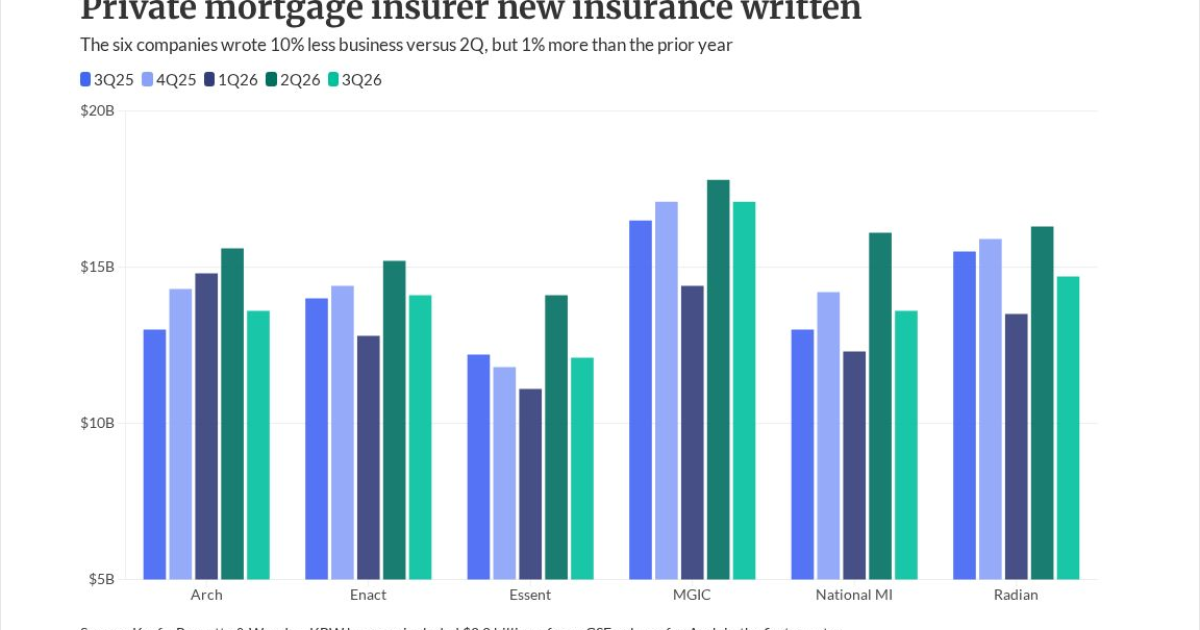
Its new insurance written of $17.1 billion was down from $17.8 billion three months prior, but up from $16.5 billion for the same period last year. This beat estimates from both KBW and BTIG.
Industry-wide NIW was $85.2 billion, down from $95.1 billion in the second quarter. A year ago it was $87.7 billion.
On the earnings call, CEO Tim Mattke addressed the executive order at the end of his opening remarks. "We support efforts that focus on lowering costs for new homeowners. And as always, we look forward to working with FHFA and the GSEs on ways to make homeownership more attainable."
Later, Nathan Colson, chief financial officer and chief risk officer, during the Q&A pointed to the federal law requiring cancellation when the borrower achieves a 78% loan-to-value ratio based on original value. Borrowers can request early cancellation based on current value. "I don't think we see a ton of evidence that feature is used very much," Colson said."
The delinquency rate on its portfolio of 2.52% is up 20 basis points from one year ago.
"We do still view it broadly as just the normalization of credit performance coming off of the peak kind of high-quality credit performance coming out of the COVID period," Colson said.
Inigo purchase paying off on Radian's bottom line
Radian Group's net income of $164 million is an improvement over the second quarter's $116 million and one year ago's $141 million. This is including discontinued operations
The acquisition was likely the only reason Radian had higher earnings versus the comparable periods, unlike its competitors.
The most recent results reflect the impact of $21 million from purchase accounting adjustments, amortization of acquired intangible assets and acquisition-related expenses related to specialty insurer Inigo.
It was also the
"The strategic rationale for acquiring Inigo is beginning to show up in our results," Weinbach said on the earnings call. "We said the transaction would diversify our earnings, expand our ability to deploy capital and add a scaled specialty platform without changing the disciplined way we approach risk. Those building blocks are now in place, and we're seeing them translate into results."
Radian is also supportive of the executive order's goals. "For the record, we're also supportive of aligning the GSE servicing guides," Weinbach said. "I can't remember if that happened before the last quarter or not, and we support the actions FHFA and Fannie Mae have taken to do so."
The company had $14.7 billion of NIW, compared with $16.3 billion for the period ended June 30, and $15.4 billion one year ago.
Details lacking on the pilot, Enact's CEO said
Enact Holdings is another underwriter whose net income was strong, just not as good as the comparative quarters.
It earned $159 million in the third quarter, down from $175 million three months prior, and $163 million
NIW of $14 billion was $1 billion lower than the second quarter and flat with the third quarter of 2025.
When asked about cancellation concerns during the earnings call, "from a consumer behavior perspective, that is tough to predict," Rohit Gupta, president and CEO said. "From a social media activity perspective or policy discussion perspective, those topics typically do not get reflected in consumer behavior, but too early to tell."
Later, Gupta commented the industry does not have a lot of details beyond what is in the executive order.
"We have not received guidance from the GSEs or FHFA on what the scope of the pilot would be, what the parameters would be and whether it's an automated valuation model or it's an FHFA price index," he continued. "So governance, transparency of whatever the methodology would be is very important in setting up the criteria and its resilience through cycles would be definitely part of the discussion."
Arch seeking MI opportunities outside of US line
The mortgage insurance segment at Arch Capital Group did $13.6 billion of NIW in the third quarter, down from $15.6 billion in the prior quarter. But it is up from just under $13 billion in the same period during 2025.
But the segment also includes Arch's international MI and U.S. credit risk transfer lines.
"Our business outside of primary U.S. mortgage insurance wrote $66 million of net premiums in the quarter, and we continue to see opportunities in these businesses, providing diversification from our USMI business," said CEO Nicolas Papadopoulo on the earnings call.
Segment underwriting income of $201 million was down from $220 million in the second quarter and $260 million in the year ago period.
At the holding company level, Arch reported net income of $1 billion, down from $1.3 billion in the prior year. Arch also reports specialty insurance and reinsurance segments.
Borrowers already taking advantage of cancellation, NMI exec says
National MI, the underwriting subsidiary of NMI Holdings, missed KBW's new insurance written forecast for the period by a little over $1 billion.
KBW's outlook called for $14.7 billion, National MI did $13.6 billion for the third quarter. It was also a 6.5% miss to BTIG's forecast.
NMI Holding's net income was $93.5 million, compared with $105.8 million in the second quarter. It was also lower than $96 million in the third quarter of 2025.
When asked about a decline in persistency rates in the 2020 vintage, Adam Pollitzer, president and CEO, said the policy cancellation trend dovetails with the executive order. NMI's experience looks to be different from MGIC's.
"We've seen much higher utilization on the borrower initiated cancellation as well based on value," Pollitzer said. "What's underpinning that is there's a lot more equity in the homes, borrowers are aware of that, and so it's been coming through, but also in an environment where the low note rate on your existing mortgage is keeping existing homeowners in their current homes, they're not moving with the same frequency."
They also don't have the same opportunity to refinance, he continued.
Essent misses analysts' take on NIW
Essent Group remained the laggard in NIW and it missed analysts' estimates from both BTIG and KBW.
The company did $12.1 billion, a miss of 8% to what Harter expected. "The NIW miss is a combination of both smaller than expected market (down 3% from BTIG's forecast) and lower market share (a drop of 60 basis points quarter-to-quarter)," the report said.
KBW was looking for NIW of $12.7 billion. Essent was the last of the MIs to report.
In the third quarter, Essent reported net income of $163.4 million, versus $189.7 million in the second quarter. For the same quarter last year, it earned $164.2 million.
On the earnings call, Mark Casale, chairman and CEO, said Essent is not necessarily concerned about share given the smaller size of the competitive market.
"I would look at it as every MI seems to have their own buy box," he said. "Some like lower LTVs, some like higher credits, some like certain geographies, certain lenders. But I do think it kind of balances out in the end."