- Key Insight: A handful of states reached investor-property shares exceeding 25 percent.
- Expert Quote: 'While investor home purchases increased during the second quarter, they didn't keep pace with the much larger increase in overall home sales during April, May and June," — Ivo Draginov, BatchData President
- Forward Look: What's coming: A noticeable rise in non-QM activity expected in 2026.
Overview bullets generated by AI with editorial review.
A handful of states have investor-property shares exceeding 25%, a number that may provide clues to lenders looking to tap into the growing market for the type of non-qualified mortgages designed for the segment.
Approximately 15.9 million homes, representing 18% of the U.S. market, were classified as
Certain states, though, had a much larger share of such properties, the real estate data provider said. Maine led the nation with 30.9% of units classified as investment real estate, followed closely behind by Wyoming at 30.6%. Rounding out the top five were Alaska at 26.7%, Montana at 26.6% and Hawaii with 25.6%.
"All of these states depend heavily on tourism, so it's likely that many of the investor-owned homes are vacation homes and short-term rental properties," researchers at BatchData wrote in its second-quarter pulse report.
Three other states that see
Currently, the states with the greatest number of investor units are the most populated scattered across the Sun Belt, led by Texas at 1.4 million properties, BatchData reported. California follows at just under 1.2 million, with Florida just behind at 1.1 million investor properties.
The numbers hint at where opportunity may lie for lenders seeking to grow or expand into debt-service-coverage-ratio mortgages, one of the types of loans defined as non-QM.
With residential mortgage rates now at their highest in years, industry leaders have touted the
Investment purchases grow, but market share shrinks
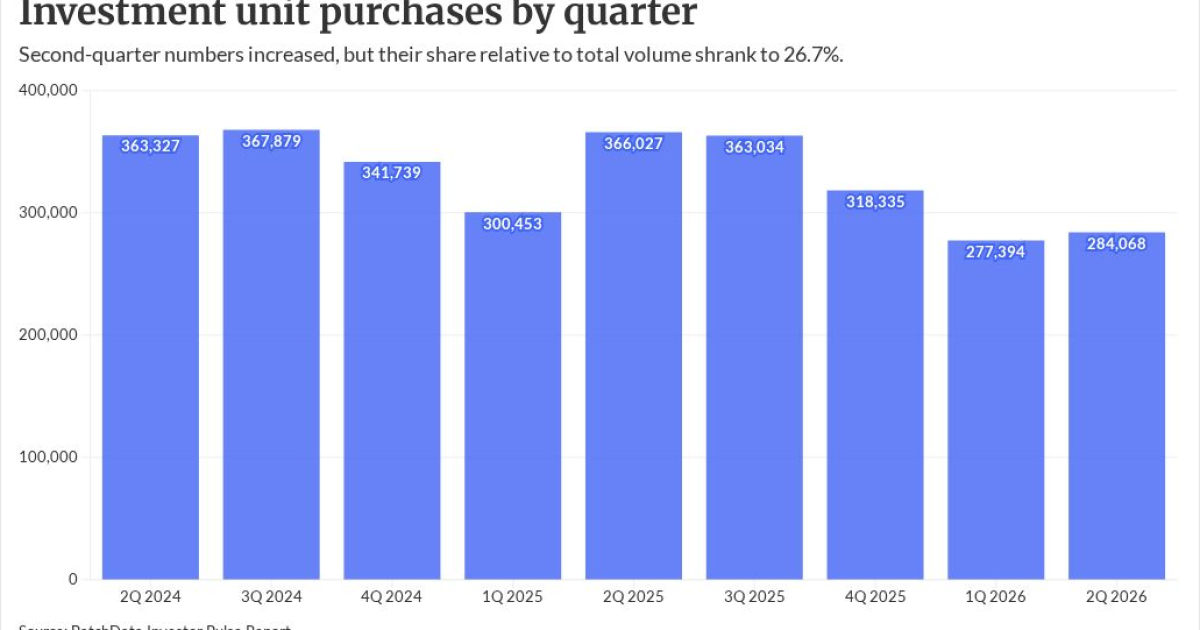
Just as the housing market has seen activity slow in recent months, investment property sales similarly retreated compared to a year ago, according to the report. Investors bought 284,068 homes in the second quarter, a 22% drop from the 366,027 purchased a year earlier.
On a quarter-to-quarter basis, though, investor purchases grew from approximately 277,394 three months earlier. Still, market share decreased over the three-month period.
"While investor home purchases increased during the second quarter, they didn't keep pace with the much larger increase in overall home sales during April, May and June," said BatchData President Ivo Draginov.
Despite the quarterly uptick, the number of purchases accounted for just 26.7% of sales transactions, the smallest slice in five quarters, as traditional homebuyers were responsible for the majority. The current investor share is still above percentages seen two years ago.