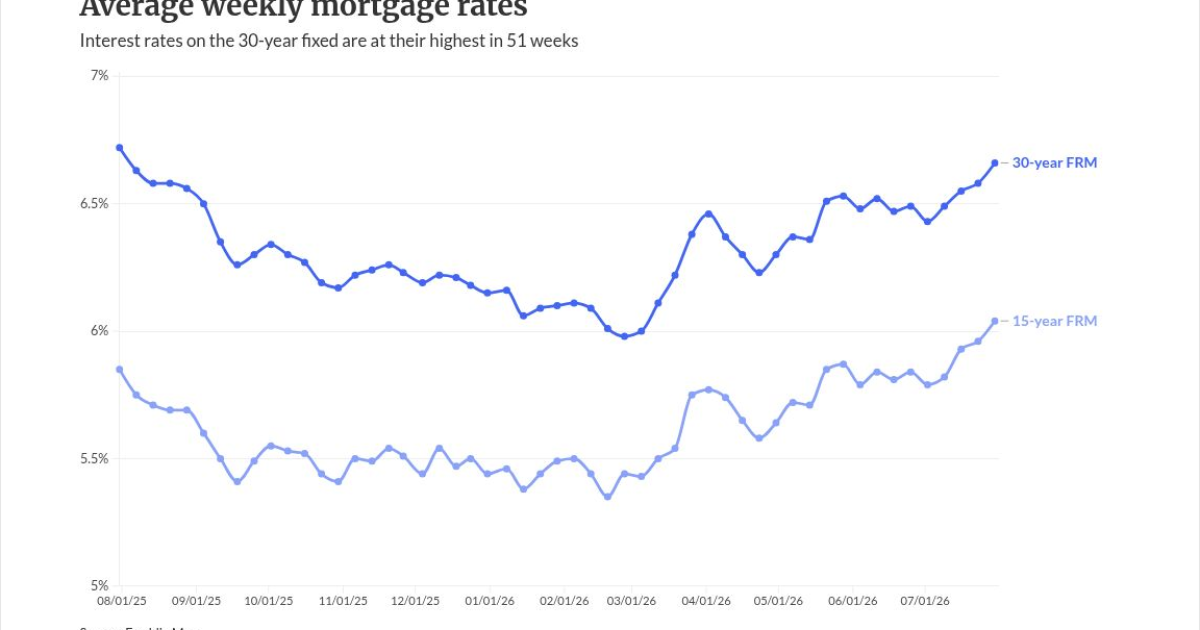
Mortgage rates climb further this week, rising 8 basis points to their highest in nearly a year, the Freddie Mac Primary Mortgage Market Survey reported.
This is the fourth consecutive week of increases and it comes as the 10-year Treasury, likely in reaction to yesterday's news from the Federal Open Market Committee, broke above the 4.68% level as of 11:15 a.m. on Thursday morning.
It is still better than
Even with the 10-year's drop for most of the week, the 30-year fixed rate mortgage had increased 8 basis points to 6.66% from 6.58% by Thursday. For
The 15-year FRM increased to 6.04%, its highest point since April 17, 2025. Last week it averaged 5.96%, while for the week of July 31, 2025, the 15-year was at 5.85%.
"The housing market continues to benefit from more available inventory, providing prospective homebuyers with additional options and helping support buyer activity as mortgage rates fluctuate," Freddie Mac Chief Economist Sam Khater said in a press release.
What other mortgage rate indicators are showing
Lender Price data posted on the National Mortgage News website for the 30-year FRM has remained above 6.9%. As of noon on July 30, it was at 6.92%, a drop of 3 basis points from the previous week.
Optimal Blue had the conforming 30-year FRM at 6.67% as of July 29, up 5 basis points from the previous day but 1 basis point lower than where it was on July 23.
The
"The Fed may have stood still this week, but mortgage rates moved decisively upward," Wood said in a Thursday morning statement before the Freddie Mac data release.
This inaction is having the effect of increasing market participants' inflation expectations. While the Fed vote does not directly affect mortgage rates, investor expectations do, and this is typically seen in the yields of longer-term instruments like the 10-year Treasury.
"While it's unclear if or when the central bankers might raise the funds rate, there's plenty of concern that inflation's running unchecked," Wood said. "Between that and Iran we're seeing Treasury yields surge, and mortgage rates are being dragged up along with them."
How the FOMC vote affects housing
With three dissenting votes on the FOMC, and all pushing for an increase, the bias for its next move is to do just that, said Kara Ng, senior economist at Zillow Home Loans, in a Wednesday statement.
"Mortgage rates are slightly lower than a year ago, but that boost to housing activity may not last much longer," Ng said. "Although rates are expected to decline from today's levels, a year-end rate of 6.4% would be slightly higher than the range buyers encountered in the fall and winter of 2025. That would
The FOMC doing nothing was its best course of action, said Melissa Cohn, regional vice president of William Raveis Mortgage.
"That doesn't mean that a rate hike is off the table in September," Cohn said. "The answer to that will be in the data over the next two months."
Inflation will be the driver of mortgage rates, she said.
"With no movement from the Fed, all eyes will go back to watching the price of oil and the impact on bond yields," Cohn noted. "Depending on what happens with the war in Iran, and if oil prices decline, we can hopefully look forward to lower mortgage rates."
Before the meeting, some were of the view the Fed was likely to raise rates, said Michael Chadwick of Fiscal Wisdom Wealth Management.
"But the reality is, under the covers, the economy isn't great and inflation remains an issue," Chadwick said. "We expect the Fed to cut rates far before they start raising them."
However, the markets are now looking at a short-term rate hike before the end of year, said Mike Fratantoni, chief economist of the Mortgage Bankers Association, in a post-FOMC meeting statement. The MBA has been on the record for several months that its expectations for the
"Higher inflation, and this turn in monetary policy, certainly have contributed to the increase in mortgage rates, now at their highest levels since last August," Fratantoni said. "These higher rates are posing a headwind for the housing market."