
- What's at Stake: More lenders face penalties of up to $1,500 per "willful" violation of the law for alleged mortgage solicitations.
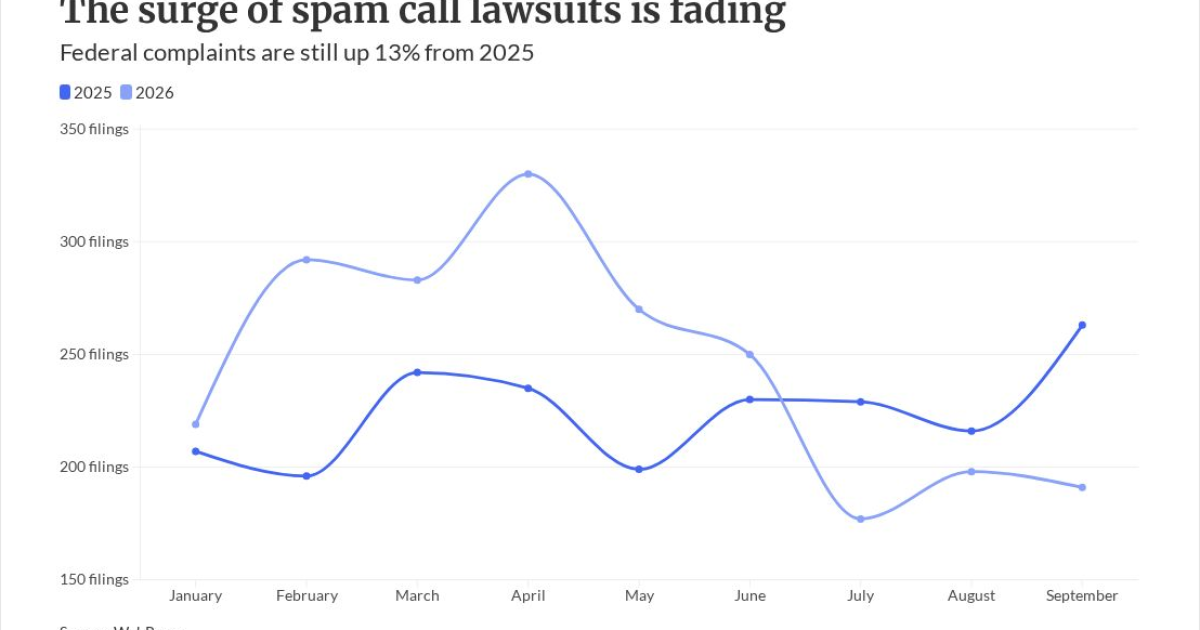
- Supporting Data: Federal Telephone Consumer Protection Act lawsuits against all defendants are down on a monthly basis, but still up 13% on the year.Overview bullets generated by AI with editorial review.
Consumers are hitting mortgage lenders with spam call lawsuits as fast as they can swat them away.Seven more origination shops have been sued for
Companies can run afoul of the law if they send two or more unwanted phone calls in a 12-month period to a customer on the national Do Not Call Registry. While some of the latest lawsuits allege that lenders hit that small threshold, other consumers describe a harassment campaign of mortgage solicitations spanning months.
"Consumers in the United States are united in their disdain for unsolicited marketing calls and texts," wrote attorney Max Morgan of The Weitz Firm on behalf of one of the latest plaintiffs, in a statement Friday. "Congress has warned telemarketers about the consequences of disturbing people without their permission."
Penalties for each call can range from $500 to $1,500 for a willful and knowing violation. Real estate firms have
Who's being sued?
Some of the latest real estate companies named as defendants in recent months have already been sued this year. They include:
- Barrett Financial Group, with $9.96 billion in volume year-to-date per Modex;
- eMortgage Funding, with $769 million in volume;
- GFS Home Loans, with $872 million in volume;
- Mortgage Pros, with $1.22 billion in volume;
- Mutual of Omaha Mortgage, with $8.2 billion in volume;
- Swift Home Loans, with $3.2 billion in volume.
A plaintiff also sued Premier Agency Real Estate, a Southern California-based brokerage with 27 agents. Several attorneys for both plaintiffs and defendants, and company representatives, declined to comment on the pending litigation.The cases are structured similarly, although the number of combined mortgage solicitations via text messages and phone calls varies.
Christopher Laccione accuses Swift of sending him at least two dozen home loan solicitations, despite his pleas that he wasn't interested. He accused the alleged Swift callers of failing to identify their affiliation.
"Upon information and belief, SHL trained its representatives to be evasive because SHL knew it was violating the TCPA and various state laws and did not want to reveal its identity to minimize complaints and litigation," attorneys for Laccione, including Max Morgan, wrote.
In a motion to dismiss last month, Swift argued that the plaintiff could only prove one of the phone calls came from a Swift representative, and that the consumer did not reply "stop" to text messages offering him to end outreach.
An attorney and representative for the company didn't respond to requests for comment.
Litigation exposure easing?
In some recent motions to dismiss, lenders have
Of the earlier cases filed against the industry this year, lenders have reached resolutions in at least a dozen of those filings.
The torrid pace of TCPA litigation against businesses nationwide has slowed somewhat. While federal TCPA complaints are still up around 13% on the year through October, their monthly pace has fallen,