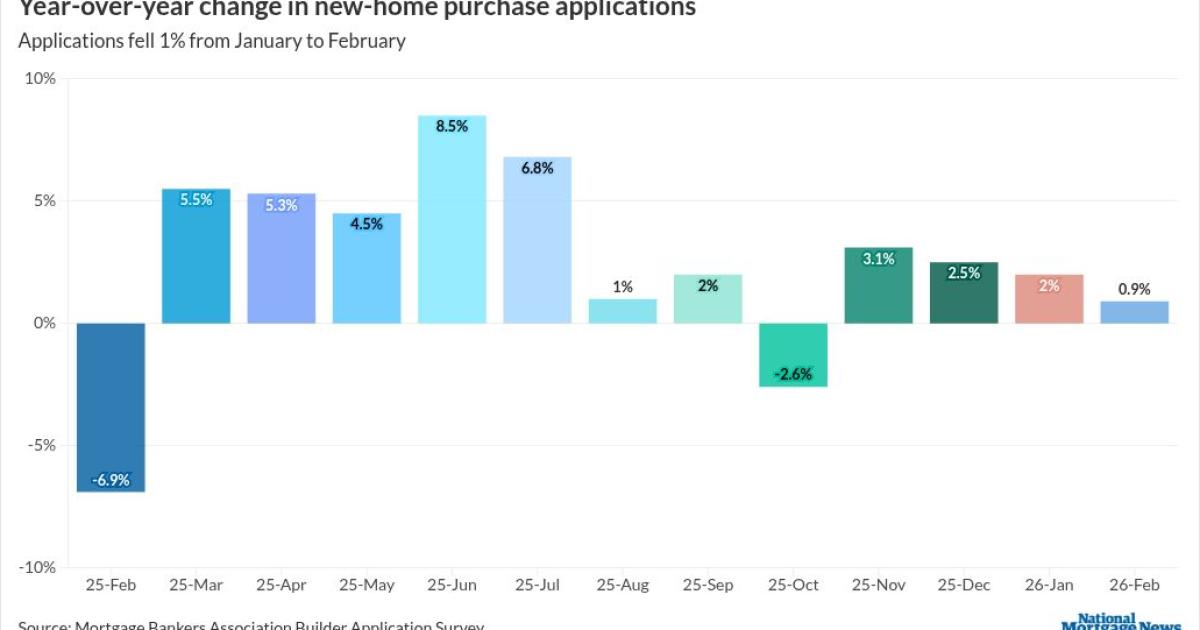
There was less interest in buying a newly constructed home last month, as macroeconomic uncertainty squashed a recent market rally.
New home purchase applications for February were up 0.9% from the same time last year, but down 1% from January, the Mortgage Bankers Association reported Thursday. The tepid
"Macroeconomic uncertainty likely played a role in this sluggishness, especially given the weakening job market," said Joel Kan, the MBA's vice president and deputy chief economist, in a press release.
Last month's data doesn't reflect the economic reaction to the Iran war, which started February 28 and since sent the
Separately,
Fewer sales, smaller prices
Kan added that demand could be slowing in Sunbelt states, where inventory is more abundant, even with easing home price growth. The average loan size for new homes fell slightly in February, from $385,506 in January to $383,570.
The approximately 57,000 new home sales in February was also down slightly from the estimated 58,000 such transactions in January, the MBA said. Overall, new single-family home sales were running at a seasonally adjusted annual pace of 641,000 units in February, down 3.3% from January's pace.
The slowdown comes on the heels of the winter gains, when December housing start data reached a five-month high.
The product mix for new construction shifted slightly, with conventional loan applications ticking up to 49.4% of all activity, and Federal Housing Administration-backed loans rising slightly to 35.3% of applications. Department of Veterans Affairs-sponsored loans accounted for 14.1% of share, followed by 1.2% of applications for U.S. Department of Agriculture Rural Housing Service mortgages.
New homes were part of the focus of the