
- Key Insight: A projected slowdown in home renovation spending may require lenders to adjust the who and how of marketing strategy.
- What's at Stake: Many lenders had viewed renovation-project funding as one possible solution that would offset a pullback mortgage originations this year.
Overview bullets generated by AI with editorial review.
New research suggests subdued prospects for home improvement businesses ahead, a trend that would exacerbate challenges for lenders, many of whom saw remodel and renovation projects as a potential antidote to sluggish mortgage originations.
Yet despite a bleaker 2027 outlook from the new report, experts in the remodeling segment counter that the conditions that supported growth this year are still largely in place and see steady activity ahead. The economic environment, though, may require adjustments to lenders' marketing strategies, with a focus on first-time buyers' pent-up demand for homeownership possibly bringing rewards.
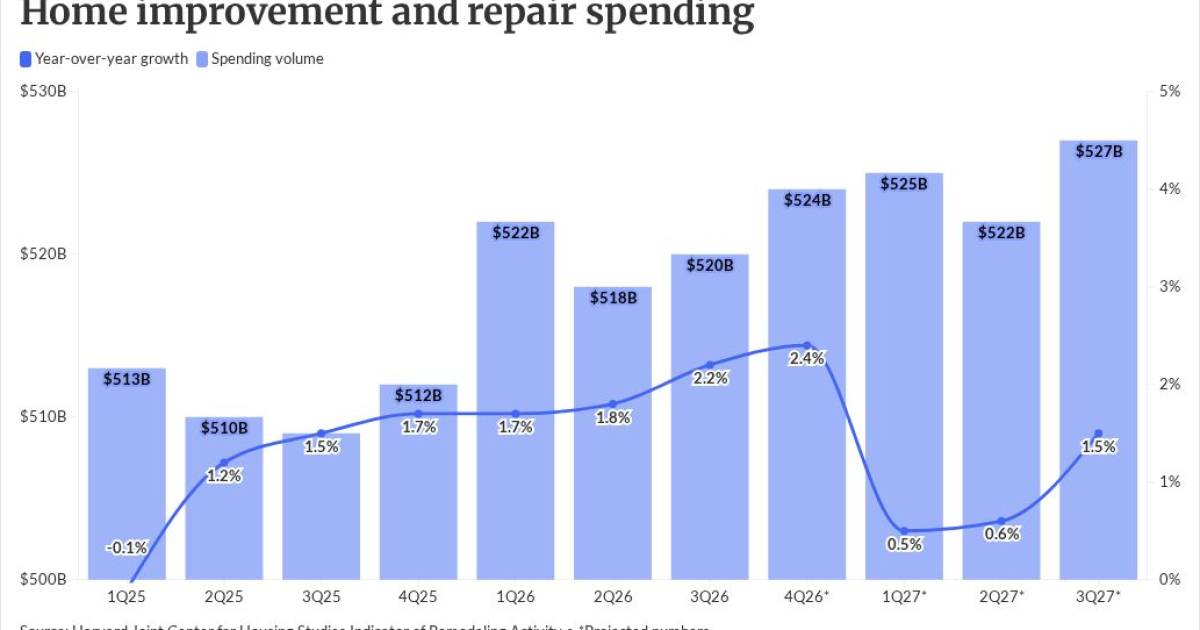
The number represents a slowdown from the 2.2% year-over-year pace reported by Harvard at the end of the recent third quarter, when volume hit $520 million, but was on par with the 1.5% rate in the same three months of 2025.
Researchers forecast renovation spending to grow 2.4% by the end of this year before a noticeable pullback begins in early 2027, when growth is expected to slow to 0.5% in the first quarter. Numbers were not seasonally adjusted.
"Retail spending on building products has been flat to negative, and remodeling permits have stagnated, which points to continued sluggish renovation activity," said Rachel Bogardus Drew, director of the Remodeling Futures Program at Harvard JCHS, in a press release. "We expect annual spending to hover around $525 billion through the third quarter of next year."
Home equity lending, which property owners commonly rely on to fund repairs and improvement projects, has
Macroeconomic challenges hitting the housing market, including new construction starts, lie behind a potential slowdown, the Harvard report concluded. "These ongoing headwinds could slow growth in remodeling spending even further in the quarters ahead," said Chris Herbert, managing director of the center.
Industry leader suggests where customers will be found
Despite the unexpected persistence of economic challenges this year, the same factors that provided hints of optimism for renovation spending are not going away and will still support business expansion, countered Skip Schenker, founder and co-CEO of Ready4Remodel, a technology platform designed for home improvement customers.
Lenders can tap into existing economic conditions to capture customers, with much of the demand to be driven by necessity, Schenker said.
The majority of homeowners holding mortgage rates under current levels and who are hesitant to relocate represent a potential source of customers, with a large share of the occupied homes today consisting of properties more than 40 years old, he pointed out.
"The systems in each of those homes — the HVAC, the roof, the windows, the doors, the plumbing, the electrical — if those systems haven't been updated, they are timing out," he said.
Schenker anticipates incremental growth similar to 2025's pace, rather than the pullback reported by Harvard JCHS.
A pipeline of potential customers also comes from the pent-up demand of aspiring first-time homeowners, he said. Many who are eager to own but unable to afford the "perfect" property that checks off their wants will settle for a fixer-upper.
In addition to home equity products, loans such as the
"I'm saying the new starter home is a fixer-upper," Schenker said. "A renovation loan is a financial vehicle to help transform an older home into a home where dreams can thrive."
Following a downturn in 2024, when growth in renovation spending turned negative, Harvard's remodeling indicator has shown consistent growth over the past six quarters. Earlier in 2026 prior to the most recent report, repair and home improvement activity grew year over year by 1.7% and 1.8% in first and second quarters, respectively.