- What's at Stake: Homebuyers face escalating borrowing costs if the 10-year Treasury yield, which is used to price mortgages, remains elevated.
- Expert Quote: "It's not just that rates keep rising, it's how quickly they're going up." — Kate Wood, NerdWallet's lending expert
- Forward Look: Expect rates to ease to 7.1% by 2026 and 6.5% by 2027, Zillow said.
As the 10-year Treasury yield remains at levels last seen briefly in June 2007, mortgage rates again rose by double digits this week.While expecting the 30-year fixed to remain above 7% this year, one observer predicts moderate easing through the end of 2027.
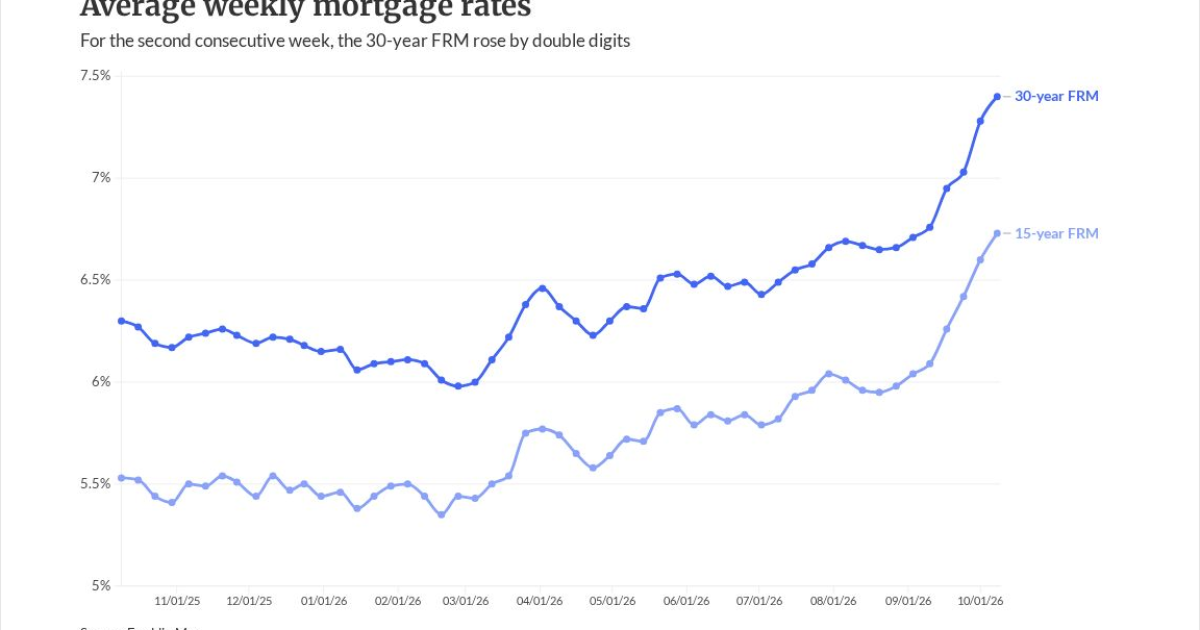
The conforming 30-year fixed rate mortgage was 12 basis points higher this week the Freddie Mac Primary Mortgage Market Survey found,
The 30-year FRM averaged 7.4% on Oct. 8, compared with last week's 7.28% and
The last time Freddie Mac had the 30-year at a higher rate
This was the seventh consecutive week this rate has increased.
Freddie Mac also tracks the 15-year FRM, which was at 6.73% this week, versus 6.6% on Oct. 1 and 5.53% a year at this time.
It's not just that the rates are rising, its the speed at which they're going up
"It's not just that rates keep rising, it's how quickly they're going up," said Kate Wood, NerdWallet's lending expert in a statement.
NerdWallet gets its rate data from Zillow and the average for the 30-year FRM in this tracker has increased by "two-digit increments for four weeks running," Wood said. "In the course of a month, the average has jumped two-thirds of a percentage point."
The rate climb seems to have slowed when compared with the past few weeks, Kara Ng, senior economist at Zillow Home Loans, in a separate statement.
"Rates are now at their highest level in about three years, but they seem less intent on bulldozing through the 2023 high," Ng said.
"Zillow expects the next move is more likely down than up, but our forecast for relief is modest — we expect the 30-year fixed rate to ease to 7.1% by the end of 2026 and only 6.5% by the end of 2027."
The last time the 10-year was sustained above the current 5.3% is back in April 2002. The yield has closed at or above 5.24% every day since Sept. 28.
Lender Price data on the National Mortgage News website shows the 30-year fixed at 7.824% as of 11 a.m. on Oct. 8.
What economic influences matter for the 10-year Treasury
A stronger-than-expected purchasing managers index on Sept. 23 helped to push the 10-year yield up 15 basis points at that time to 5.11%, said Craig Brothers, senior portfolio manager at Bell Air Investment Advisors.
"Other things to note are that nominal growth has been above 5% for the last two years, unemployment has ranged between 4.10-4.50 % over the last two years, the
The nominal gross domestic product, a measurement of real estate and inflation, "is a good proxy for where the 10-year should reside."
During the 2010 through 2022 period, where the Federal Reserve had its quantitative easing program, which made rates during this period an anomaly from the norm.
"Today's rate is justified based on high nominal GDP, a strong labor market, a very large Federal deficit/ borrowing needs, and inflation above target," Brothers said.
Last Friday's
"But structural pressure on long-term yields remains from inflation, government borrowing, energy prices and enormous public- and private-sector demand for capital," Busch said. "This matters well beyond bonds," as long-term Treasury yields influence mortgage rates among other things.
Current probability for a December hike on CME FedWatch is 70% for 25 basis points and 16% looking at 50 basis points.