- Key Insight: How middle-income homebuyers are shifting toward government-backed Ginnie Mae loans.
- What's at Stake: Lenders and servicers have to manage more FHA and VA loans as policymakers extend diminished leeway to distressed borrowers.
- Expert Quote: "The affordability issue is climbing up the AMI ladder." — Chrystal Kornegay, MassHousing
Overview bullets generated by AI with editorial review.
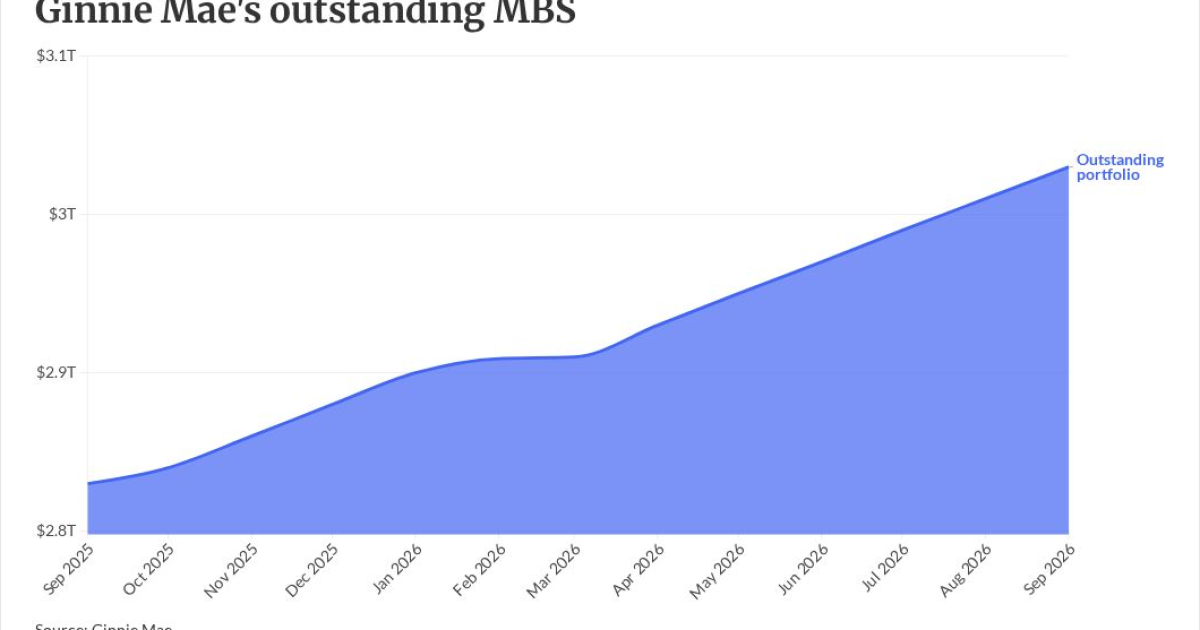
Ginnie Mae's latest report shows its outstanding mortgage-backed securities volume has risen into the $3 trillion range, signaling how reliant lenders have become on the government-backed market.
The move above $3 trillion, which began in August and became more established in September, occurred as the mortgage-backed securities guarantor's pace of growth has surpassed other agencies, according to Ginnie's research.
Its portfolio grew to its current size following its guarantee of $46.5 billion in MBS issuance during September. The government corporation, which is part of the Department of Housing and Urban Development, has supported loans for roughly 62,891 first-time homebuyers year-to-date.
What's driving the shift toward government loans
The Federal Housing Administration's
While Ginnie Mae's overall portfolio growth stems in part from more consumers seeking affordable products, it also reflects recent
That said, the percentage of locked-in borrowers has gradually decreased.
The majority of borrowers today have higher rates above 3%, Nora Wittstruck, chief analytical officer, governments, at S&P Global, said during an economic outlook session at the company's 2026 Affordability Forum.
Rates have stabilized in the past week, home inventory conditions have improved and employment is relatively strong, but consumer affordability is still under strain
"Wages are not keeping up with actual costs," said Wittstruck. "This has really been a big problem for the economy and people who want to buy a house."
These developments have pushed financial duress further into the middle-income market more typically served by government-sponsored enterprises rather than Ginnie.
"The affordability issue is climbing up the AMI ladder," said Chrystal Kornegay, CEO, MassHousing, while speaking during a separate session at the S&P Global event on housing challenges. (AMI refers to area median income.)
While affordability is a challenge and has discouraged some homebuyers, it's encouraged others, Kornegay said.
"People are thinking, 'I'd better buy that house before interest rates go up any more," she said, while noting that how much this motivation is compelling to borrowers has limits to the extent hikes persist.
To deal with affordability concerns, interested buyers have been using downpayment assistance and that has fueled a large pickup in MassHousing's single-family portfolio, Kornegay said.
Government-backed loans in the Ginnie market like the FHA's, VA's or the U.S. Department of Agriculture's, provide relatively more leeway on financial requirements like down payments and credit scores to help lenders finance borrowers under these conditions.
However, total FHA loan costs are typically high relative to GSE programs. Also FHA loans are relatively more vulnerable to performance issues than others because the borrowers who take them out may have less of a buffer against financial pressure than other types of mortgages.
This means lenders may want to add their own underwriting overlays on FHA loans to manage the risk, and servicers should be paying closer attention to them as federal policymakers have withdrawn pandemic leniencies they previously allowed distressed borrowers.