While housing affordability has improved year-over year in all of the 50 markets tracked by First American, the sizes of the gains have varied across that universe. Plus, on a comparative basis, home prices remain higher than prior to the pandemic.
A recent analysis from the company quantifies these differences.
Consumers' house-buying power nationwide in February rose by 10% relative to list prices from a year ago, said Sam Williamson, a senior economist at First American.
But regional variations in this metric are largely affected by interest rates remaining higher. Those have had different impacts depending on the city.
"Improved affordability suggests the housing market is entering spring on somewhat stronger footing than a year ago, even if the recent rise in mortgage rates has tempered some of that momentum," Williamson said in a press release. "That means any pickup in sales is likely to be uneven rather than broad-based.
The impact of March's rise in interest rates
At the end of February, the 30-year fixed rate mortgage averaged 5.98%, according to Freddie Mac. However, the Iran conflict led investors to flee the 10-year Treasury during March, pushing yields higher. This resulted in the
This increase "could take some wind out of the spring market's sails, but not enough to knock it off course," Williamson added in a follow-up comment.
"While higher rates may trim the number of homes within buyers' budgets, buyers are still in a stronger position relative to list prices than they were a year ago," he continued. "That should help keep the spring market moving forward, particularly in markets where affordability is closer to pre-pandemic norms."
In an earlier article, Williamson noted that house buying power has topped the median list price for the first time since 2022. In December, house buying power was $417,000, 5% over the national median list price of $396,000.
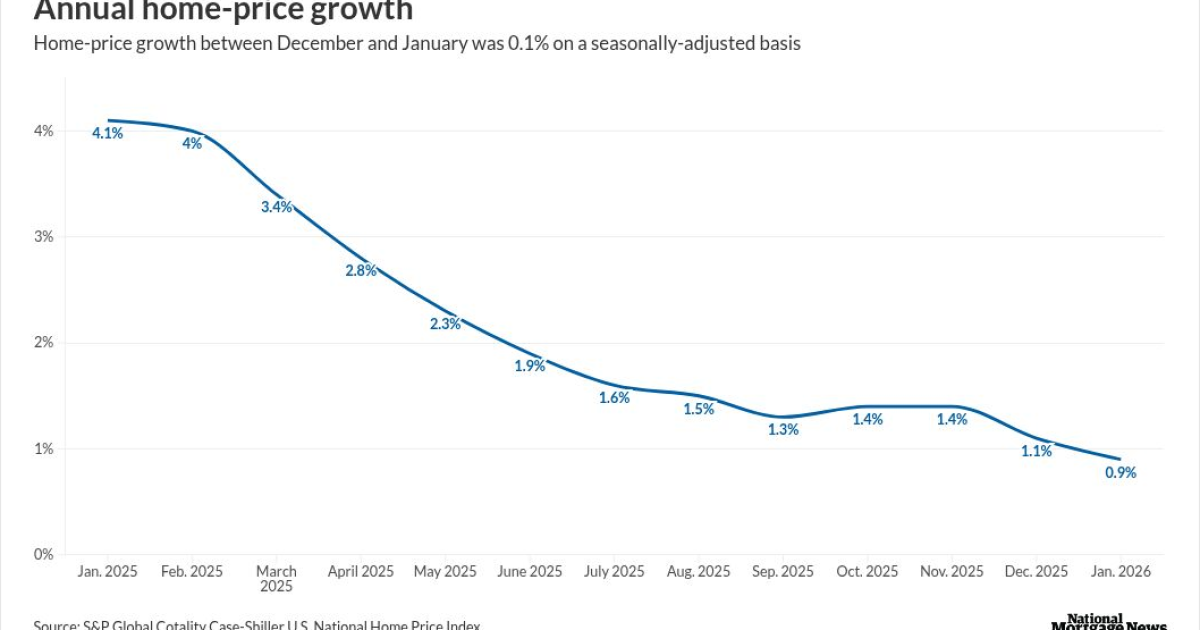
On the other hand, price growth continues to moderate.
The Federal Housing Finance Agency House Price Index
Case-Shiller has a pair of sub-indices, the 10-city which reflects older areas, and the 20-city, which covers a broader range of newer markets. Those both increased at a higher level on an annual basis than the national index, at 1.7% and 1.2% respectively.
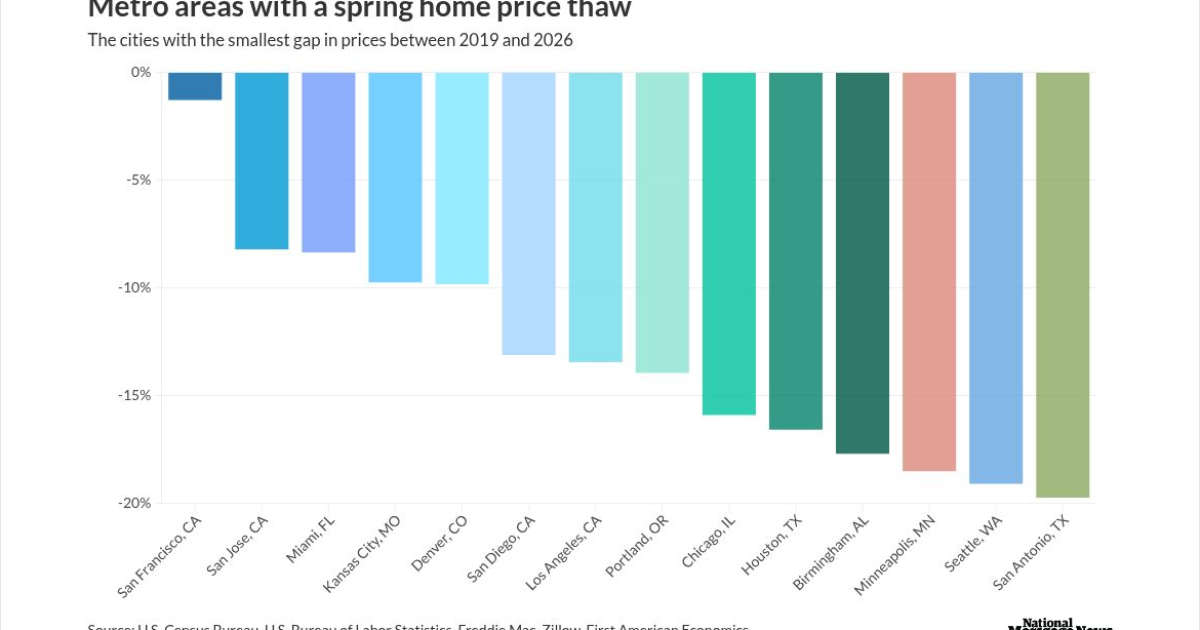
Cities where the price gap has narrowed
The local market with the lowest difference in buying power-to-price ratio for the period between 2019 and 2026 is San Francisco, at -1.3%, according to First American. Its neighbor in the Bay Area, San Jose, was next, at -8.2%, followed by Miami at 8.3%. Kansas City, Missouri and Denver rounded out the top five.
However, San Francisco
Those cities closest to their pre-pandemic level are
"In those markets, a greater share of homes has come back within buyers' budgets." Williamson said. "Elsewhere, where affordability gaps remain wider, the thaw is likely to come more slowly."
Housing markets where the thaw will take some time
Where the freeze will last longer is Hartford, Connecticut. The affordability gap is -74.4%, the worst by far. It is "an outlier even among the most strained markets," Williamson said. In most markets, homebuying power has increased, at an average of 7% to 8% since 2019. In Hartford, it declined 11%. Milwaukee was down less than 1%.
Behind Hartford on the still frosty list were Philadelphia, -49.9%, and Pittsburgh, -43.4%.
At -30%, Milwaukee is in the group of markets First American described as experiencing notable thawing but in its case not enough to pull it out of its deep freeze.