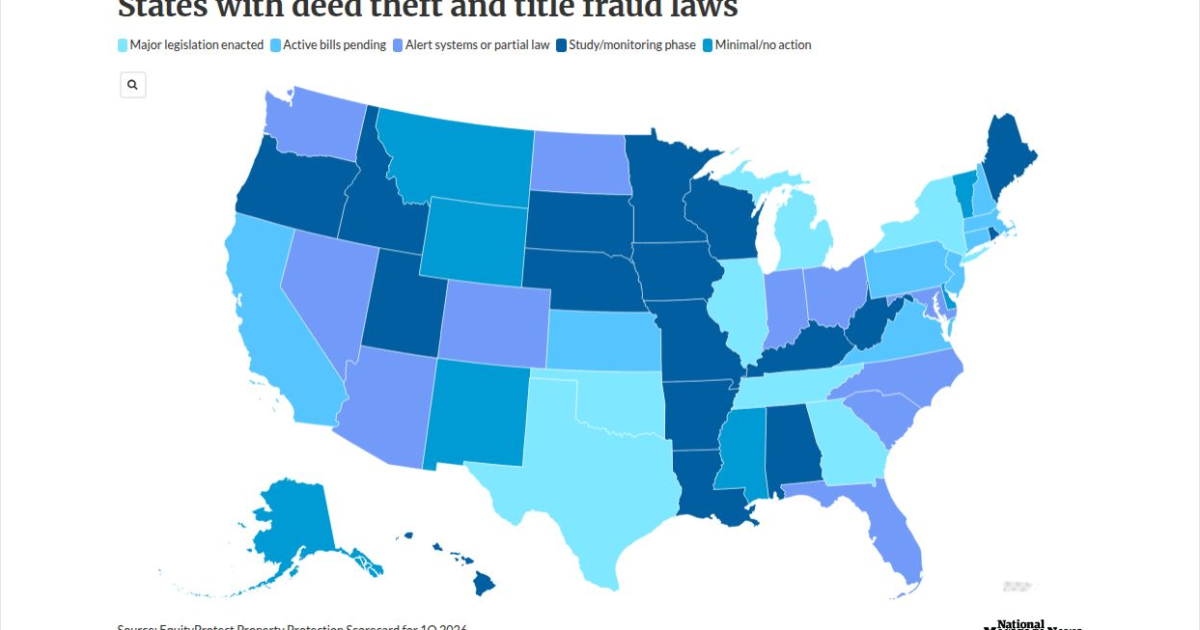
Approximately one-third of states do not have any deed-fraud specific statutes covering residential property titles, a new quarterly ranking from EquityProtect noted.
The EquityProtect Property Protection Scorecard classifies the 50 states, along with the District of Columbia, into five tiers, ranging from major laws acted through minimal or no action.
Seven states have added deed fraud laws since 2023, including New York, where Attorney General Letitia James has
Before it passed its law,
In 2024, 9,359 complaints for title or deed theft were filed with the Federal Bureau of Investigation, with $173.6 million in losses. For the four prior years, over 58,000 complaints of real estate fraud were made to the FBI, with $1.3 billion in combined losses.
The
Seniors are especially hit hard by this crime, representing 19% of the alleged victims but 44% of the financial losses.
EquityProtect created the scorecard to give people in both the mortgage and title industries actionable intelligence, beyond just simple awareness of this problem, said Jon Dovidio, its vice president of business development.
The title insurance industry also has taken measures to help prevent deed fraud. Last August, the American Land Title Association
A companion endorsement for existing owner title insurance policy holders was rolled out at the same time, the ALTA 49.1 Endorsement. It allows a homeowner to add coverage for risks such as deed or mortgage forgery which may occur after the policy endorsement date.
A fraudulent property deed can be filed with the county recorder faster than a mortgage. "Too many lenders are operating under the assumption that state law or a county alert system is doing the job," Dovidio said. The findings show gaps exist.
Alert systems fundamentally misunderstand the problem. They tell the homeowner that a document has already been recorded in their name, which means the fraud has already happened.
"For a mortgage professional, that means the collateral has already been compromised, the title is already clouded, and the clock is already running on what could be a six-figure legal recovery process," Dovidio said. "Notification is not prevention."
Reversing a fraudulent title, even in states with strong criminal statutes, costs victims an average of between $50,000 and $150,000 in legal fees, EquityProtect said.