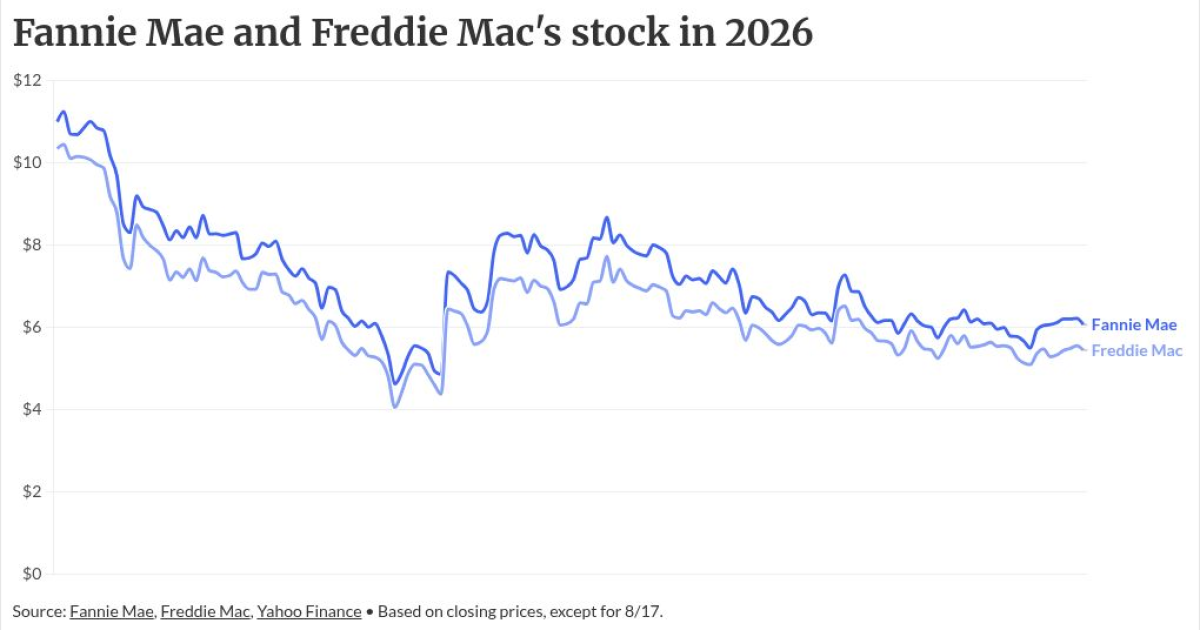
Trends in how Fannie Mae and Freddie Mac's legacy shares trade are similar, but there is some variation in views of the two that recent investor disagreement over their prospects highlights.
Jon Oksenholt, who holds more of Freddie's shares, recently took issue with Pershing Square's assessment of the two government-sponsored enterprises late last year, in which that company valued Freddie at 13x and Fannie at 16x. Pershing is more heavily invested in Fannie.
"I think Pershing has it backwards," Oksenholt wrote in a recent report in which he also noted that he generally agrees with that company's chief executive, Bill Ackman, on
While the positions the two investors have taken may be in part due to which GSE they hold more shares in, the disagreement does raise questions about whether one the enterprises objectively has a more favorable outlook as an investment.
"When you look at the capital efficiency, growth and competitive momentum, I think there is a real argument that Freddie should get the higher multiple," Oksenholt contends.
Oksenholt also said Freddie has been giving Fannie more of a run for its money in some areas.
He points to a change in a GSE tax diversification measure used to determine the share of uniform mortgage-backed securities allocated to a particular enterprise.
That measure, the deemed issuance ratio, most recently was 52% allocated to Freddie, in contrast to a period between 2019 and 2021 when it was closer to 40%, Oksenholt said.
"Deemed issuance is not a valuation formula, and we are not pretending it is. But it is a meaningful fact: Freddie has gained ground," he wrote. "That should matter when somebody is trying to justify a permanent discount."
Broader views of Fannie vs. Freddie
Fannie is historically a larger player and that plays a big role in why investors like Pershing Square have favored that enterprise. While Fannie and Freddie's stock price moves mirror each other in many ways, the former tends to trade ahead of the latter for that reason.
However, there is debate over which enterprise would be able to get in position for a stock offering or conservatorship exit most quickly.
Others
Those who view Fannie as potentially moving faster are typically focused on its historical scale allowing it to build more dollars worth of capital at a quicker pace. That said, Fannie's size also calls for it to raise more capital than Freddie under existing standards.
In addition, Freddie has historically been more active in use of
Overall, analysts do have somewhat similar views of the GSEs with some leaning slightly more toward a buy recommendation for Freddie due to the cheapness of its shares.
On a scale where 1 is a buy recommendation and 5 a sell, analysts generally agree both Fannie and Freddie are close to the low end of the scale, according to S&P Capital IQ. Freddie averaged a 2 at the time of this writing and Fannie was assigned a 2.5.