The limits on institutional ownership of single-family rental properties is likely going to be a credit positive for the segment with a gradual improvement in collateral quality, a Morningstar DBRS FAQ said.
The sector's future is cloudy for lenders as well as investors, with the restrictions on ownership prescribed in
This could be where originators of
"As large institutional investors increasingly allocate capital toward BTR communities and reinvest in existing SFR assets, securitized pools should benefit from a higher concentration of purpose-built rental properties and enhanced property condition across legacy portfolios," the report said.
The difference between single-family rental and build-to-rent
Morningstar DBRS compared the two types of rental homes and why these differences are important in terms of credit.
"BTR communities are typically newer, require less near-term maintenance, and can be operated more efficiently because of their centralized layouts," it said. On the other hand, SFR properties are more likely to be scattered, making them more expensive, along with being operationally complex, to manage.
"As a result, while we do not anticipate meaningful changes to key performance metrics such as delinquency, occupancy, or leverage, we believe collateral quality within future SFR securitizations will improve through a greater share of institutionally managed BTR assets and increased capital investment in existing homes."
The uncertainty around BTR as the bill was being debated did lead
How SFR issuance has been affected so far this year
SFR issuance has been lower this year, even as another type of non-agency residential mortgage backed securitization, non-qualified mortgages, set a new annual record with four months to go in the year, the Bank of America Securities weekly report for Aug. 28 said.
"The SFR market has had to compete with other forms of funding solutions (bank facilities and insurance funding), as well as navigate policy uncertainties this year," B of A Securities said. "Bilateral financing with banks as well as insurance has taken SFR assets away from securitizations and into the private market."
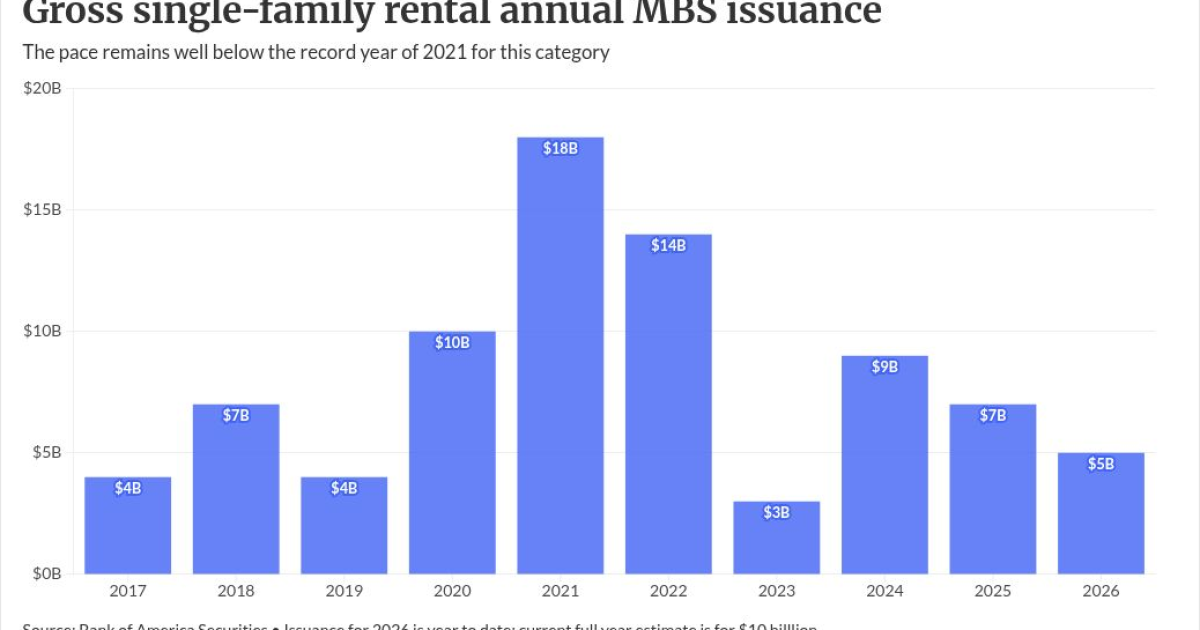
So far this year, gross issuance of SFR totaled $5 billion, with B of A Securities expecting full year activity of $10 billion. The best year for issuance was 2021 at $18 billion.
"Operators still maintain healthy unit count and rent growth, but is off 2023-24 peaks," B of A Securities said. "SFR dispositions this year have increased due to strong housing price growth enabling disposition gains, higher financing/replacement costs, as well as uncertainty in regard to the ROAD to Housing Act.
Build-to-rent is a fast growing segment of housing
B of A Securities added that build-to-rent remains one of the fastest growing segments of the housing market. However, even with the legal changes, "we also foresee SFRs sticking around, as rising inflation and higher-for-longer interest rates continue to make homeownership less affordable," the FAQ said. "SFRs are an option for those who desire a single-family home and all of its benefits (private yards, garages, etc.) but cannot afford to buy one in the current housing market."
This is good news for lenders who product menu includes business purpose loans, but has the potential to reduce the customer base for originators who work with consumers.
The Act does
Because institutional investors will have to refocus their business, it will for the lender/issuer community, "likely provide more clarity around which property types are more often considered for large pools."
B of A Securities predicts "the stock of scattered-site single-family homes will probably decrease over time as issuers strategically sell homes that have significantly appreciated in value beyond what they can generate in rental income. At the same time, their share of exempt asset types, especially BTR properties, will grow."