- Key insight: While markets had been favoring a federal funds rate hike this month, Federal Reserve Gov. Christopher Waller believes there may be good reasons for the central bank to hold steady.
- Expert quote: "To paraphrase John Lennon, I'm willing to give disinflation a chance." — Federal Reserve Gov. Christopher Waller
- Forward Look: Waller, like other Fed officials, said his ultimate decision at the next Federal Open Market Committee meeting will depend on forthcoming employment and inflation readings.
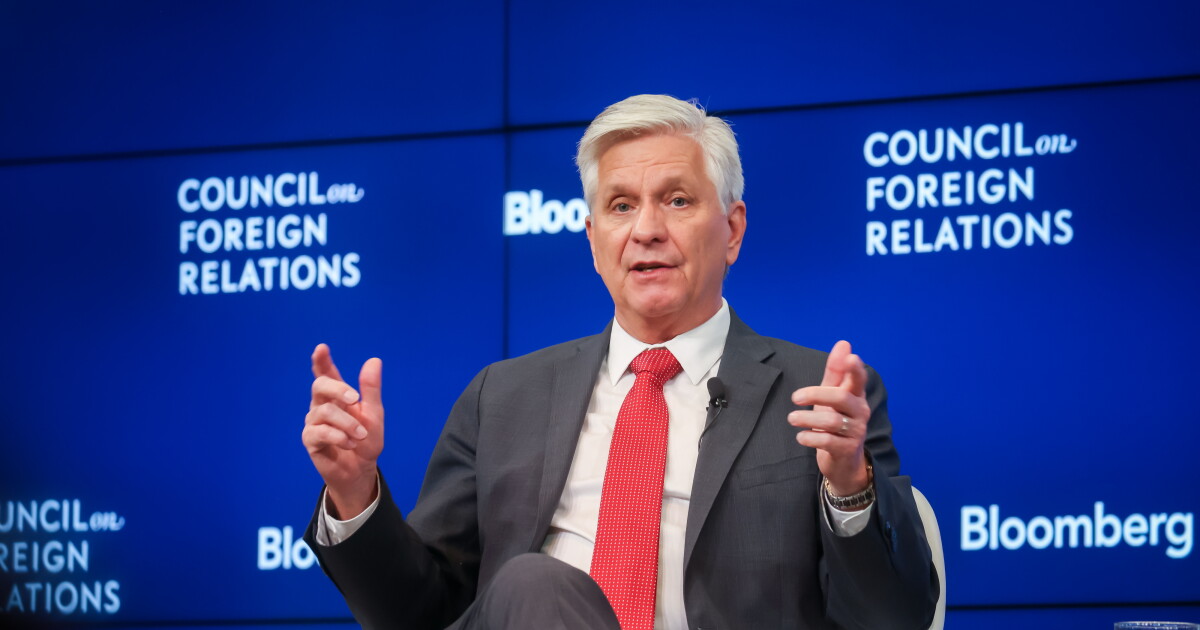
Federal Reserve Gov. Christopher Waller threw cold water on the idea that a federal funds rate increase is needed this month.
In a Thursday morning speech, Waller said inflation — while still uncomfortably high — has been moving in the right direction and might actually be more stable than headline readings indicate.
"Three-month core inflation is 3.05 percent for the three months through July, a level that is still not consistent with the FOMC's 2 percent goal. Nevertheless, it is important to note the trend," he said. "Three-month inflation has fallen steadily from 4.76 percent in February. That is a considerable improvement, and the speed of this downward trajectory is encouraging."
If inflation readings from August show a similar trajectory, Waller said he would favor keeping the federal funds rate at its current range, between 3.5% and 3.75%. But he was quick to note that his stance was not definitive, noting that a swift uptick in inflation could make him favor a 25 basis point increase.
"I don't expect that the employment data will deviate much from what we have been seeing," he said. "So my decision on the appropriate stance of policy will be heavily influenced by what we learn about August inflation."
Still, Waller's remarks appear to have tamped down market expectations of a hike during this month's Federal Open Market Committee meeting. Bond traders and futures markets had been
Coming into Thursday, federal funds futures contracts, as tracked by CME Group, showed 63% of market participants expecting higher rates, with 37% anticipating no change. After Waller's speech this morning, however, the split moved closer to 50-50. Likewise, two-year Treasury yields dropped by 6 basis points during Waller's remarks.
During the speech, Waller noted that one category of prices in the personal consumption expenditure index may have distorted recent inflation readings. He said non-market prices, which are implied based on other economic indicators rather than derived from real prices, have driven more than half of recent inflation growth.
The Commerce Department, which produces the PCE index through its Bureau of Economic Analysis, is set to adjust how it measures these non-market prices, a change that Wallers said could shave an additional 20 basis points off the inflation index. That adjustment is expected to go into effect at the end of the month.
"I don't like throwing out specific categories going into the estimate of PCE inflation, but nonmarket services prices have always been an issue for me, since they are imputed and not actual price changes," Waller said. "So, ignoring this one factor, my take is that underlying inflation is doing better than the core numbers suggest."
Read more:
- OCC and FDIC finalize narrower bank supervision procedures
- As education costs rise, credit unions chip in for employees
- A $111 million scheme to keep bad merchants banked
- How Google and Apple's youth plays are pressuring banks
The tenor of the speech marks a shift in Waller's view of the inflation outlook. In July, the Fed governor said he was
Yet, as he detailed in his Thursday speech, inflation did not move up. Instead, it
Waller said he would like to see if this trend continues rather than risk raising rates at a time when inflation is falling, a combination that could unnecessarily weaken the U.S. economy.
"To paraphrase John Lennon, I'm willing to give disinflation a chance," Waller said.
At the same time, he said that the economy could be nearing a "pivot point" with respect to inflation, in which case focusing on trendlines could cause the Fed to fall behind the curve.
"I'm willing to sit and wait and be patient, but if the progress we've seen reverses, it's time to pull the trigger and hike rates," he said.
Communications strategy
During his speech, Waller also weighed in on communications strategies at the Fed and for himself as a monetary policy maker. He drew a distinction between three different types of central bank commentary: one explaining past decisions, one describing a reaction function to incoming data and one giving guidance about ongoing monetary operations, such as quantitative easing.
Waller's comments come at a time when the central bank's communications strategy is in flux, with Warsh taking a sweeping view of what constitutes forward guidance and opting for
On the reaction function specifically — something Warsh did not explore in his Jackson Hole speech last week — Waller equated the Fed's view of the economy to a home plate umpire in baseball.
"The players don't expect the umpire to have a perfect strike zone — they just need a rough idea of its parameters and some guarantee that it won't change much on every pitch," he said. "Perfection is not needed for them to play well. So, when it comes to my reaction function, I do not let perfection become the enemy of the good."