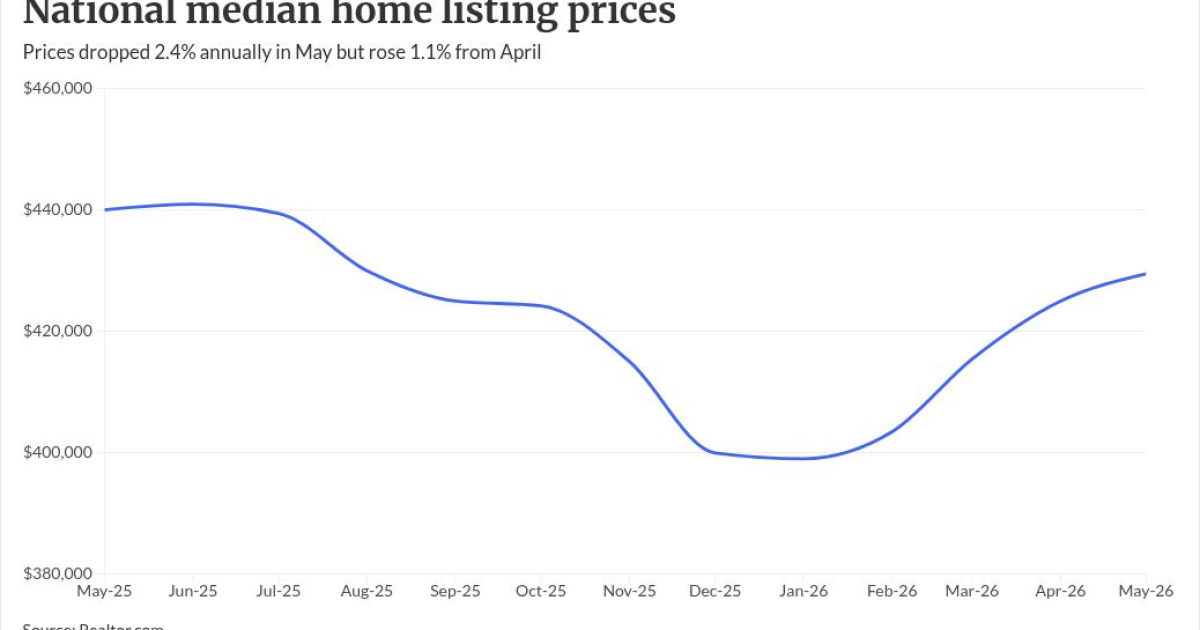
Current homeowners looking to sell during May posted at prices 2.4% lower than one-year prior, the steepest decline since 2017, according to Realtor.com
This came as pending sales increased for a sixth straight month. It was also the best May for new listings since 2022, with a 2.1% annual increase.
Sellers are doing their homework before they put their property on the market, not afterwards, said Danielle Hale, chief economist at Realtor.com.
Higher mortgage rates and geopolitical uncertainty over the Iran conflict did not sideline either buyers or sellers. "Instead, we've seen six months of sellers adjusting their expectations and buyers rewarding them for it," Hale said in a press release on Wednesday. "
What was May's national median list price
The national median list price of $429,500 for May was still 1.1% higher
On an annual comparison, the median list price declined seven months in a row.
The West led the way with a 4% list price reduction year-over-year, followed by the South, down 2.5%, Northeast, 1.8% lower and the Midwest, which reported a 1.2% drop.
"Perhaps the most telling price signal in May came from what did not happen: price cuts fell rather than rose," said Jake Krimmel, senior economist at Realtor.com.
What share of sellers reduced the list price in May
The share of active listings where the seller decided to reduce the list price was 17.5% in May, a decline of 1.6 percentage points from the prior year.
"In a crashing market, sellers list optimistically and
He termed it as a "meaningful behavioral shift," which is why potential buyers are staying in the market even with the 30-year fixed over 6.5% in recent weeks.
Another good sign, listings in pending status increased for the sixth month, to 4.3% annual growth in May, with the flow of contract signings rising by 3.5%.
What to look for in June
For June, the statistic to watch is contract cancellations and delistings, Krimmel said. Last May and June tariff-driven uncertainty spilled into the marketplace leading to deals being terminated and homes pulled from the market.
A February Redfin report found
So far this year, cancellations have remained below levels of recent years.
Another factor to look at will be if inventory gains in the Northeast and Midwest continue. If this happens, it would be a sign the broader market is normalizing.
But if stalling inventory growth taking place and rising days on the market in the South and West regions start contributing to cancellations, it is an early warning sign that macroeconomic pressures are affecting behavior. So far, Krimmel said, this has not been the case.
"It's too early to declare the spring market has fully weathered the storm, but the leading indicators are holding," said Krimmel. "Cancellations are low, new listings are growing, and sellers are cutting prices less even as list prices fall."
The share of properties that were taken off the market in April
Redfin, now part of Rocket, put out its own report on Wednesday based on an analysis of April multiple listing service data which paints a slightly darker view of the market.
Nationwide, 5.8% of listings were taken off the market in April, tied with last December for the highest share since March 2020, a month where pandemic-driven pessimism drove the housing market to a halt.
This is happening because potential sellers are seeing the housing market as one favoring buyers and they are not getting the price they want for their home.
"Prices aren't soaring like they were five years ago — high gas prices and the rising cost of living overall is trickling down to the housing market, making buyers much less likely to bid prices up," said Patricia Ammann, a Redfin agent in Arlington, Virginia. "Buyers know they have negotiating power, often offering under the asking price and completing inspections, but some sellers just won't budge."
Why sellers are taking their homes off the market
Among the factors Redfin said driving the current conditions are:
- Homes taking longer to sell
- Inventory rising faster than demand
- Sellers who still have pandemic-era expectations about the price of their property
- Economic uncertainty's impact on both buyers and seller
- Delisting as a strategic reset, to relaunch at a later time with a new price, photos or during a more active season.
If anything, this last bullet point is seen in sellers relisting being at its highest share since 2020. During April, 2.5% of the properties on the market were homes whose sellers pulled the original listing in the prior 12 months.This has been constant with the share for February and March, Redfin noted. It should be noted many of the 2020 relistings were to take advantage of the hot pandemic era market.