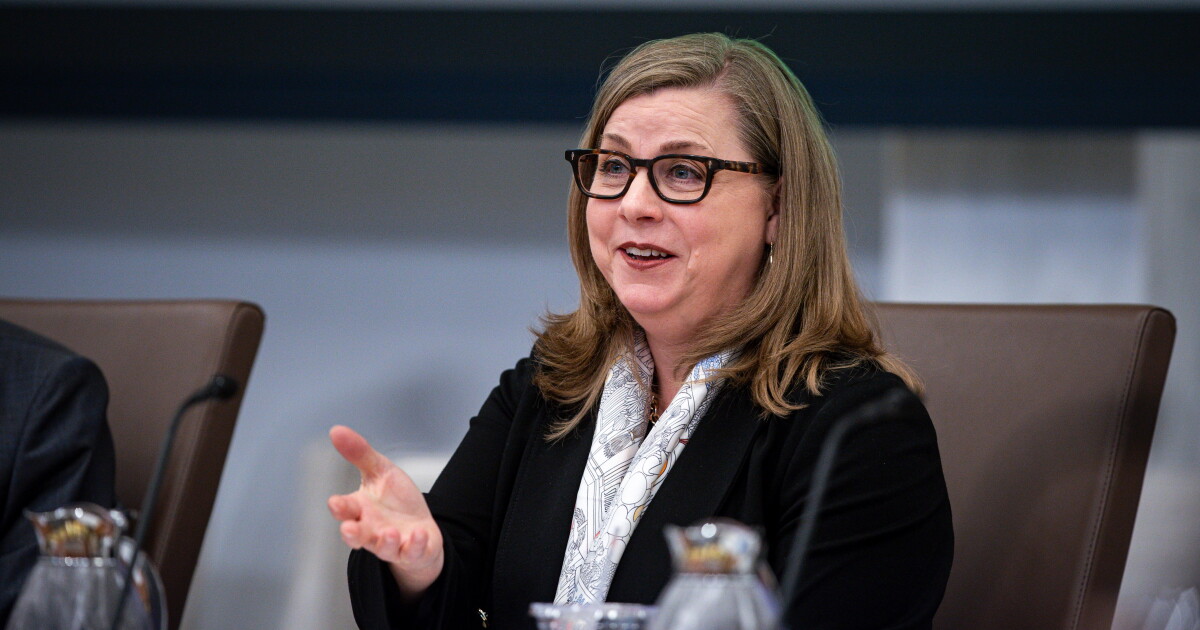
- Key insight: Federal Reserve Vice Chair for Supervision Michelle Bowman said that abandoning Federal Reserve districts in favor of five regional hubs will streamline joint oversight with state regulators.
- Supporting data: For decades, the Fed relied on complex internal committees, resulting in delayed enforcement and a lack of accountability, according to Bowman.
- Expert quote: "In practice, these committees became a source for plausible deniability and a disincentive for examiners to take prompt and decisive action to address identified risks." — Michelle Bowman, Fed vice chair for supervision
Federal Reserve Vice Chair for Supervision Michelle Bowman laid out a sweeping overhaul of the central bank's supervisory role that involves dismantling a web of internal committees, realigning oversight into five regions and revising the definition of a community bank.
In a speech Tuesday morning at the St. Louis Fed's annual community banking research conference, Bowman announced an aggressive revamp, including a reorganization of bank supervision into five regional divisions that follow state lines rather than Federal Reserve Bank district boundaries. The goal is to coordinate directly with state bank supervisors so that each region has a single leader directly responsible for all supervisory activity in that territory, she said.
The new model is designed to empower examiners to issue early supervisory findings without getting bogged down by delays, Bowman said.
"The Federal Reserve's supervisory approach should not be a mystery," Bowman said in prepared remarks. "Supervisory expectations should be transparent, clear and consistent. A bank should not learn about and then be held accountable for changed expectations during an examination."
In addition, the Fed is expanding the definition of a community bank to include certain firms with traditional, non-complex business models, so they are no longer pushed into higher supervisory tiers built for more complex firms.
Bowman, a former Kansas state bank commissioner, did not provide details about how the definition of a community bank will change. For the past 15 years, community banks have been defined as those with assets of less than $10 billion.
"By expanding the range of institutions treated as community banks that operate using a traditional community bank business model … we will preserve safety and soundness while effectively applying appropriately tailored and risk-calibrated supervision and regulation," Bowman said.
Bowman also said the Fed plans to make significant changes to certain regulatory thresholds that it says are outdated.
The Fed will consider updates to fixed-dollar asset thresholds in regulations to account for inflation and economic growth, she said. The proposal will increase static thresholds, with a mechanism to update them every five years.
Jaret Seiberg, an analyst at TD Cowen, said Tuesday that he believes the Fed has the leeway to make the changes to thresholds that Bowman discussed. He argued that the new regulatory thresholds could be 50% higher than the current ones, which would benefit banks of various sizes.
"That means the $100 billion threshold would be $150 billion, the $250 billion would be $375 billion, and the $700 billion would be more than $1 billion," Seiberg wrote in a note to clients.
Bowman's critique of
Last month, Bowman received preliminary findings from an independent firm hired to
"The independent review highlighted a long-standing structural issue in the supervisory function — a mismatch between authority for decision-making and accountability for supervisory decisions," Bowman said Tuesday. "For decades that structure has disincentivized a critical link between responsibility and accountability and has been further complicated by a complex web of dozens of committees, resulting in dysfunction when critical decisions are most needed."
Bowman said that in recent years, the Fed's examinations "had drifted to focus on process over substance, prioritizing checklists of requirements instead of applying judgment and expertise to evaluate safety and soundness."
Read more:
As fintechs nab bank charters, what's happening to BaaS? Overheated data center knocked 23 credit unions offline Chris Britt still says banking is broken, but Chime can fix it Two thefts decades apart, and a victim's quest for answers
Going forward, the Fed's supervisory role will be informed by the regional structure implemented by the Conference of State Bank Supervisors, Bowman said.
"After all, our banks are 'state member banks,' and each state conducts supervision jointly with us and, ultimately, holds the state bank charter," she added.
Bowman identified several structural issues that she said have hindered the ability of the Fed to "optimally perform the supervisory function."
To that end, she said the Fed has relied for many years on a complex web of committees that over time became "a source of delay, created barriers to prompt action, and obfuscated decision-making responsibility and accountability."
One of the lessons learned from the SVB failure, Bowman said, is that Fed committees helped shield examiners from taking immediate action.
"In practice, these committees became a source for plausible deniability and a disincentive for examiners to take prompt and decisive action to address identified risks," she said. "When a committee shields accountability or discourages examination teams from using informed judgment in a timely manner to defer to an unaccountable committee, safety and soundness can suffer as a result."
Bowman also said the Fed plans to revisit certain regulations including Regulation O — which governs bank lending to executives, directors, major shareholders and other executives. That regulation seeks to ensure that insiders do not get better loan terms, lower interest rates or looser underwriting standards than regular customers.