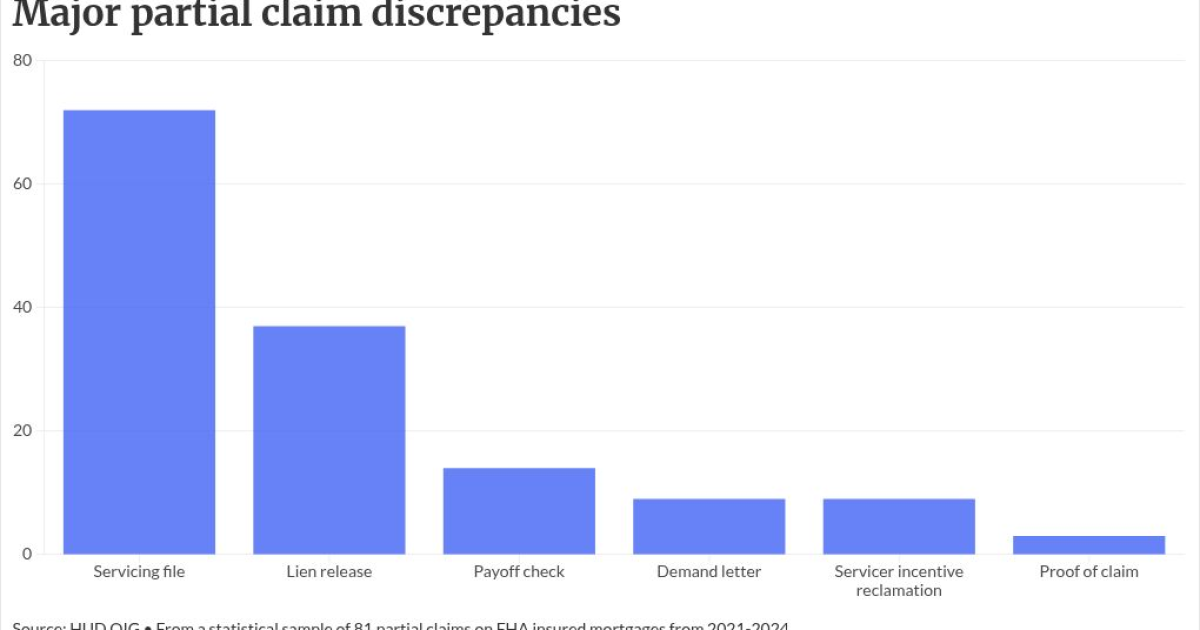
The Department of Housing and Urban Development's Office of Inspector General recently reported that it found many inconsistencies in records for due-and-payable partial claims in a recent audit.
The most common discrepancy found in 74 instances within a statistical sample of 81 loans from 2021-2024 was that the
Other major disparities included 14 slow deposits of payoff checks, 9 demand letters delayed or never sent, 9 instances of neglect around the Federal Housing Administration's responsibility to reclaim servicer incentive fees for procedural errors, and 3 "untimely" proof of claim filings.
Matt Jones, HUD's deputy assistant secretary for single-family housing, conditionally agreed to do more to manage due-and-payable
If HUD were to receive the funding and other resources' Jones agreement with the recommendations is conditioned on, it could have a mixed impact on servicers.
In some cases, smoother processing on HUD's end could help mortgage companies manage their loan portfolios, but when it gets applied to something like reclamation of servicing incentives for procedural errors, it could be a concern.
Recommendations
The HUD OIG's audit report recommends the department take the following actions:
- Draw up new procedures aimed at ensuring borrowers get notified of their due-and-payable amounts on partial claims and when these debts need to be satisfied.
- Work with the inspector general's office to "develop, implement and maintain formal procedures" for monitoring a servicing contractor HUD works with in order to address "a lack of well-defined partial claims tracking and collection performance requirements" in the LSC's existing agreement.
- Improve the tracking of partial claims with technological measures that include interfaces to the single-family insurance system, automation for letters, and automated timelines that better serve that goal.