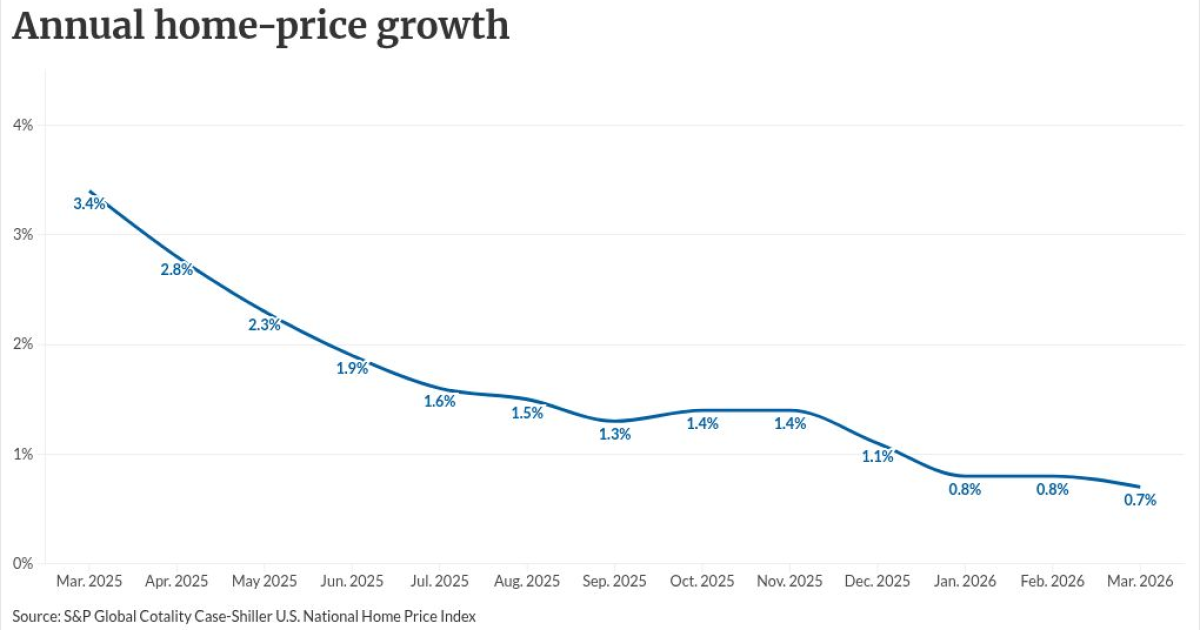
The gap between inflation and home-price growth widened in March, as price gains continued to slow, an industry report found.
The S&P Cotality Case-Shiller home price index rose 0.7% annually in March, down from
"With consumer inflation accelerating to roughly 3.3% in March, U.S. home values have now fallen in real terms for the 10th consecutive month, underscoring an ongoing erosion of inflation-adjusted housing wealth," said Nicholas Godec, head of fixed income tradables and commodities at S&P Dow Jones Indices, in a press release Tuesday.
Home prices climbed in the first quarter of this year by 1.7% compared with the first quarter of 2025 and by 0.5% compared with
"The national housing market has enjoyed steady growth each quarter since the beginning of 2012, so a period of flattening prices is healthy for a market that has left many would-be homebuyers on the sidelines," Bankrate Financial Analyst Stephen Kates said. "This slowdown acts as a pressure valve, allowing local incomes to catch up with the cost of shelter after years of unsustainable jumps. For prospective buyers, this is welcome news; for existing homeowners, it is a worrisome trend."
Regionally, seven of the nine census divisions the FHFA analyzes saw positive house price changes year over year. The East North Central division recorded the strongest appreciation from the first quarter of 2025 to the first quarter of 2026 at 4.4%, while the West South Central division posted a 0.7% decline, the report showed.
Prices also increased in 42 states year over year in the first quarter, led by Illinois at 7.3%, Alaska at 5.5%, Vermont at 4.9%, Connecticut at 4.7% and Kentucky at 4.7%. Colorado experienced the most significant price decline at 2.4%, the FHFA report found.
In March, specifically, Chicago led all cities in annual price growth again at 6.1%, followed by New York at 4% and Cleveland at 3%. Meanwhile, Seattle, Denver and Tampa, Florida, posted the largest declines at 2.5%, 2% and 1.9%, respectively, according to the Case-Shiller report.
The 10-city composite saw an annual increase of 1.4%, down from 1.5% in February, while the 20-city composite posted a year-over year gain of 0.8%, down from 0.9% in the previous month, the Case-Shiller report showed.
Mortgage rates rose every week in March to 6.38%, expanding affordability struggles for buyers and constraining home-price growth. The 30-year fixed-rate mortgage began to fall again in April, but has since jumped to
"Buyers are feeling another affordability squeeze and refusing to overpay," Kates said. "Sellers can no longer expect standard bidding wars or demand wild asking prices, especially since more than half of the major metropolitan markets are now experiencing annual price drops."