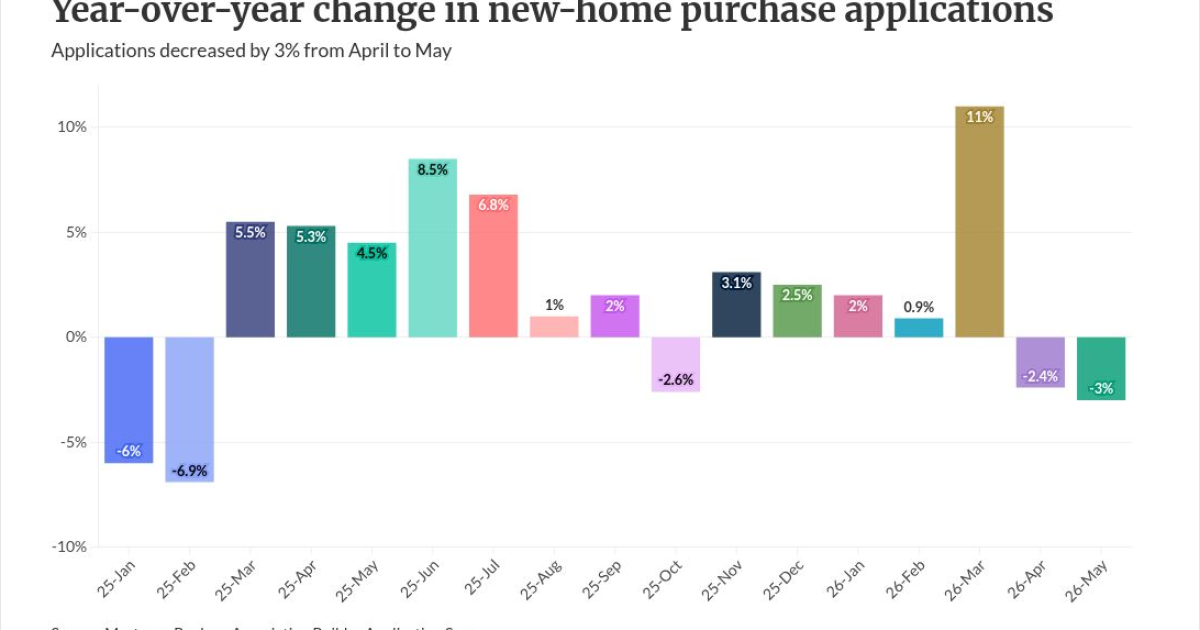
A slow start to the spring selling season from an affordability crisis led to less interest in buying a newly constructed home last month.
Though new home purchase applications for May were 3.8% higher from the same time last year, they were down 3% from April, the Mortgage Bankers Association reported Thursday.
"Even as home builders continue to offer concessions to increase sales, homebuyers have been hesitant because of higher prices, increased economic uncertainty, and mortgage rates averaging over 6.5 percent in May," said Joel Kan, MBA's vice president and deputy chief economist, in a press release.
Government-backed loans also accounted for more than half of builder applications for the fifth consecutive month. Mortgages the Federal Housing Administration insures represented 35.6% of new-home loan applications, followed by those the Department of Veterans Affairs guarantees at 13.7%. U.S. Department of Agriculture products accounted for another 1.1% Conventional loans made up the remaining 49.6% of builder applications.
Affordability's role
The heavy lean toward government programs has contributed to the average loan size falling to a 10-month low of $372,825. Buyers are opting for lower-priced homes to manage affordability. Conventional loans often require higher credit scores and larger down payments, so flexible government programs are favored in a high-rate environment.
Home sales were running at a seasonally adjusted annual rate of 642,000 units in May 2026, down 2% from April's pace. Unadjusted, there were 58,000 new home sales in May 2026, a decrease of 3.3 percent from 60,000 new home sales in April.
Builder confidence dipped to 35 in June, marking the
Historically, new homes are more expensive than existing homes but a shift has occurred over the
In response, the U.S. Department of Housing and Urban Development has been looking to update the