- Key insight: Currency security is banking's oldest technology problem, and today's $100 bill still carries features that descend from the anti-counterfeiting Benjamin Franklin engineered into colonial notes by hand.
- Supporting data: By the end of the Civil War, nearly one-third of all U.S. currency in circulation was counterfeit, the Secret Service estimates.
- Forward look: Because no security feature stays counterfeit-proof, Treasury has made currency redesign a permanently recurring process.
Overview bullets generated by AI with editorial review.
Long before the United States had any banks, Benjamin Franklin engineered anti-counterfeiting features for paper money.
His money network printed notes with leaf patterns pressed from real leaves, colored fibers and flecks of translucent mica worked into the paper, and a dense black ink all its own — features designed to be easy to spot and hard to reproduce.
Counterfeiting these features would not just have required great effort and attention to detail; many of them rested on recipes and methods Franklin's network kept secret.
Franklin and his network did not share how, for example, they mixed their ink. Franklin sold soot-based ink to other printers and used a special recipe for his own money.
The paper he used had its own secrets. Franklin kept his dealings with the papermaker behind his distinctive "money paper" in a separate ledger that has never been found. Historians infer that it held the confidential recipe for those colored fibers and mica flecks.
A
The researchers found Franklin had printed the money with graphite ground from rock, not the soot most printers used. Counterfeiters, copying only what they could see, reached for an ink made from charred bone and failed to match the real thing.
The counterfeit ink carried a tell; charred bone left calcium and phosphorus in the fake notes that Franklin's graphite lacked. Researchers used this chemical signature to sort his genuine bills from forgeries.
"Franklin was creating a multi-layered security system, much like modern banknotes rely on several complementary security features rather than a single one," Khachatur Manukyan, a Notre Dame physicist who led the study, told American Banker.
As the United States marks its semiquincentennial, here is a look back at the parallel 250-year history of American financial technology that has yielded money that is harder to fake and bank-built machinery that moves, clears and settles it.
The sweep runs from colonial currency to instant payments, and American Banker has its own place in it. But the story begins in a messy place.
A financial system with no banks
In 1776, the United States had no banks, and hard coinage was scarce. Britain had never supplied enough of it, and it barred the colonies from minting their own.
In lieu of coins, the New World ran on a patchwork of credit and paper.
Colonial governments printed their own bills of credit, but those bills were not quite money in the modern sense. Each was a government IOU with a maturity date, when a colonist could hand it back to pay taxes.
Until redeemed, it changed hands at a discount; it was worth less than the number printed on it.
Farley Grubb, a University of Delaware economist and author of "The Continental Dollar," likens the bills to U.S. savings bonds, which pay full value only at a future date and cash out for less before then. Colonial bills, unlike a savings bond, could be traded.
"Imagine what it would be like if our only paper money today were tradable U.S. savings bonds," Grubb said to American Banker.
Merchants kept book credit with each other and settled long-distance debts with bills of exchange, which were paper IOUs payable by a merchant house in London.
That book credit formed long chains. A country storekeeper would extend a farmer credit for supplies against the coming harvest, then use the crop he was repaid in to clear his own debt to the merchant who stocked his shelves, according to Grubb.
It was a web of short-term credit running "in a long chain from Europe to American farmers and back again," Grubb said. "There were no incorporations or IPOs, nor any incorporated banks in America."
Money you could trust
Colonists' most trustworthy coin was the Spanish milled dollar, prized for its consistent silver content and distinctive design,
The U.S. had a sophisticated payment network built with little more than pen and paper, according to the
He was a working printer first, according to Manukyan, and many of the innovations "likely grew out of practical attempts to improve the quality and durability of printed currency while making it more difficult to counterfeit."
The result was deliberate all the same. Franklin "systematically exploited materials, printing methods and natural patterns to create currency that was both recognizable and difficult to imitate," Manukyan said.
A nation awash in paper
To help fund the war against Britain, the Continental Congress chartered
Congress had run its own paper money into the ground. The Continental dollar, printed to fund the Revolution, was over-issued until it collapsed, yielding the phrase "not worth a Continental," according to the Philly Fed.
The Continental dollar itself was not new technology, according to Grubb. "It was not an innovation," he said; its design copied the bills of credit colonial legislatures had issued for decades.
What set it apart was who stood behind it. Congress could print the notes but had no power to tax anyone to redeem them, and it leaned on the states to honor pro-rated quotas they had only loosely promised to cover, Grubb said.
The lesson for a modern reader, he said, is that "'fiscal credibility' matters, and that not-well-thought-out large financial rule changes can be damaging and disruptive."
The decades after independence produced what today looks like monetary chaos and a golden age for counterfeiters. Hundreds of private, state-chartered banks each printed their own notes with no single national currency.
By 1860, more than 10,000 distinct notes circulated in the U.S., and forgery flourished alongside them, according to historian Stephen Mihm, author of "
By the end of the Civil War, nearly one-third of all currency in circulation was counterfeit, the
The anti-fraud technology of the age was a newsletter.
Publications called counterfeit detectors and bank-note reporters came out weekly or monthly, listing the known fakes and the discount rate at which each bank's notes traded. Merchants would check the bulletin before taking a payment.
American Banker traces its own origins to one of these bulletins, Thompson's Bank Note Reporter, which the New York broker John Thompson launched in 1842, a decade after he opened a Wall Street bank-note brokerage, according to Mihm.
(Two printers, Anthony Stumpf and Charles David Steurer, bought the Thompson's Bank Note and Commercial Reporter in 1885, dropped its old name and renamed the weekly the American Banker, according to profiles of the pair in the 1896 volume "
Bank Note Reporter "inventoried the nation's monetary system," with "every bank in the United States" represented "along with the rate of discount on its notes" and "a compilation of all known counterfeits," according to Mihm's A Nation of Counterfeiters.
A surviving issue of Bank Note Reporter
These detectors were also deeply flawed, though. They "proved far more useful to counterfeiters than to their subscribers," Mihm wrote, because engravers read the published descriptions of each forgery's flaws and used them to perfect their plates.
The business could also be turned against the banks it covered. A publisher who labeled a sound bank "doubtful" could trigger a run, buy up its notes cheaply and profit, Mihm wrote.
Publishers could also squeeze the banks directly. Some solicited bribes or cheap loans in exchange for a favorable listing, threatening to brand a bank's notes "doubtful" if it refused to pay, Mihm wrote.
The machines
The monetary chaos ended with a national currency.
The Civil War greenback, the Union's wartime paper money, and the uniform national currency that followed swept away the world of private bank notes and put the counterfeit-detector business out of work, Mihm wrote.
The government took over the machinery of making money hard to fake.
The Bureau of Engraving and Printing centralized production and became the sole producer of all U.S. currency by 1877. It built anti-counterfeiting engraving into the greenback from the start, according to the
Enforcement got its own department; the U.S. Secret Service, created in 1865, hunted counterfeiters before it ever guarded a president.
Concurrently, banks rebuilt the machinery for moving, clearing and settling money, each step faster and more automated than the last. A few moments mark the path.
First, banks started meeting on
Starting around 1871, when Western Union began wiring money, the telegraph enabled money to move at the speed of electricity. The Federal Reserve has run a wire of its own since 1915, which grew into
In the 1950s, to keep paper checks from burying the back office, Bank of America and the Stanford Research Institute built a machine
The pace only picked up from there. Magnetic stripes made payment cards machine-readable;
Online banking followed, climbing from servicing under 5% of consumers in 1995 to 53% by 2007, by the
Franklin's heirs
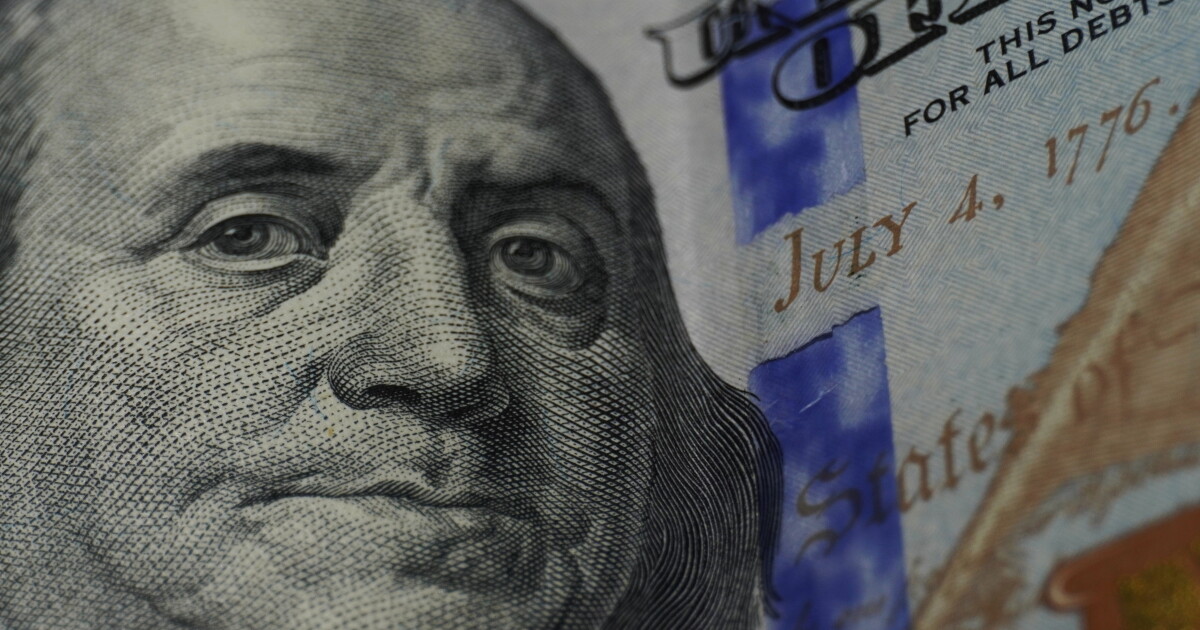
Today's U.S. currency carries the same kind of engineered defenses that Franklin's did: Security threads, color-shifting ink, microprinting and watermarks.
"The underlying principle has changed remarkably little," Manukyan said of these centuries-long constants. Franklin "recognized that trust could be built into the physical properties of the currency itself, rather than relying only on printed text or artwork."
Since 1996, the $100 note has carried a
Studying Franklin's technology "made his place on today's $100 bill feel much more meaningful," Manukyan said. The man who engineered colonial anti-counterfeiting now helps secure the country's largest bill.
No security feature is counterfeit-proof over time, Treasury officials told the
The tools have changed since Franklin's print shop. The problem he was solving has not.