
Analysts are bullish on the prospects for UWM Holdings common stock, even with (or possibly because of) the recent negative trends in its stock price.
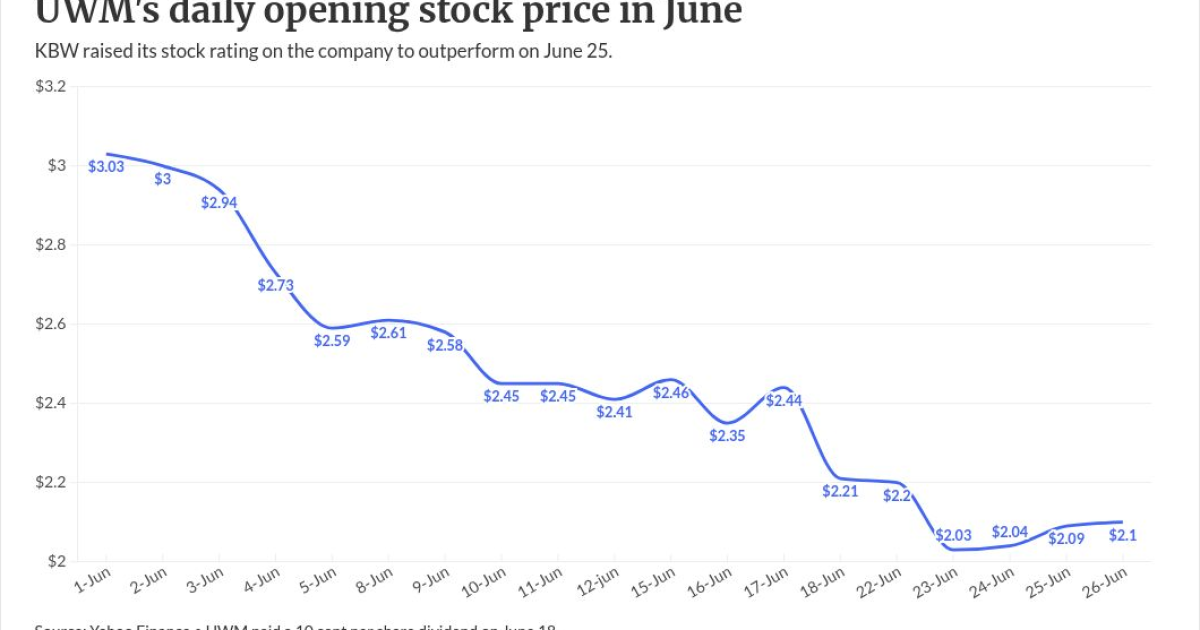
On both June 24 and 25, the stock reached a 52-week low of $2. The price has been moving lower since the company
Among the concerns is UWM's leverage levels, which will increase if it is successful for Two Harbors and the majority of those shareholders elect (as expected) to take the $12.50 per share cash option.
Keefe, Bruyette & Woods upgraded UWM to outperform from market perform based on its valuation.
"We expect a dividend cut, which should help to grow equity and stabilize the balance sheet," wrote Bose George, who announced the change in his industry second quarter earnings preview. "We see this as a positive near term catalyst."
UWM still a 'buy' even with rate and leverage overhang
Meanwhile, BTIG, which recently
"UWMC stock remains weak on both macro (interest rate) and company specific (leverage, dividend) concerns," said BTIG analyst Doug Harter. "These are headwinds for sure, but we see the shares offering attractive risk/reward at current levels given low valuation."
UWM's stock is down 52% so far in 2026; the price on June 25, the date of the report, was five times George's 2027 revised earnings per share estimate of 41 cents per share, a ratio "well below peers."
BTIG's report added that UWM's stock price should rebound with resolution of the Two Harbors situation, no matter what the outcome is, and by reducing its dividend.
Harter's price target is $4 per share, also unchanged. George dropped his target to $3.75 from $4.50.
The base case for dividend cut at UWM
BTIG's base case for the UWM dividend is a reduction to 5 cents per share, starting with the third quarter, from the current 10 cents.
UWM remains committed to returning capital to its shareholders but Harter predicts going forward this "is more likely to come in the forms of special dividends and/or share repurchases."
This change aligns more with the volatile nature of the mortgage origination business, along with allowing the wholesaler to reduce leverage and ultimately, retain more servicing rights to get the recurring cash flow stream.
UWM has called itself
"Using our estimate of cash earnings (earnings plus MSR amortization less MSR capitalization) UWMC consumed $748 million of cash in the first quarter, modestly larger than the $650 million consumed on average throughout 2025," Harter said. The cash consumption is not a surprise given the relative size of UWM's servicing portfolio versus its origination business.
The company funded this shortfall by selling $604 million of servicing rights, and getting financings of its MSRs created of $200 million, which allowed it to be $60 million positive prior to the dividend, Harter said.
2027 EPS outlook reductions also at Rocket and Rithm
George dropped UWM's 2027 EPS outlook by 10%. In comparison, the forecast for Rithm was reduced by 6%, Rocket by 5% and PennyMac Financial Services was unchanged.
Second quarter origination volume is now expected to be lower than originally forecast because of
Still,
"We are not making meaningful changes to mortgage insurer estimates and expect the sector