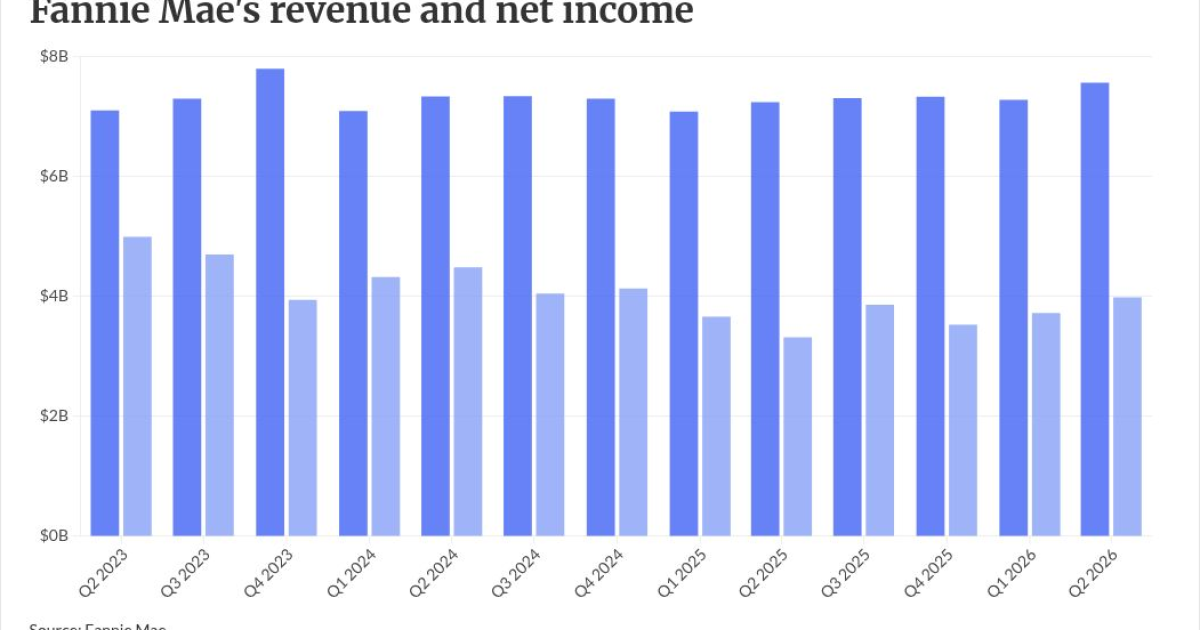
Fannie Mae's net income jumped to its highest point in over a year amid a seasonal revenue surge that outweighed negative adjustments to credit loss provisions and fair value.
The government-sponsored enterprise earned $4 billion during the period compared to $3.7 billion
Spring homebuying, which fueled the highest dollar volume of loans acquired since the third quarter of 2022, contributed to revenue and pointed to strength in lenders' purchase business prospects despite higher rates and softening in some parts of the housing market.
"Our performance reflects the durability of our guarantee business, the resilience of our balance sheet, and the disciplined execution of our strategy," Peter Akwaboah, Fannie's acting CEO and chief operating officer, said during an earnings call.
Interest income from portfolios and deferred guarantee fees were higher on a net basis and drove revenue. Fannie also reported a positive shift to investment gains and lower non-interest expenses.
"The quarter once again demonstrated the strength and stability of our core guarantee business, which represented nearly 80% of total net revenues," Chief Financial Officer Chryssa Halley said during the call.
Around $125 billion of liquidity the company provided to the mortgage market supported 417,000 households' ability to refinance loans, buy or rent homes during the past year, according to Akwaboah.
Fannie acquired $111 billion in single-family mortgages during the quarter with home purchase loans accounting for around $73 billion of the total and refinancing making up the remaining $38 billion.
The enterprise's administrative expenses rose but the bulk, $56 million of the $66 million increase, stemmed from transitional costs for severance and reductions in its real estate footprint, Halley said.
"Our second quarter administrative expense ratio of 10.7% remained below the quarterly levels observed from 2023 to 2025, reflecting the sustained impact of the efficiency initiatives," she said.
Fannie also has generated more than $3 billion in estimated homeowner savings since 2018 through appraisal alternatives, Bill Pulte, director of US Federal Housing, said in a statement. USFH, Pulte's alternate name for the Federal Housing Finance Agency, is Fannie's conservator.
Net worth, a key capital measure closely watched in Fannie's long-term plan to exit conservatorship - and
Fannie's illustrative return on required equity rose from 10.4% in the first quarter to 10.8% in the second. Illustrative ROE is based annualized year-to-date net income divided by Fannie's average common equity tier one capital requirement.
Some consider consensus net income estimates ahead of earnings less pertinent for Fannie, since it was forced into government conservatorship in 2008. Standard & Poor's Capital IQ Pro reported that revenue beat consensus for $7.2 billion.
Serious delinquencies in Fannie's single-family book of business were flat on the quarter at 58 basis points but up from 53 a year earlier. Multifamily serious delinquencies fell to 60 basis points from 78 but the improvement was due to loan modification and foreclosure activity.
"We expect ongoing multifamily challenges," Halley said.
Weaker multifamily property valuations, replacement of seasoned loans with new acquisitions that carry higher capital requirements at origination, and reduced credit-risk transfer activity contributed to slightly higher risk-weighted assets and density on a consecutive-quarter basis.
Fannie primarily acquires single-family mortgages but it also has
Where investors stand
The GSE's results arrive just days after a Washington, D.C., appeals court's affirmation of a past $612 million decision in
The GSE has now been consistently profitable for 34 quarters but it's unclear when or if private investors might be able to obtain more benefits from its results.
One step Fannie's private investors are watching for is a revision to Fannie's capital requirements that they hope to expedite a new stock offering. Analysts say that while Fannie is making progress under existing requirements, it has a way to go.
Fannie's current status "still leaves a $13.8 billion shortfall to the adjusted total capital requirement," Douglas Harter and Will Nasta, equity researchers at BTIG, wrote in an earnings note Wednesday morning.
The share price for Fannie's stock was flat to slightly higher at $6.13 per share early Friday morning.