
- Key Insight: See what strategies help a small but growing segment of middle-class homeowners requiring more loan servicing intervention.
- What's at Stake: Some middle-income homeowners may struggle to keep up as affordability pressures climb the pay scale.
- Supporting Data: 5.33%: The monthly increase in home retention actions for struggling borrowers.
Overview bullets generated by AI with editorial review.
Servicers of Fannie Mae and Freddie Mac loans may want to add loss mitigation capacity now: inflation is pushing affordability problems into the middle-income borrower base, and the government-sponsored enterprises' home retention actions are already rising as a result.
Affordability woes are "climbing up the pay scale and becoming more of a middle-income thing that is affecting cities," Sarah Sullivant, managing director and sector lead, local governments - U.S. public finance at S&P Global, said at a recent conference.
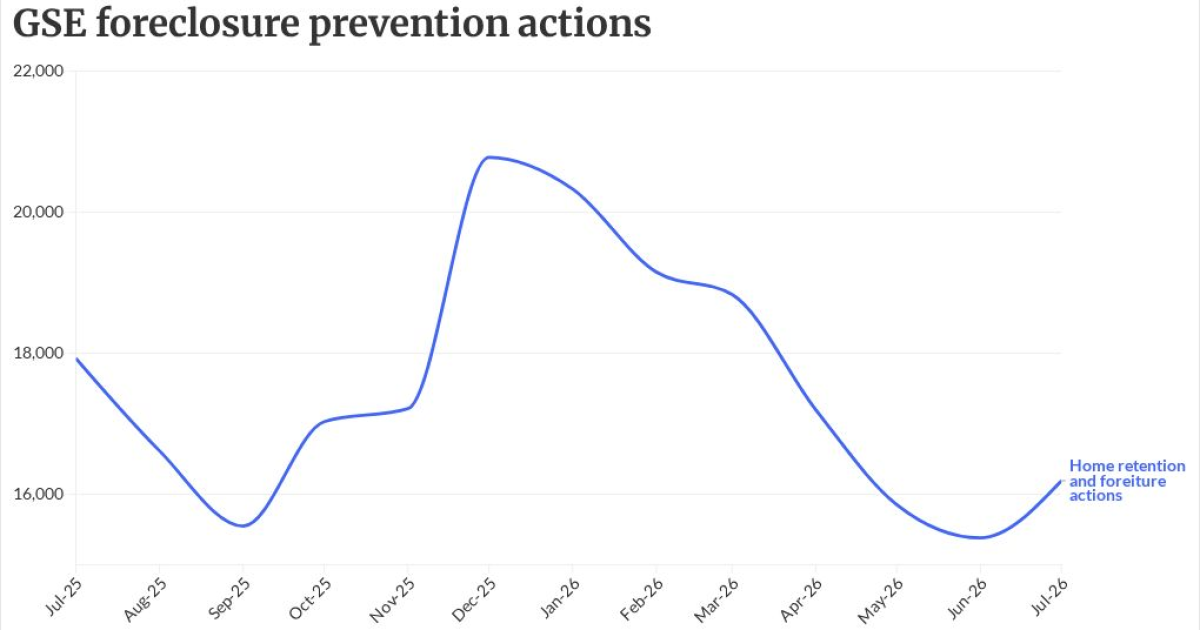
Actions in which borrowers retained their homes climbed 5.33% from the previous month to 16,038 in July, according to the Federal Housing Finance Agency. Total home forfeiture actions outside of foreclosure, which are included in retention numbers, plateaued at 157.
The FHFA's latest monthly report shows that Fannie Mae and Freddie Mac's collective preventative actions have generally paid off in the past month by way of stable or reduced delinquency rates.
The share of mortgages late by 30-59 days dropped from 1.05% in
At levels below 1%, the GSEs' outstanding loans still have historically low delinquencies and have been experiencing strong performance relative to mortgages in
But the uptick in prevention actions, along with an increase in cash-out refinancing activity amid rising consumer prices, shows distress is a little more prominent than it was earlier this year for GSE loans. So servicers have had to work a little harder to help borrowers.
Breakdowns for borrower options
Cash-out activity, in which borrowers add to their balance rather than reducing it, rose from a little over half of all refinances or 54.4% in June to 58.1% in July, even as this type of lending faced more competition from the booming
Modifications increased 6.05% during the month when they climbed to 7,503, representing almost half of 46.33% of all foreclosure prevention actions in which borrowers did not forfeit their homes. Deferrals increased 9.36% and represented almost 30.83% of home retention efforts.
Forbearance, repayment plans and charge-offs-in-lieu accounted for the rest of the home retention efforts.
WIthin the small number of home forfeiture efforts, short sales dominated at 108 but there were two fewer of them than the previous month. Deed-in-lieu-of-foreclosure outcomes increased by two to 49.
Forfeiture options aim to allow for the resolution of loans without a long foreclosure process that would mar the debtors' credit. Servicers also may offer other benefits in return for quicker access to collateral, such as cancellation of some debt or cash toward a less expensive home.