The immediate impact of Wednesday's turmoil in the Treasury markets was felt by many in the mortgage business, including brokers, whose wholesalers sent out new rate sheets during the day. Lenders, instead of quoting a static rate, should structure client pre-approvals around multiple interest rate scenarios to keep prospective buyers active even as purchasing power shrinks.
Grace Maxwell, the broker owner at Canter Financial noted on Wednesday, she already had seen a "significant reprice for the worst" on wholesalers' rate sheets.
"While I think that was largely reactionary, the actual rate available to the consumer goes down slower than it goes up," Maxwell said. "I typically tell my clients that the rate available to them on a given day already takes into consideration the expected news going forward, like when you have packed for a trip based on the weather you expect next week."
Wholesalers have been known to send out intraday rate sheet changes, sometimes even multiple times, based on capital market shifts.
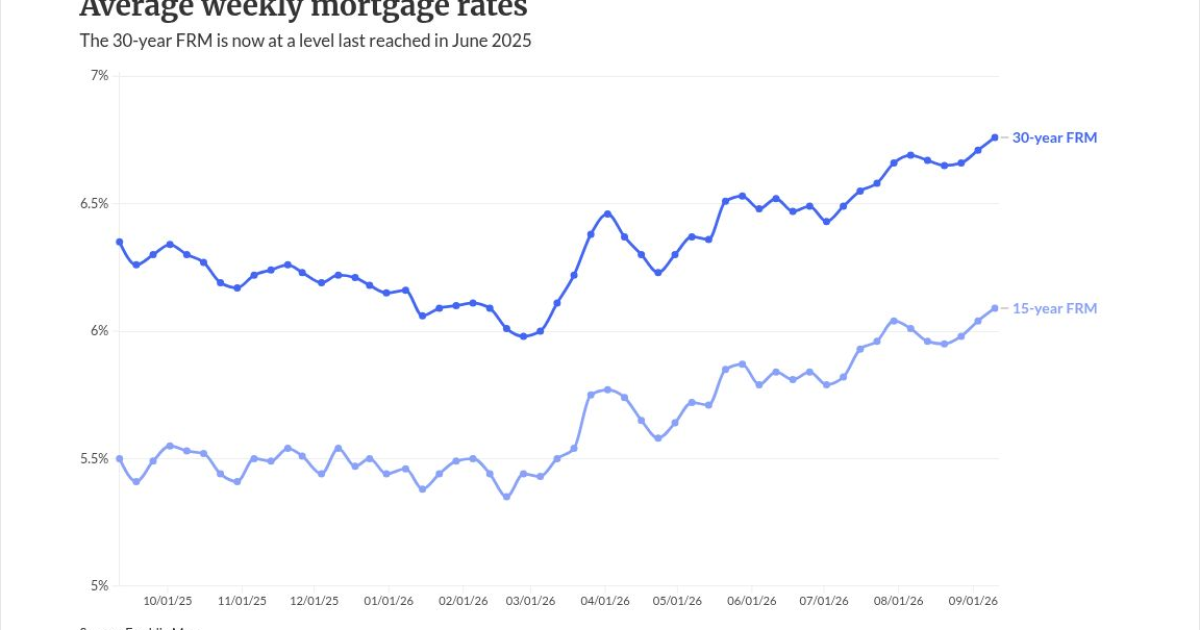
Right now, the Freddie Mac Primary Mortgage Market Survey for Sept. 10 had the 30-year fixed rate mortgage at 6.76%. This compared with
The other product Freddie Mac tracks, the 15-year FRM, averaged 6.09%, up from last week's 6.04%, and
In the days leading up to the Freddie Mac report, the
During the day on Sept. 9, the 10-year Treasury reached 4.86%, a level it had not been at since Nov. 1, 2023. It did retreat slightly to a close of 4.84%; the day before it closed at 4.81%. The next day, after the Producer Price Index release reported a 0.4% rise in its inflation metric, the 10-year broke through the ceiling and hit 4.9%, likely resulting in another round of rate sheet repricing.
Before Sept. 8, the 10-year last closed over the 4.8% mark on Jan. 13, 2025. The previous time it ended the day above this level was on Oct. 31, 2023.
Investors on Wednesday were reacting to two pieces of news. Brent crude prices rose above $100 a barrel as the Iran conflict heated up. Next, Treasury Secretary Scott Bessent's decision to now triple the size of his debt buyback further pushed up yields on the 10-year, which is one of the benchmarks used to price 30-year fixed rate mortgages.
Prepare clients for the unexpected
Maxwell tells clients that a mortgage rate available on any given day already takes into consideration any expected news, comparing it with packing for a vacation trip based on the weather predictions for the next week.
So when it comes to economic data, no matter if the news is good or bad, as long as it is close to what everyone anticipated, it won't affect mortgage rates significantly.
"Today's announcement was the equivalent of a hurricane on your beach trip: not totally out of the question for the time of year, but almost certainly not what you planned for," Maxwell said.
Tell clients not to step away from the market
The biggest immediate impact on Kristina Morales' clients is on their purchasing power.
"However, I don't think buyers should interpret one Treasury spike as a reason to completely step away from the market," said Morales, a mortgage loan officer and real estate agent at Loanfully. "The current environment is already one where buyers have
But the long-term question is whether this is a temporary spike or a sustained repricing of borrowing costs, she said.
"Ultimately, the 10-year Treasury spike reinforces the importance of getting pre-approved, understanding the payment at several rate scenarios, and having a strategy for refinancing if market conditions improve later."
The mortgage math is now harder
With rates now at the upper end of the 6% to 7% territory they have been occupying for the last couple of years, "the mortgage math got harder for prospective buyers," said Kara Ng, senior economist at Zillow Home Loans.
Zillow revised its year-end 2026 forecast upward to 6.7%. "Given rates ended 2025 in the low-6% range, sales will be challenged," Ng said in a Wednesday evening comment.
Lender Price data on the National Mortgage News website on Sept. 9 put the 30-year fixed at 7.23%.
For the same day, Optimal Blue had the conforming 30-year at 6.805%, the highest since June 11, 2025. The jumbo rate was 6.791%. slightly lower.
The Mortgage Bankers Association's Weekly Application Survey, which covers the week ended Sept. 4, had
He noted rates are weighing on prospective homebuyers, even as inventory has risen recently.
Prepare for short- and long-term pain
"This isn't what most people want to hear, but short term pain is very likely," said John Ortega, a home loan specialist at Churchill Mortgage.
Originators should get ready for a reduction in refinancing activity. "Longer term persistent inflation and higher energy costs are driving this, not to mention the federal deficit, which will push rates higher — and for a longer period of time," Ortega said.
He does also expect purchase mortgage volume will be affected but more modestly. However, while home values will be softening, "I don't see a sharp drop in home prices due to inventory constraints.
"As long as those concerns remain in place, mortgage rates could stay elevated,
The 10-year does not act in a vacuum
For mortgage lenders whose client base includes a fair amount of first-time home buyers, the rising yields have affected them "especially acutely," said Landy Liu, the CEO of Foyer.
But the changes in the 10-year yield are not occurring in a vacuum, Liu continued.
"There's a lot of uncertainty around inflation, geopolitics, the Iran war, and even how AI could affect long-term borrowing risk for the U.S. government," Liu said. "All of that is making investors ask for more compensation to hold long-term debt."
The long-term answer relies on what is driving the current Treasury market behavior, said Jeff Adams, real estate investing strategist at Home Investors Zone.
"Many factors could keep the 10-year yield high, such as inflation, fiscal deficits, and heavy Treasury issuance," Adams said. "If that happens, mortgage rates will probably stay structurally higher for longer, and that's a problem because it constrains housing affordability, limiting transaction volume, even if home prices don't take a big hit."
For
A pair of things were clear to bond investors — they don't like rising oil prices, and they were not impressed by Bessent's announcement, said Melissa Cohn, regional vice president of William Raveis Mortgage. The second drove the yields even higher.
"Higher oil prices equal inflationary pressures, and it will be hard to get the bond market to rally back before there is an end to the conflict in Iran," Cohn said.
Why lenders might have to worry about other countries
Meanwhile another item affecting Treasury pricing is other nations reducing their holdings, which also tends to have a negative effect on yields.
Last week, Norges Bank Investment Management, which runs Norway's sovereign wealth fund, said it would cut its holdings in U.S. Treasurys, said Nigel Green, CEO of the deVere Group. The weighting in the portfolio would go to 21.9% from 34.1%.
"One of the most disciplined, longest-horizon investors on the planet is publicly rethinking how much trust it puts in government debt, and U.S. Treasurys above all, to do the job investors have counted on them to do for generations," Green said in a press release.
On the other hand, the fund is shifting toward mortgage-backed securities and corporate credit, which Green called a signal of the direction for long-term serious capital investments.
"Diversifying away from a single type of government paper and into a broader mix of credit and fixed income is the direction thoughtful, long-term investors are already moving," he continued.
While the latest Treasury Department data is from June, it is a sign of trends. Japan reduced its holdings to $1.11 trillion from $1.14 trillion in May.
The United Kingdom went to $939.9 billion from $948.6 billion, while China cut its holdings to $633.4 billion from $659.3 billion.
The latest FOMC bets
On Thursday morning, after the PPI came out, 68% of those polled on CME FedWatch now believe at next week's FOMC meeting, a 25 basis point rate hike is likely. This compared with 61% on Sept. 9. A week ago, 50.6% said the FOMC will keep rates unchanged.
"For lenders and borrowers alike, I'd focus less on reacting to a single Treasury move and more on the broader rate trend and the borrower's individual financial position," said Giorgia Mattana of Coach Financing Solutions.
Cohn said the Consumer Price Index report to be released on Friday is the key to the Fed's next move.
Ironically, a fed funds rate hike could help lower mortgage rates, she continued.
"That could actually provide relief in the bond market," Cohn said. "I think it would be prudent if they hike rates, and I think the bond market would react favorably; bond yields would go down, and mortgage rates would go down."
The last time the FOMC started a rate reduction cycle, mortgage rates initially rose, she pointed out, adding "I think there's a very good reason mortgage rates could go down if the Fed actually does raise rates."
Fed Chair Kevin Warsh reportedly does not want any one piece of data to determine how the FOMC acts, said Kate Wood, lending expert at NerdWallet. The August CPI release, however, creates this scenario.
"If CPI comes in above market predictions, we could quickly see rates cover the rest of the distance to match a 25-basis-point hike," Wood said. "It wouldn't drop rates if CPI's on target or there's otherwise any room for ambiguity, but it'd be less of a push."