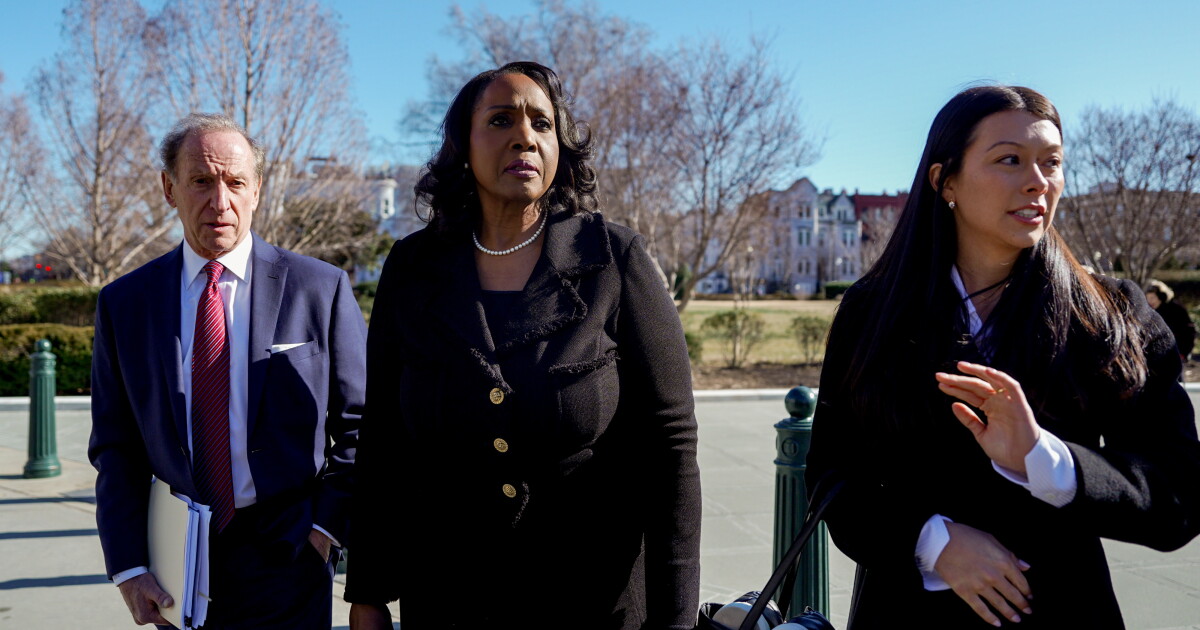
- Key insight: The Supreme Court ruled in favor of Federal Reserve Gov. Lisa Cook, allowing her to remain on the Fed Board of Governors pending the outcome of her lawsuit challenging her purported removal by President Donald Trump last year.
- Expert quote: "The Court decides this application on the narrow ground that the President failed to afford Cook the procedural protections to which she was entitled by statute. Without such protections, she could not properly dispute the charges the President laid against her." — Supreme Court Chief Justice John Roberts
- Forward Look: The decision cements the Fed's special status in the eyes of the court, but also lays out more explicit procedural steps that a president must take to lawfully remove a Fed governor.
Federal Reserve Gov. Lisa Cook will remain on the Federal Reserve Board after the Supreme Court shot down President Donald Trump's move to fire her.
The high court ruled in favor of Cook, in a
The ruling held that the process by which Cook was purportedly removed was fundamentally flawed because it offered no meaningful opportunity for her to counter the accusations brought against her, and such an opportunity must be present in any move to remove a government officer whose independence is both critical and sanctioned by the constitution.
"The Court decides this application on the narrow ground that the President failed to afford Cook the procedural protections to which she was entitled by statute," wrote Chief Justice John Roberts, writing for the majority. "Without such protections, she could not properly dispute the charges the President laid against her. Only after Cook has had the opportunity to respond to the charges made against her may a final decision be made. And only then can the courts assess the validity and sufficiency of such charges."
The ruling follows a yearlong saga stemming from Trump's
Last August, Federal Housing Finance Agency Director William Pulte sent a criminal referral letter to the U.S. Depart of Justice alleging that Cook claimed two properties — one in Michigan, the other in Georgia — as her primary residence on separate mortgage applications.
Five days after the letter was sent, Pulte released it publicly, leading
Less than two weeks after Cook's lawsuit, the judge overseeing the case issued a
Those
The case against Cook carried with it several questions, including whether she actually attempted to claim multiple homes as her primary residence — an act that would allow her to receive a more favorable mortgage rate than if she claimed one as a second home or investment property — whether she committed in doing so crime and, if so, whether that would be cause for removal, given that she applied for and secured the loans before being confirmed to the Fed's board in May 2022.
More broadly, the case has been seen as a test of the extent to which the Federal Reserve's status as an
In recent years, the Supreme Court has nodded to the Fed having a "special" status under the law, though it has never fully explained what that means, particularly in the context of removal powers.
In Monday's ruling, the justices repeatedly acknowledged the Fed's "unique status," structure and role in the government.
"Like its predecessors, the Federal Reserve operates at a deliberate remove from the ordinary political process, including a budget free of congressional control … and policies set not only by Governors, but also by representatives of the private regional banks," Roberts wrote in the majority opinion. "Not only the fact of independence but also the appearance of independence is key to the Federal Reserve's design."
Roberts also noted that the Fed, like the U.S. central banks that preceded it, was granted this special status to insulate the nation's money supply from political meddling.
"The Court declines to sow doubt as to the status of one of the Nation's (and the world's) most important financial institutions, and would not so quickly unsettle this 'special arrangement sanctioned by history,'" he wrote
The Supreme Court also ruled on another case dealing with the president's removal powers on Monday. In Trump v. Slaughter — a case brought by two Democratic commissioners on the Federal Trade Commission who were fired in March 2025 — the high court ruled 6-3 in favor of the administration.
The justices found that presidents have a broad discretion to remove appointees from government agencies, arguing that the constitution was designed to vest all executive power in the government as a means for making the government more accountable to the voting public.
The ruling all but eradicates the legal precedent laid out in the 1935 case Humphrey's Executor v. United States, which maintained that independent agencies were valid under the constitution if the agencies wielded "quasi-legislative" and/or "quasi-judicial" powers, meaning their powers are not entirely executive in nature and thus operate at a remove from the White House.
"If anything more is left of Humphrey's, the Court overrules it," Roberts wrote in the Slaughter opinion. "Humphrey's has for decades been a result in search of a rationale, and every relevant factor to stare decisis — the 'quality' of the decision's reasoning, its 'consistency' with the Court's other cases, the 'workability' of its rule, and reliance interests … counsels in favor of letting Humphrey's go."