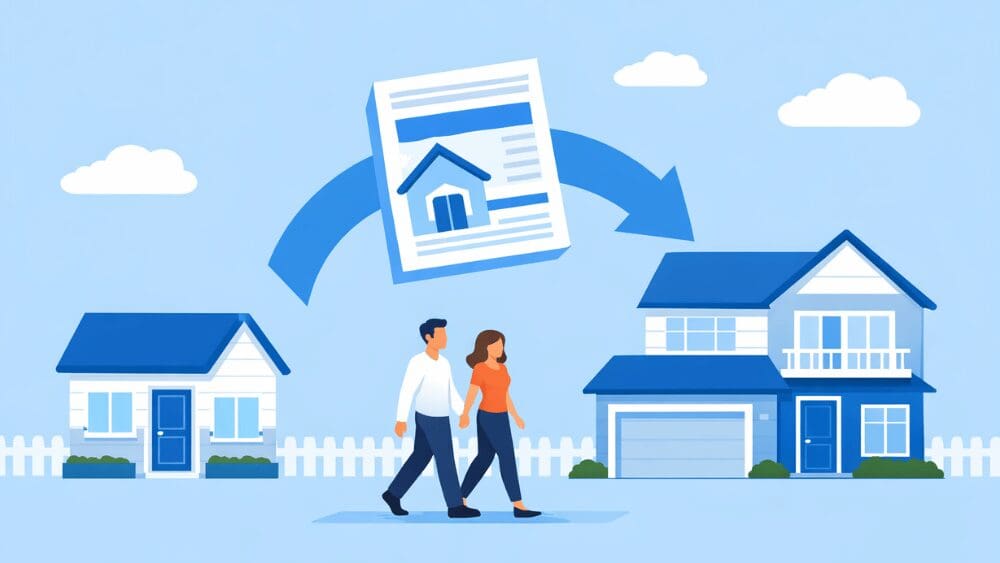
If you’ve locked in a mortgage rate in the 2%, 3%, or 4% range, the idea of moving can feel like financial foolishness. Selling your home means taking on today’s higher rates and larger monthly payments. Wouldn’t it be nice if you could carry your low pandemic-era rate over to your new home loan? While portable mortgages aren’t currently available in the United States, they’re used in other countries and are now being discussed by U.S. housing officials as a possible way to ease the rate lock-in, or “golden handcuffs,” effect. But what is a portable mortgage? How does it work? Who might it help? To explain the concept, we spoke with Steven Chester, a loan officer in San Antonio, Texas, with 24 years of experience in mortgage lending. “Portable mortgages basically allow you to take your existing mortgage debt on your current property, at that same rate, and carry it over to the next property,” Chester explains. In simple terms, instead of paying off your current mortgage balance and starting over at today’s rates, you transfer that mortgage debt to your next home. “If the new property is more expensive, you have to cover the difference with cash or equity,” Chester says. “But you’re essentially able to lock in your existing rate and take it with you.” In most real-world portability programs, the original home must be sold within a set timeframe. We’ll share an example scenario and a portable mortgage calculator you can try later in the post. While the exact rules vary by country and lender, the core mechanics of a portable mortgage are fairly straightforward. When a homeowner moves: From a lender’s standpoint, the borrower doesn’t automatically get a free pass. Chester notes that qualification still matters. “A consumer would still have to qualify for that mortgage,” he says. “They would still be evaluated. It’s really about validating that the consumer is in the same or a better position than when they originally got the mortgage.” Operationally, however, this is where uncertainty creeps in, especially in the U.S. “We haven’t done portable mortgages in the United States,” Chester says. “There could be some risk with title issues because you’re transferring things, and it may not go under the same scrutiny. We don’t know that yet because it hasn’t been designed here, so it’s difficult to fully forecast what the risk would be.” That lack of a tested framework is one reason portability remains theoretical for U.S. buyers today. In countries where portable mortgages are available, the goal isn’t novelty, it’s affordability. “The problem they’re designed to handle is keeping the housing payment low,” Chester explains. “The consumer gets in with a great interest rate on a certain amount of money, and it helps keep their mortgage debt reasonable and their payment reasonable.” In Canada, for example, mortgages are often structured around shorter renewal periods (5 years is the most common term), which can make portability easier to implement within the broader lending system. Even so, the underlying purpose remains the same: allowing homeowners to move without completely resetting their financial footing. That coveted purpose — preserving affordability while enabling mobility — is what’s driving new interest in portable mortgages as many U.S. homeowners remain sidelined by today’s higher rates. Mortgage portability isn’t designed to help everyone equally. According to Chester, the biggest beneficiaries are homeowners who locked in historically low rates and have built substantial equity since then. “The consumers that would benefit the most are those people who got in during market lows,” he says. “If they bought their house during the market low, they have a historic interest rate, and they’re able to move that debt to their next asset.” This group often includes: First-time buyers, by contrast, wouldn’t see any benefit from portability because they don’t have an existing mortgage rate to carry forward. In short, mortgage portability primarily favors homeowners who already hold a low-rate advantage and want a way to preserve it while making a move.What is a portable mortgage?
How portable mortgages are supposed to work
Why portable mortgages exist in other countries
Who benefits most from mortgage portability