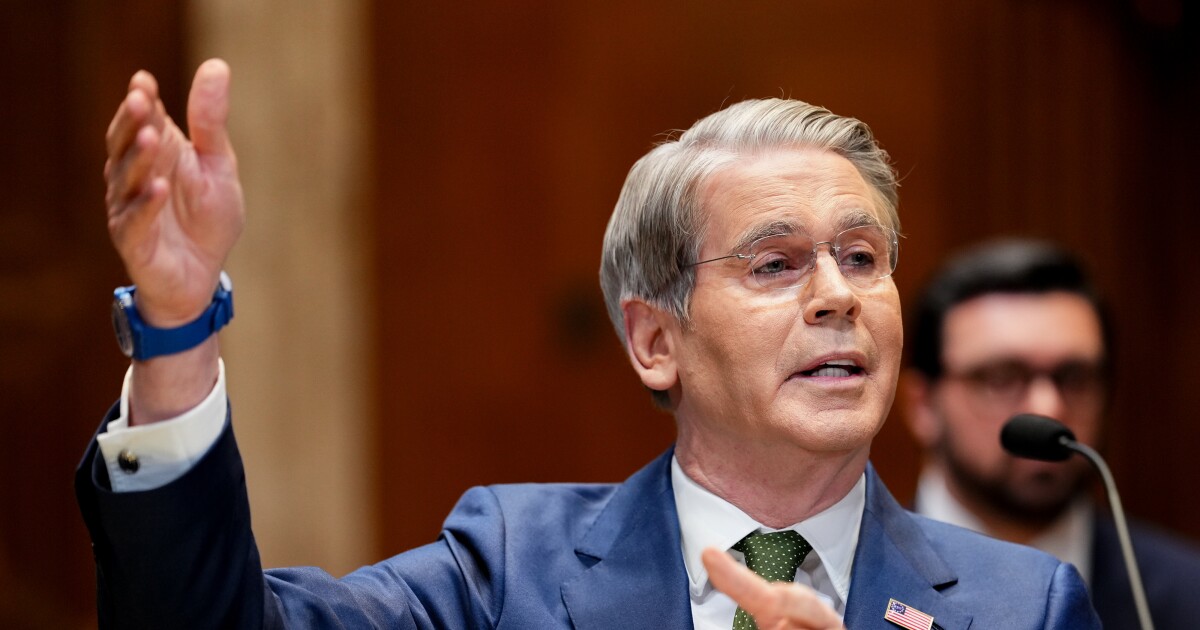
- Key insight: Treasury Secretary Scott Bessent backed the president's call in his 2027 budget for a 60% reduction to the Community Development Financial Institution Fund, arguing it had a "partisan agenda."
- Supporting data: The president's budget cut more than $204.5 million from the fund's budget for fiscal year 2027.
- Expert quote: "They're sustaining daycares in small communities of just over 300 people," Sen. Deb Fischer, R-Neb. said. "They're keeping retail stores in rural downtown, initiating new businesses on the Winnebago and the Omaha reservations in northeast Nebraska, and they're supporting efforts to increase that rural housing developments, which is so needed."
Treasury Secretary Scott Bessent Wednesday said the Community Development Financial Institutions Fund "had lost its way," defending the administration's proposed cuts to the program.
Speaking during a Senate Appropriations subcommittee hearing on the President's fiscal year 2027 budget request, Bessent told Sen. Chris Coons, D-Del. — who had questioned the wisdom of cutting more than $200 million, or more than 60% of the program's funding — that the fund had drifted toward "a partisan agenda."
"First of all, that was an OMB apportionment. The funding is now $280 million," Bessent said. "And I do support the new $100 million program in rural areas. And I can tell you that part of the CDFI program had lost its way in terms of a partisan agenda."
The administration's fiscal year 2027
"Past awards enabled lender practices in which race was a key determinant in access to loans, and provided funds for products and services that advanced immigration, gender, and climate radicalism," the White House budget request said. "By refocusing CDFI Fund awards to expand access to capital, finance infrastructure, and bolster Main Street business development in rural America, the Budget allocates resources efficiently and prevents taxpayer dollars from again supporting [diversity initiatives]."
The CDFI Fund has come under fire from the Trump administration following a White House
The attempts to dismantle the CDFI fund has produced a rare instance of bipartisan pushback, with over 100 Republicans
During the Wednesday hearing, Sen. Deb Fischer, R-Neb., pointed out the "good work the 11 CDFIs in my state do in investing in those rural communities." She argued the CDFI program and the community lenders it funds have served customers larger financial institutions are unwilling to serve.
"They're sustaining daycares in small communities of just over 300 people," Fischer said. "They're keeping retail stores in rural downtown, initiating new businesses on the Winnebago and the Omaha reservations in northeast Nebraska, and they're supporting efforts to increase that rural housing developments, which is so needed."
In response, Bessent — who in a March 2025 statement called CDFIs "a key component of President Trump's commitment to supporting Main Street America" — argued the program had become a source of fraud and waste, using that claim to justify narrowing the fund's focus to rural communities.
"We want to make sure that it is doing what it is designed and not loaded with a partisan wish list," Bessent said at the hearing. "We also want to make sure that the CDFI program is free of waste, fraud and abuse. There's a CDFI [named]
The hearing also turned to conversation around the ongoing conflict in Iran. When asked by Senator Jack Reed, D-R.I., about the conflict's impact on gas prices for Americans, Bessent said, "I think the conflict will end," adding that gas prices could actually decrease to levels lower than they were before the war.
"The crude market is currently in what is known in the energy business as very steep backwardation, which means that the future prices are much lower than we are at present," Bessent said. "I think gasoline prices will come back to where they were, or perhaps lower. President Trump has shown that he is good at getting energy prices down and that our energy dominance agenda has the lower prices."
When pressed by Reed how fast prices of gasoline would come down again, Bessent responded "that is path dependent on when the war and the conflict end."
Bessent was also pressed by Sen. Coons on the administration's move in March to issue a temporary waiver allowing the sale of Iranian oil already at sea and to let Russian cargoes already loaded on tankers move without triggering sanctions. The administration said earlier this month it would not renew the Iran waiver, but extended the pause on Russian shipments to ease supply shortages from the Iran war. He defended the move as necessary to prevent a spike in global prices, which would benefit even sanctioned entities who sell their oil at a discount.
"Oil prices are at $100, if we had not done those sanctions, really, they might have been at $150 because the world became very well supplied." Bessent said. "So if Russia was selling their oil at a 20% discount, I can tell you that 100% of $100 is less than 80% of $150 and the American consumer has been better off."