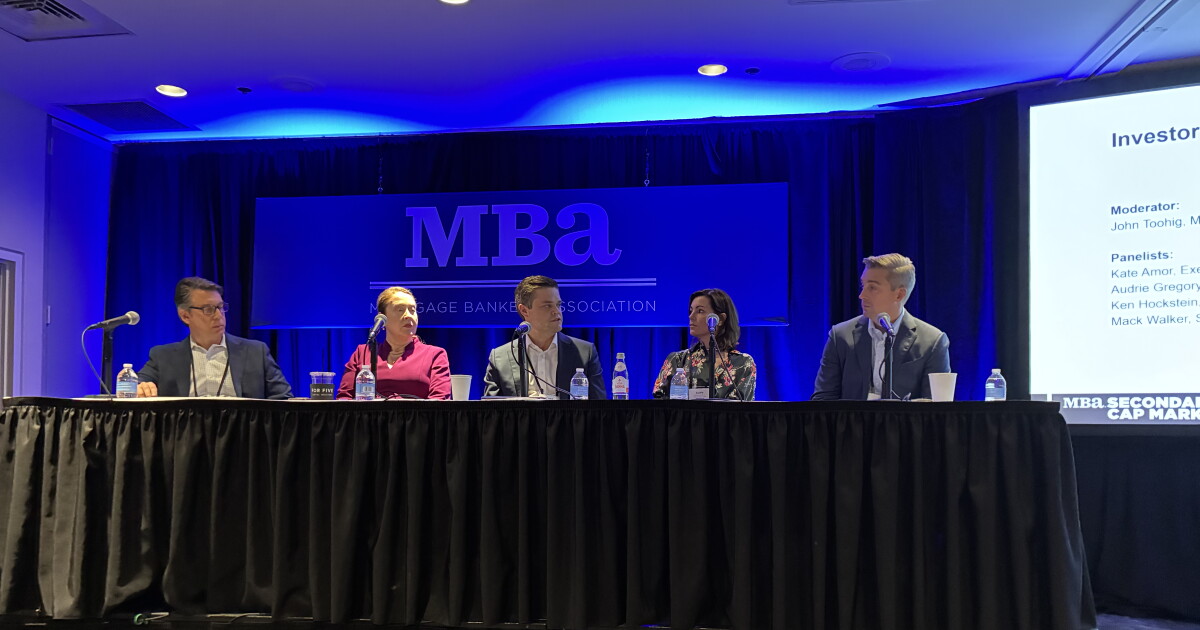
Call it non-QM, call it non-agency, call it whatever you want. Just don't call it a niche product anymore. That's what panelists at the Mortgage Bankers Association's Secondary and Capital Markets Conference sought to drive home.
And this business is
"I would even say that about half of what we're doing today actually falls into what we like to refer to lovingly as non-QM, but I think sometimes that's just a label that we wrap around products with certain attributes," said Kate Amor, executive vice president, head of enterprise products at Rate.
Deephaven Mortgage is a third party originator of these loans, and is having "healthy conversations" with its customers about them, said Mack Walker, senior vice president of capital markets.
"The best way I would describe those conversations over the last few years has moved from a niche product to more mainstream," Walker said. "The folks really focused on it today, it rises to a bigger percentage of their book of business."
What investors want in non-agency
Voya Investment Management had long faced operational constraints that made non-agency investing difficult, said Ken Hockstein, senior insurance portfolio manager. But now the firm is ramping up its presence in the space.
"It's just become easier and easier
Furthermore, it is a misperception these loans have lower asset quality, he said. "It's just different, and with the easier access to it now, it's a great time for us to get involved."
When it comes to underwriting non-agency products, "it's not really rocket science, it makes sense," said Audrie Gregory, vice president sales for correspondent lending at
Lenders are not doing 100% financing today, she said. John Toohig, managing director at Raymond James & Associates and the panel's moderator, noted this isn't what was being originated in 2005, with originators
Now at most, for fully-drawn second liens, the combined LTV is 90%, with a 770 credit score, he said.
Approaching entering the non-agency market
For lenders coming from the conventional side, entering the non-agency market requires a fundamental shift in thinking and Gregory knows that firsthand.
Gregory started at Verus in 2017 with a background in the conventional side of the business,but quickly found that non-agency products opened new doors for the company's third-party customers. Many of those products were shaped by customer demand, she said. Lenders would come in with requests for specific features, and Verus would build them.
"You're not talking about rate, you're not talking about price, you're bringing real solutions, you're looking at the situation," Gregory said. "Today we have a surplus of conventional people coming to this space, which is great, but with that comes the conventional mindset."
That mindset has to change. Lenders need to get comfortable with what Gregory called "operating in the gray" when it comes to underwriting.
Her advice for those looking to build out a non-agency business: "Have a desk, put resources at it, make sure your loan officers are supported, give them training that will help you with adoption. But don't look at it like a conventional transaction; use it as a core program and build it as such."
Amor pushed back slightly on the "gray area" framing, preferring to call it cash flow underwriting instead. "This is like literally common sense underwriting," she said.
That means investing in underwriters who take the time to understand how to construct these loans, Amor said, and then choosing the right counterparties. On the investor side, Hockstein said his firm has been developing its own buy box, with significant customization available so investors can tailor criteria to their portfolios.
Walker added that guidelines require careful calibration in which they're comprehensive enough for correspondents to follow, but not so rigid they become unworkable. "You've got to thread the needle," he said.
Unlike agency lending, which is largely checklist-driven, non-agency underwriting demands a fuller picture, Amor said. Cutting corners carries real consequences.
"I've seen people not follow that protocol in non-QM, and then the road to glory is paved in early payment default," she warned. "You don't want to be there."
What's next for non-agency mortgage lending
When asked what's next for the non-agency business, Gregory replied it would depend on
"Our products are modernized and they serve a lot of borrowers, but, how it got traction on the market was simply because of the interest rate environment," Gregory said. "Sure, people were forced into it, a lot of people didn't want it."
While some people jumped in early, others only added the product line "kicking and screaming." They might still not want to do them, but they have to have these on their menus, she said.
Opportunities in
Overall, "I think we've seen opportunities shift again as the markets evolved, and so for us it's been important to be positioned to capitalize on those opportunities as the macro picture changes," he said.