
- Key Insight: Find out how LoanDepot is shifting its origination focus amid industrywide volume decay.
- Supporting Data: A $28.7 million net loss posted by the lender in the third quarter.Overview bullets generated by AI with editorial review.
LoanDepot CEO Anthony Hsieh expects the lender's investments and pivot to home equity to pay off in the coming months despite a tough market, returning the company to profitability next year.
The Irvine, California-based lender and servicer saw bottom-line losses multiply in its latest earnings, with the company failing to post a profit
The sticker shock of accelerated mortgage rates over the third quarter drove origination "volume decay" across the home lending industry, according to CEO Anthony Hsieh on LoanDepot's earnings call.
"This company was never designed to carry this type of cost structure with the little volume that we enjoyed last year, so we've been heavily scaling the organization. And our origination channels over the last year — all are pointing very positive in achieving greater market share," he said.
"Getting over the seasonality of Q4 and Q1, and of course, not knowing where the market will end up next year, but if it stays at this level, we are very confident that we'll get to a breakeven or profitability by first half or mid next year," Hsieh continued.
Company leaders pointed to the positive signs emerging from consumer activity as they focused on home equity lending in recent months.
"We view home equity as a permanent strategic growth category that complements rather than replaces our existing mortgage platform," LoanDepot's CEO said. Executives touted the company's ranking as one of the top three nonbank home equity lenders during the recent quarter based on volume.
LoanDepot's performance by the numbers
Across all business lines, though, the news was less positive, with the lender and servicer posting a net loss of $28.7 million in the third quarter, falling further into the red from $6.62 million and $8.7 million on a quarterly and yearly basis.
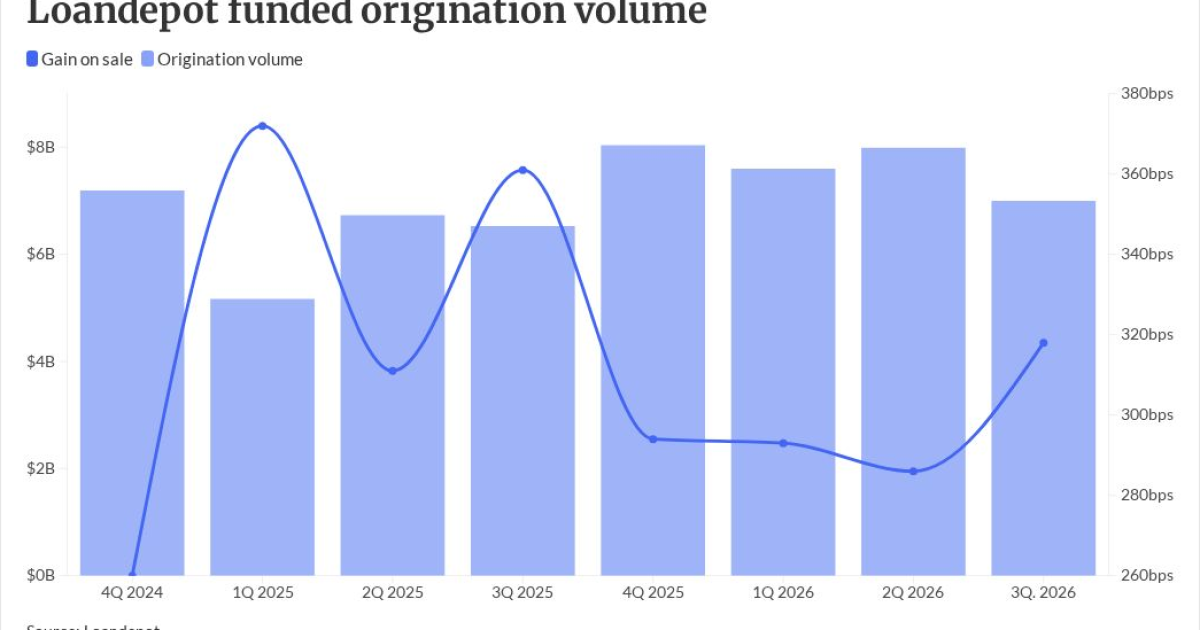
While it highlighted originations unit volume growth of 7% largely based on momentum in home equity products, the company reported its monetary total of loan production dropping 11.8% to $7 billion from nearly $8 billion between second and third quarters, with volume deterioration and seasonality both playing a role. The latest dollar amount, however, represented an increase of 7.9% year over year from $6.5 billion.
The fourth-quarter outlook calls for further anticipated pullback to between $4.5 billion and $6.5 billion, the company reported, in line with opinions from
Gain-on-sale margins boosted the bottom line, increasing to 318 basis points from 286 basis points between April and June. Year-over-year gain on sale retreated from 361 bps.
On a pull-through-weighted basis, margins increased both quarterly and yearly to 399 bps from 345 in the second quarter, attributed to the shift toward home equity originations. Compared to a year earlier, the number rose from 339 bps.
On the servicing side, fee income increased on a quarterly basis from $112 million to $113 million. LoanDepot held $115.8 billion in unpaid balance within its servicing book at the end of the third quarter, a decrease from $123.4 billion in the previous three months and $118.2 billion a year ago.
The company raked in revenue of $307.1 million, a decrease of 8.9% and 5% compared to $337.3 million and $323.3 million in the prior quarter and year.
In its earnings call, executives also addressed ongoing efforts to shore up liquidity levels through reduced expenses and sales of mortgage-servicing rights. In the most recent quarter, LoanDepot completed a $10 billion sale of agency MSRs, while also agreeing to sell another $9 billion of government mortgage-servicing rights.
"Our cost to produce improved by 16% year over year. Meanwhile, our investment in technology is making us more efficient," said Chief Financial Officer Dave Hayes, who noted a 28% cut in headcount over the past 12 months.
"We continue to actively work to address our upcoming debt maturity and are pursuing several financing alternatives to refinance or extend our debt with financing counterparties," Hayes added.