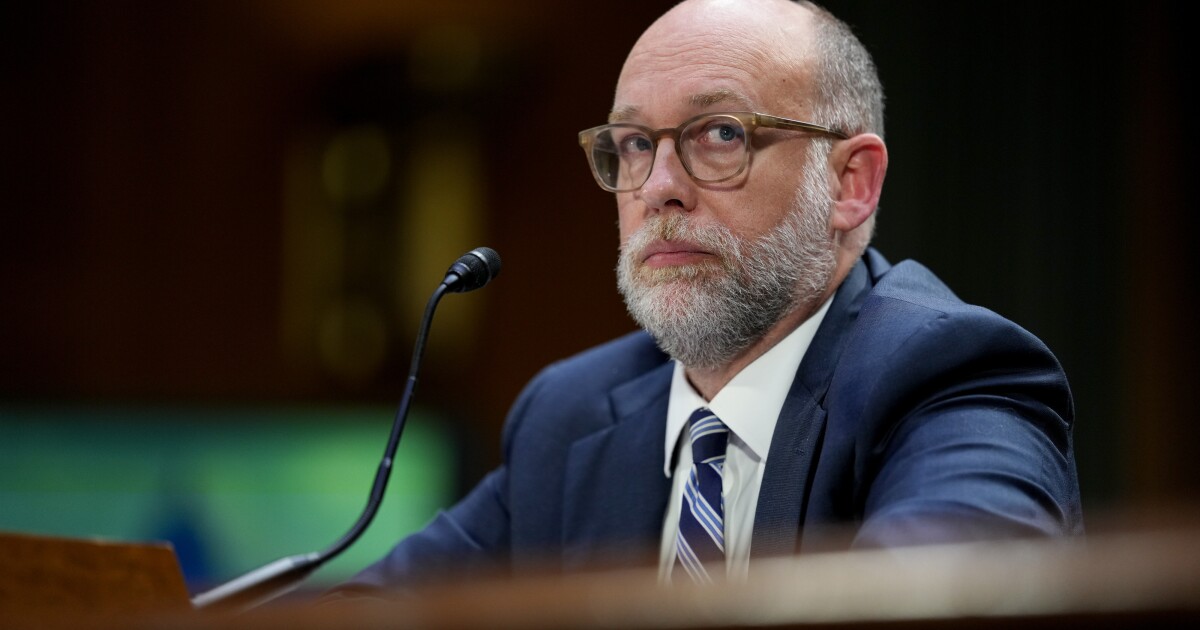
- What's at Stake: Russell Vought, who also leads the Office of Management and Budget, has publicly stated his intent to shut down the CFPB, and recently refused to request funding for the agency.
- Supporting Data: Under the Federal Vacancies Reform Act, the lapse enables Russell Vought to remain as the acting director of the CFPB for another 210 days.
- Forward Look: What happens next for the CFPB is likely to be decided by the courts.
The Senate has paved the way for Russell Vought to remain acting director of the Consumer Financial Protection Bureau by allowing the nomination of a permanent director to lapse.
Under Senate rules, nominations that are not acted upon are automatically returned to the president if the Senate adjourns or is in recess for more than 30 days. By letting the nomination lapse, the Senate has prolonged the overall confirmation process for a permanent director, allowing Vought to serve another 210 days, based on the Federal Vacancies Reform Act. The Senate gave no explanation for why it allowed the nomination to lapse.
President Trump nominated Stuart Levenbach in November to lead the CFPB permanently, though he was
As a result, Vought will remain acting CFPB director for another seven months, or roughly until August. Vought is also the director of the Office of Management and Budget and has publicly stated that he wants to shut down the CFPB. He recently refused to
Though the CFPB is still operating, many employees are not technically working but rather have been told to be "work ready." Vought has claimed the CFPB will run out of money in the next month or so even though he has a packed deregulatory agenda including the reconsideration of two major existing rules: the 1033 open-banking rule and the 1071 small-business data-collection rule. Both rules have extended compliance deadlines in 2026 and 2027 but litigation has caused delays for their full implementation.
Though Levenbach was a placeholder, he is closely allied with the Trump administration. He works for Vought as the OMB's associate director of natural resources, energy, science and water. But he also serves as vice chair of the National Capital Planning Commission, which has authority over the federal development of Washington, D.C., including the White House ballroom project, which is also wrapped up in litigation.
What happens next at the CFPB will be decided by the courts. A dispute over Vought's layoffs at the CFPB is currently on appeal to the U.S. Court of Appeals for the D.C. Circuit.
Last month, a federal judge rejected the Trump administration's reasoning that it cannot request funding for the agency. The Department of Justice's
District Court Judge Amy Berman Jackson
Judge Jackson wrote that a preliminary injunction issued last year requires Vought and the CFPB "to perform certain specific statutory functions and to maintain a sufficient number of employees and the physical space and technological capacity to do them."
She minced no words in describing how the Trump administration has tried to eliminate the CFPB but rejected its view that the Fed has no earnings.
"It appears that defendants' new understanding of 'combined earnings' is an unsupported and transparent attempt to starve the CFPB of funding and yet another attempt to achieve the very end the Court's injunction was put in place to prevent," Judge Jackson wrote in the order. "This ruling therefore construes the scope of the existing Order to clarify that the defendants' unilateral decision to decline to request funding, based on an unsupported interpretation of the Dodd-Frank Act, contravenes the preliminary injunction."
Manny Newburger, a partner at the law firm Barron & Newburger, said it remains to be seen if Vought decides to request funding from the Fed or defy the court's order.
"The order makes it crystal clear that the court recognizes the pattern of gamesmanship employed by the CFPB and its counsel and that Judge Jackson will not allow the defendants to do an end-run around her injunction," Newburger said.