
- Expert Quote: "Prospective borrowers may be holding off decisions until rates and economic and political conditions settle," — Bob Broeksmit, MBA President and CEO.
- Forward Look: Predictions of a chillier 2027 spring home shopping season.
Overview bullets generated by AI with editorial review.
Mortgage professionals should be calling borrowers already in their pipelines this week. The bond market's reaction to the
The window may be short, and the borrowers best positioned to take advantage are the ones already in process. "When rates move favorably, demand responds quickly," said Kyle Bass, production business manager at Refi.com. "The borrowers positioned to act on that are the ones already in the process, not the ones starting from scratch when the number lands."
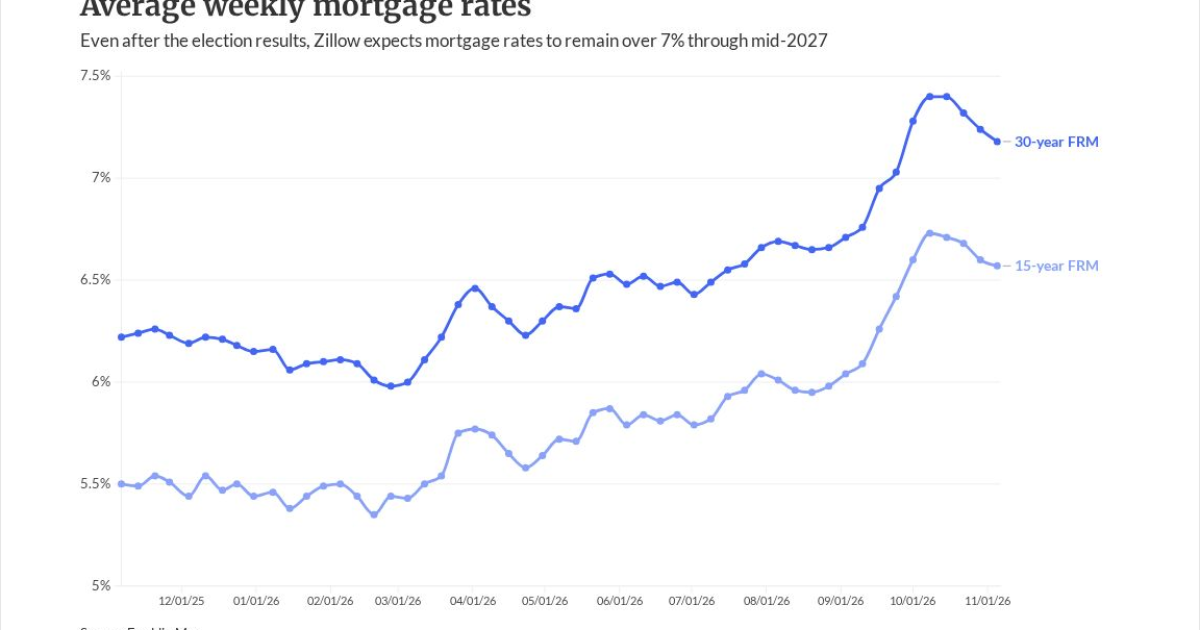
While the 30-year fixed remained above 7% for the seventh consecutive week, it FRM by 6 basis points, to 7.18% for Nov. 5. Last week, it averaged 7.24%, while for the
The 15-year FRM went to 6.57% from 6.6%
"Mortgages have rallied on back-to-back days, post midterms," said Chris Affinito, the chief revenue officer at Total Mortgage. "A positive for our industry as we are seeing a flight to quality trade that is looking like it is going to drive bond yields down."
How the housing industry saw the election results
"Mortgage rates are not abstract to a family trying to buy a home," said Danielle Hale, chief economist at Realtor.com, in a post-election commentary. "They show up as the home they can no longer afford."
A year-over-year comparison of home prices was a vivid measure of why housing affordability landed as a pocketbook issue for voters on Tuesday, she said.
"The [Iran] conflict's inflationary impact is one source of uncertainty, but households feel the consequences in their monthly budgets and in the homes they have to take off their list," Hale said.
While mortgage rates continue to move lower, Zillow Home Loans expects them
"As of Nov. 4, oil prices fell on hopes of easing geopolitical tensions and markets are weighing the potential effects of restrictions on data center construction," said Kara Ng, senior economist at Zillow Home Loans, in a commentary.
"Whether the forces keeping bond yields elevated — government deficits, geopolitical impacts on prices, and corporate borrowing to fund AI spending — could sustainably fade remains an open question."
Rates staying over 7% will likely lead to "a chillier 2027 spring home shopping season," Ng said.
While agreeing higher rates are expected to limit home buying opportunities next year, Selma Hepp, chief economist at Cotality, has a slightly more optimistic view of the market.
"More inventory and greater buyer bargaining power will keep home price growth subdued, improving affordability," Hepp said. "Market activity will favor regions with solid economic prospects, regions that attract a retiring population and offer affordable homes."
Lender Price data on the National Mortgage News website put the 30-year FRM at 7.41% on Thursday morning. This was up nearly 6 basis points from Wednesday afternoon, but 14 basis points lower than where it was a week ago.
The Optimal Blue rate tracker on Wednesday was at 7.12% for the conforming 30-year FRM, down from 7.17% on Tuesday and 7.22% one week prior.
How the bond market reacted to the election results
The 10-year Treasury, one of the elements used to price 30-year fixed rate mortgages, was at 4.83% as of 11 a.m. on Thursday. This was down 6 basis points from Wednesday's close at 4.89%.
But since Oct. 22, when investors started shifting money into Treasurys over artificial intelligence company debt concerns, the 10-year was under 5%, although remaining close enough that the daily highs were over this level through Oct. 29.
The AI company stock selloff is likely to deepen in the coming days as investors price in to their valuations the higher energy and financing costs for the buildout, said Nigel Green, CEO of deVere Group.
On Wednesday afternoon, after the Mortgage Bankers Association's Weekly Application Survey release, and in advance of the Freddie Mac data, Kyle Bass, production business manager at Refi.com, said the recent decline in the 10-year is "what tends to give mortgage rates room to breathe," adding even if it didn't shift the PMMS meaningfully, it is the right direction for homebuyers waiting on the sidelines.
"A drop in the 10-year yield [Wednesday] morning is the kind of signal that tends to bring borrowers back to the conversation," Bass said. "The window market dynamic we've tracked all year hasn't changed, when rates move favorably, demand responds quickly. The borrowers positioned to act on that are the ones already in the process, not the ones starting from scratch when the number lands."
Last week's mortgage application activity
The MBA's Market Composite Index fell 1.2% on a seasonally adjusted basis for the week ended Oct. 30, meaning the data collection period was prior to Election Day.
It reported the conforming 30-year FRM 7 basis points lower, to 7.3%, meaning the lower rates did not bring buyers back into the market. Purchase volume was down 2%, while refinance activity was flat.
"Prospective borrowers may be holding off decisions until rates and economic and political conditions settle," MBA President and CEO Bob Broeksmit said in a Thursday morning comment.