
- Key Insight: Learn why recent volatility is shifting real-estate investment trusts' appetite for home loan assets.
- What's at Stake: Home lenders could see real-estate investment trusts' demand for assets fluctuate if the market remains volatile.
Supporting Data: 22%: The share of dedicated capital one real estate investment trust allocated to servicing in the third quarter.
Overview bullets generated by AI with editorial review.
Single-family mortgage real-estate investment trusts have generally shown resilience so far, but lenders should keep an eye on the sector's particular exposure to recent volatility and impact on REITs' appetite for home loan assets.
"REITs are more of a marginal buyer as opposed to the biggest, but they are levered players. So when there is volatility in the market their impact will be greater," said Doug Harter, managing director at BTIG, in an interview.
Recent volatility and
Annaly, a REIT, reported AAA non-QM spreads to Treasuries gapped out by around 10 basis points in the third quarter. Spreads were another 10 basis points wider in a later deal that it priced. In 2020, non-QM spreads widened by 75 basis points in the first quarter alone.
Recent market disruption compared to 2020
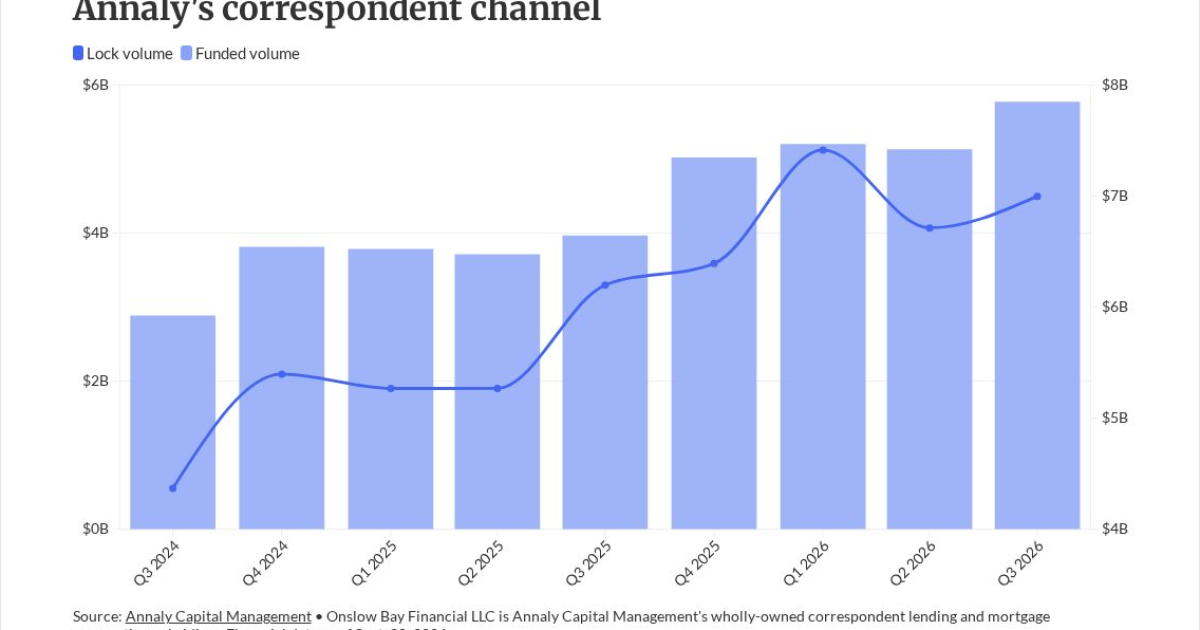
In contrast to 2020, where volatility got to a point where devalued collateral for REITs' corporate financing led to margin calls so intense that some real estate investment trusts that buy loans stopped, Annaly grew loan purchases. The company reported non-agency correspondent loan fundings through its Onslow Bay aggregation subsidiary rose more than 12% from the previous three-month period and nearly 46% from last year's third quarter to $5.78 billion.
REITs also have been taking steps to manage their corporate funding risk. Dynex Capital, a REIT almost entirely focused on buying agency mortgage-backed securities, reported that it is working with more than $24 billion in repo financing provided by a group of over 25 providers. In addition, Dynex also reported that it has a $1.3 billion in liquidity buffer.
The diversified corporate funding sources and liquidity set-aside point to strategies both REITs and mortgage lenders without ties to them can use to manage their risks when the secondary market for home loan assets is challenging due to the rate environment.
"Assets can trade at a discount and hedging can go off, resulting in sloppy pricing, whether you're a REIT or an originator," Walt Schmidt, senior vice president at FHN Financial, said in an interview, noting that these trends can impact both types of entities' corporate funding.
How REITs manage their funding also is something that mortgage lenders should monitor as their leverage grows to varying degrees, depending upon where they sit in the market.
REIT opportunities and risks for lenders now
Real estate investment trusts in the single-family loan sector may own, be affiliates of or business partners with mortgage financing businesses, but they most commonly buy agency securitizations and do less in the way of direct business with home lenders.
So REITs may not directly do business with the average mortgage lender or servicer, except to the extent that their involvement in the securitized market influences broader challenges in market prices or demand. That still makes them more important to monitor in a tough market.
"It's all interconnected. Mortgage spreads are wider, which cause book value declines at the mortgage REITs. That, all else being equal, pushes up mortgage rates. In combination with Treasury yields, that makes the environment more challenging for originators," Harter said.
Some REITs buy whole loans and invest in servicing as well as securitizations, and also sometimes sell assets to manage their portfolios. In a higher rate environment, some REITs have been shifting more toward servicing as a natural hedge as originators do.
Servicing rights represented 22% of Annaly's dedicated capital, compared to 55% allocated for agency MBS and 23% for non-agency.
Annaly's analysis of certain Fannie Mae and Freddie Mac monthly loan-level files, excluding platform acquisitions, shows that Onslow Bay was the sixth largest nonbank servicer of agency MBS at quarter end.
Lenders should examine whether the REIT pricing of any assets they trade are favorable, while being sure to have
"REITs are having trouble in this market, and they could back off on their demand," said Nathan Regehr, principal at Regehr Capital Markets Advisory. "Oftentimes REITs are the ones paying extra high for assets, but when the market pulls back, they may not want to do a deal anymore."
While asset prices may look cheap to REITs in a market dislocation related to higher rates, they have other considerations that include the fact that their financing costs will be more expensive, and may be less likely to be net buyers.
AGNC Investment Corp., a real estate investment trust, reported that its weighted average cost of funds rose from 2.89% in the second quarter to 3.09% in the third. The size of its portfolio, which is largely allocated to agency MBS, inched down by 2.88% to $94.4 billion.
Dynex's investment portfolio, which also is dominated by agency MBS, grew 3% in the third quarter to $28.3 billion but was 5% below BTIG's estimate.
Outlook for real estate investment trust M&A
REITs have been part of the broader consolidation in housing finance, perhaps most notably the bidding war that retail lending giant CrossCountry Mortgage won over Two Harbors and its RoundPoint servicing unit. Two Harbors is no longer a REIT, but part of the privately-held CCM.
Single-family mortgage REITs also have been acquirers, with TPG Mortgage Investment Trust set to buy former Freedom Mortgage affiliate and real estate investment trust, Cherry Hill, in the fourth quarter of this year.
With the market tougher for REITs but third-quarter earnings showing that they're generally holding their own and not desperate, Harter said they may be less likely to be sellers unless the market calms down, giving them more of a sense that they're selling at a profitable time.
"I think you probably need to see a little stabilization first," he said.