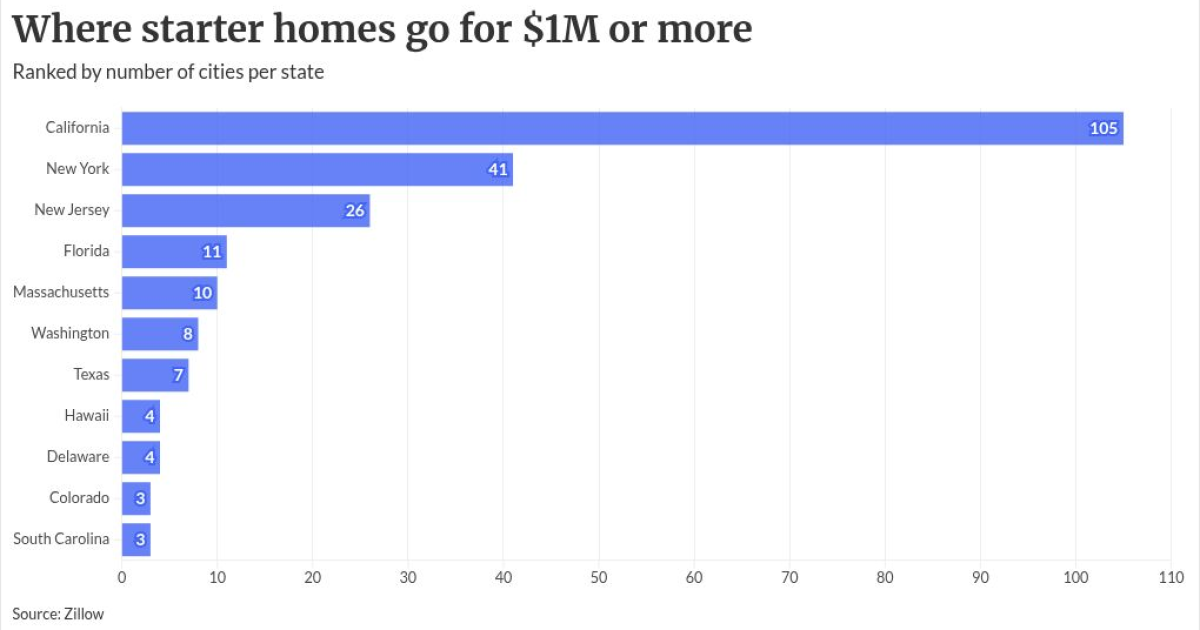
In a market showing significant regional disparities, an entry-level home now costs at least $1 million in over 200 cities even as buying conditions become "friendlier" in large swaths of the country, according to Zillow.
The
"The pandemic reset the cost of buying a home, spreading million-dollar starter homes from a handful of coastal states to more than two dozen states across the country," Zillow senior economist Kara Ng said in a press release.
California and the Northeast account for much of the growth in pricey starter homes, but the eye-popping $1 million number belies the hints of affordability found elsewhere, as those properties still prove the exception, she continued.
"More inventory, slower price growth and a narrowing rent-versus-buy gap mean buyers who are financially prepared are generally in better shape than in recent years," Ng said. A typical buyer will now break even relative to renting in approximately six years, compared to more than eight in late 2023, Zillow found.
Tracking data across the country, a typical starter home currently goes for $198,649, growing at a far more moderate 1.7% annual pace compared to the record
The best and worst markets for affordability
Northeastern states of New York and New Jersey account for much of the growth of million-dollar starter-home cities this decade. Forty-one New York markets are now on the list, increasing from 12 before 2020, while the Garden State has 26, up from just one prior to Covid-19. Six of the 10 most competitive housing markets are today located in the Northeast.
"Million-dollar starter homes are popping up in more Northeast cities because the housing shortage there hasn't been solved," Ng said. "Sun Belt markets have responded with new supply and seen price growth moderate as a result. The Northeast hasn't had that relief."
California continues to lead all states at 105 cities with the seven-figure pricing. In a sign of how the pandemic purchase boom transformed U.S. housing, such elevated entry-level markets were almost exclusively found on the coasts. Today 26 states have such cities, Zillow said.
Similarly, a new state-by-state report card from Realtor.com reinforced that inventory and building barriers are causing affordability to deteriorate in the Northeast, while supporting it in parts of the Sun Belt.
New York landed at the bottom of Realtor.com's affordability rankings, with a median listing price of $668,173 eating up more than 55% of the typical household's annual income. Joining the Empire State with an F grade were New England neighbors, Connecticut, Massachusetts and Rhode Island, alongside California and Hawaii. Faring only a little bit better was New Jersey, which earned a D and was one of three states seeing the biggest drop on the list.
At the top end with A's and A-minuses, were Indiana, Iowa, South Carolina and Texas. The $295,810 median price in Indiana requires 28.3% of typical income
"What the 2026 update shows is that the states making real headway are the ones doing both things well — keeping homes within reach of today's median earners and building enough new supply to meet demand," Realtor.com Chief Economist Danielle Hale said.
Marking the stark regional divide, every state earning an A or B grade was located in the South or Midwest. "The states at the top of our rankings benefit from available land, lower regulatory barriers, and a building culture that prioritizes volume and accessibility," said Joel Berner, Realtor.com senior economist.
"Eliminating barriers to building like restrictive zoning is the most direct path to improvement, which is something Zillow is actively advocating for across the country," added Ng.