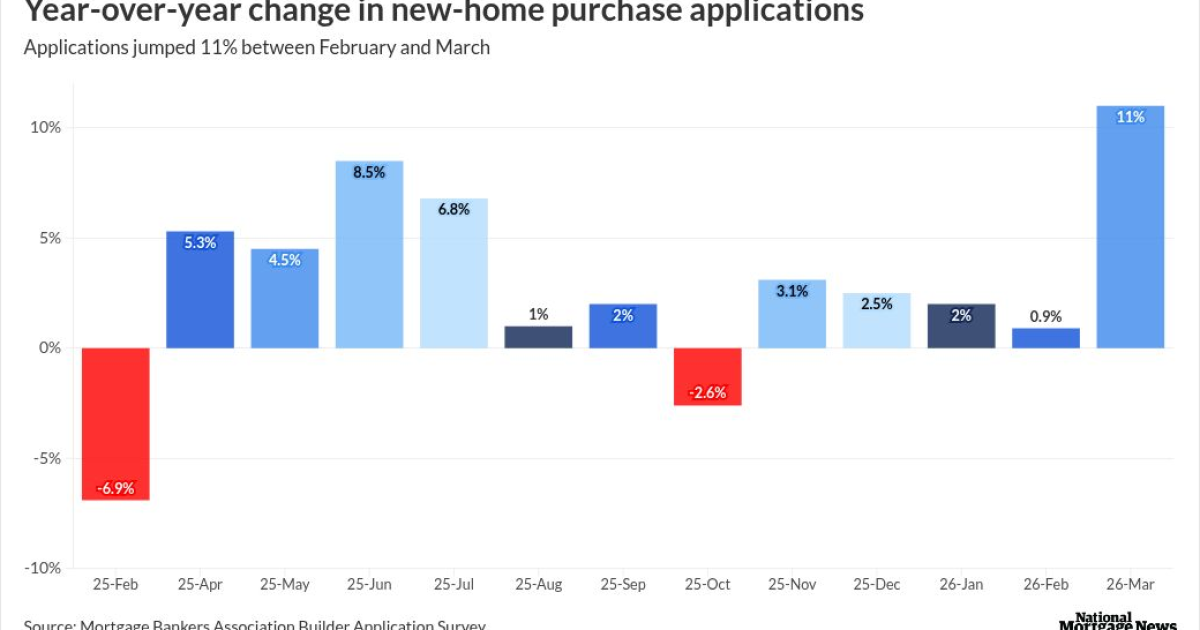
New-home purchase originations surged in March, waving off wartime macroeconomic concerns to set a record high, even as signs of a construction slowdown emerged.
Applications for newly purchased homes accelerated 11% year over year, according to the Mortgage Bankers Association's monthly builders survey. Compared to
Incoming applications sent MBA's builders index, which tracks activity at the lending subsidiaries of home construction firms, to its highest mark since inception in 2012.
"While the index is not adjusted for seasonality, March kicks off the start of spring homebuying season and does typically see an increase in purchase activity," said Joel Kan, the trade group's vice president and deputy chief economist, in a press release.
"This growth was supported by higher levels of unsold inventory in many markets across the country, some of which were move-in ready and were relatively more appealing to homebuyers who were eager to purchase a home," he added
The jump in volume led MBA to update its estimates for annual new single-family home sales to a seasonally adjusted 717,000 units, the most in four months. Totals jumped 11.9% from February's pace of 641,000 transactions.
Month over month, new-home sales volume leaped 21.1% to approximately 69,000 units in March from 57,000 in February.
Sales trended upward as the average loan size for new homes decreased in March to $381,938 from $383,570 a month earlier.
Government-backed borrowers drive sales
Buyers taking advantage of federal programs offered by the likes of the Federal Housing Administration for their purchases made up over half, or 50.9%, of last month's volume, with conventional borrowers taking the other 49.1%, according to the MBA.
"This was the third consecutive month that the government share of applications was more than 50%," Kan said. "While mortgage rates overall increased in March, rates on FHA mortgages did not increase as quickly as for conforming loans, which supported some of the shift to government loans, as affordability remains a focus for many homebuyers."
The share of government-backed loan activity came in at par to March 2025's level. More recent numbers reflect a noticeable increase from two years ago, though, when federally sponsored mortgage loans comprised just 37% of overall volume, with buyers today more likely to
Among the government mortgage programs, FHA-guaranteed applications made up a 36.3% share of total activity, while loans coming from the Department of Veterans Affairs accounted for 13.4%. Applications backed the U.S. Department of Agriculture's Rural Housing Service represented 1.2% of last month's volume.
Do permit numbers show a slowdown ahead?
While the March figures suggest a promising start to spring for home construction firms and lenders, a potentially more troubling sign shows up in newly issued permits, according to analysis from the National Association of Home Builders.
In January, builders saw the number of single-family permits drop 15.2% to 62,034 from 73,115 one year earlier. Texas, Florida and North Carolina led all states in the number of January permits issued.
With permit numbers providing a clue to future homebuilding activity, the sharp decrease could portend challenges for the industry, especially with current sales demand dictated by the supply of homes already on the market.
Factors weighing down permitting activity include higher borrowing costs and affordability constraints, NAHB researchers said.