
- Key insight: Another key policymaker has made the case that inflation has emerged as the central bank's primary concern as the war in Iran continues to drive up prices.
- Expert quote: "After five years of above-target inflation, I am particularly attuned to the risk that elevated inflation will become embedded in price- and wage-setting behavior. As such, I am prepared to raise rates, if the expected disinflation does not appear in a timely manner." — Federal Reserve Gov. Lisa Cook.
- Forward Look: Half the members of the Federal Open Market Committee have now publicly backed the idea of abandoning a perceived bias toward easing monetary policy, instead suggesting the committee should shift to a more neutral stance. Economic conditions will likely have to weaken dramatically before the central bank will approve another interest rate cut.
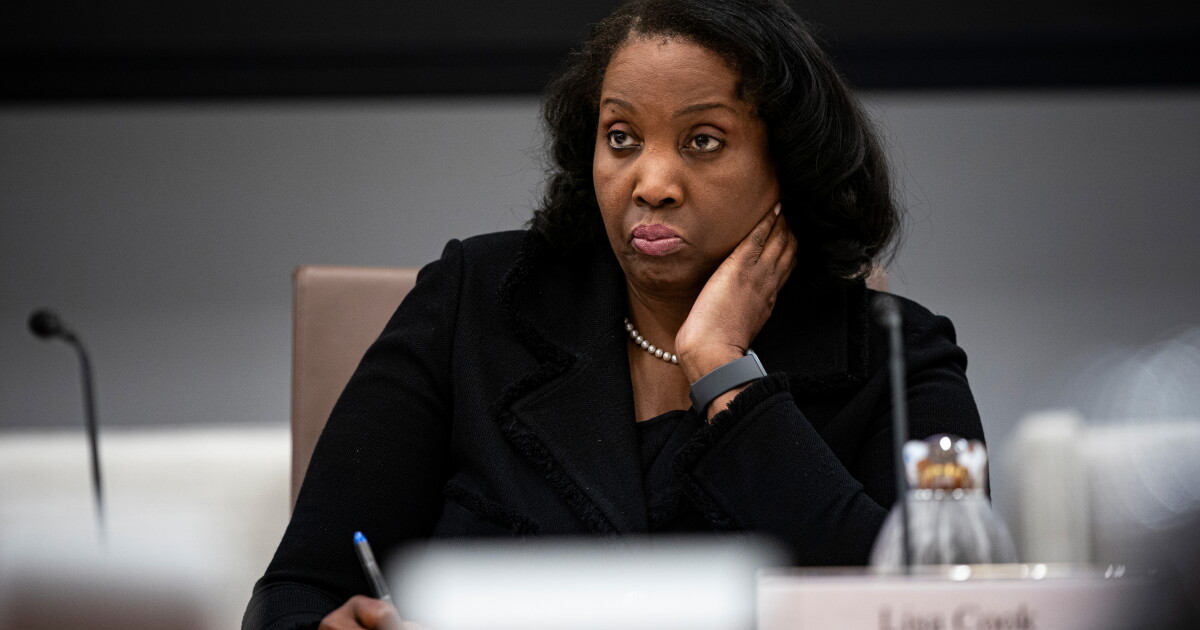
Federal Reserve Gov. Lisa Cook is the latest central bank official to take a hawkish view toward inflation.
In prepared remarks delivered Wednesday afternoon at Stanford University, Cook said the Fed should be prepared to raise interest rates if price growth remains elevated. She also echoed fears shared by other monetary policymakers that the public could be losing faith in the Fed's ability to return annualized inflation to 2%.
"After five years of above-target inflation, I am particularly attuned to the risk that elevated inflation will become embedded in price- and wage-setting behavior," Cook said. "As such, I am prepared to raise rates if the expected disinflation does not appear in a timely manner."
Cook also wants the Fed to be ready to lower interest rates if unemployment begins to rise, pointing to weak hiring figures and widespread economic uncertainty stemming from the U.S. war with Iran. Still, she said, the conflict's most pressing impact is its
"The risks remain tilted toward higher inflation," she said.
Overall, Cook said she favors keeping the federal funds rate unchanged and allowing the economic outlook to play out further before adjusting policy.
Cook joins several other members of the Federal Open Market Committee who have called for the body to adopt a neutral stance for its projected policy path.
Three reserve bank governors — Cleveland's Beth Hammack, Dallas' Lori Logan and Minneapolis' Neel Kashkari —
"I consider this language a form of forward guidance about the likely direction for monetary policy," Kashkari wrote
Since then,
Investment markets have largely matched this hawkish trend. On May 1, less than 10% of federal funds futures contracts reflected at least one interest rate hike by the end of the year, while 13% priced in one or more cuts, according to the Chicago Mercantile Exchange's FedWatch Tool. As of Tuesday, more than half had priced in at least one quarter-point hike, with some projecting as many as four. None forecasted a cut.
Impact of AI and employment
Despite the increased emphasis on inflation, Cook said the Fed should also watch developments in the labor market carefully. She said risks to employment are "elevated" because of the conflict in the Middle East as well as developments related to AI, both of which have likely dampened the demand for new workers.
"We could be approaching the most significant reorganization of work in generations," she said. "Even if, in the long run, new jobs are created, I am aware that the timing of costs and benefits of AI may differ. Specifically, AI-related job loss could precede job gains."
In her remarks, which were largely focused on the risks and opportunities of AI, Cook took an optimistic view of the emerging technology. She highlighted its ability to boost productivity and spur the creation of new businesses.
Cook noted that the AI boom was already having a meaningful impact on the economy via the massive investment into inputs and infrastructure — including $1.5 trillion of outlays for data centers alone. She said this boom is bolstering the growth in the country's gross domestic product but is also a potential driver of inflation.
"Prices have risen significantly for chips, other high-tech equipment, and software. Wages in specialty trades in construction have picked up notably. Electricity and water prices have each increased by about 5% over the past year," she said. "Further, in the coming years, firms may expand along the intensive margin, but they may also expand along the extensive margin and undertake new AI-related capital expenditure, such as in robotics."
Cook said if current investing and borrowing trends in the AI space continue, they could create a "financial stability concern," but noted that the level of indebtedness would be unlikely to reach the levels seen in the run-up to the subprime mortgage crisis.
"Even under very ambitious investment and debt-issuance projections, we would be unlikely to return to peak leverage levels observed before the Global Financial Crisis," she said.