Banks are re-entering the second-lien securitization market as rates keep rising, and that means nondepositories in the space will need to manage expenses and further diversify if they want to compete.
While nonbanks have helped rebuild a growing market for home equity line of credit products that banks had withdrawn from, that trend is reversing, according to a recent KBRA outlook report.
"Nonbank originators
Banks' renewed interest has created some opportunities for the two types of players to work together while also compounding challenges around the lack of efficiencies of scale in a market with small loan sizes.
"Banks and brokers are going to take market share from independent mortgage banks. I think they have to lower their costs," said Bill Dallas, chairman of strategic advisory firm Dallas Capital. "They have to develop more modern platforms."
Current market conditions
The growing securitized market for second liens is attractive to banks because it gives them a capital-efficient entry way to tap established investor demand, and it may be more compelling in some circumstances going forward if the Basel III proposal gets finalized in its current form.
Large players like Citigroup and JPMorgan Chase have been sponsors for securitizations of home equity lines of credit, while smaller depositories like HomeTrust Bank contribute HELOCs to these deals, a growing sub-market.
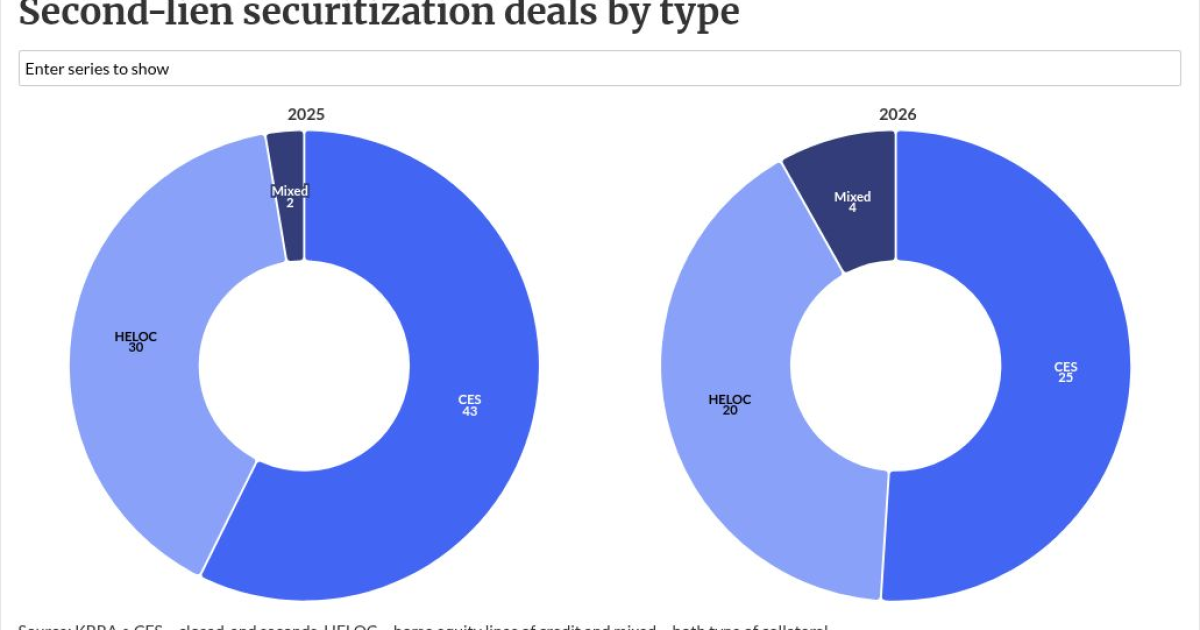
While closed-end seconds have continued to dominate deals with 25 done so far this year, there also have been 20 HELOC transactions and 4 securitizations that mix the products, according to KBRA. In 2025, there were 43, 30 and 2, of each of these types of deals, respectively.
Citi has aggregated both first- and second-lien HELOCs for securitization including production from HomeTrust and United Wholesale Mortgage's broker channel, according to Morningstar DBRS. Fay was listed as the servicer for the deal.
JPMorgan Chase aggregated mixed and temporarily frozen HELOCs that had first or subordinate liens on single-family properties in a deal with Shellpoint and LoanDepot as servicers, according to Fitch Ratings. Contributing lenders included UWM and Better.
Risks for banks to weigh
How much bank competition nonbanks face in HELOC securitization depends in part on how much appetite they have for nonprime, which KBRA defines as loans where the weighted average FICO credit score is below 720, or the full-documentation share is less than 75%.
KBRA reported that the HELOC index it uses to track arrears has a "predominantly nonprime composition" and shows there is elevated risk in lines of credit in that category, with a 3.9% 30-day-plus delinquency rate compared with 2.6% for the equivalent prime product.
Banks also should consider how a potential shift in the final version of the capital rules might affect them in the future.
The current proposal would make it more attractive for banks to get second liens off their books when they hold the primary mortgage because the subordinate debt is only additive to loan-to-value differentiators when it remains in the institution's portfolio. (Banks have traditionally been more active originating HELOCs for portfolio.)
Rulemakers may revise this rule because second liens that exist simultaneously with primary mortgages can add to a bank's loan performance risk regardless of whether they are held in portfolio or not, said Robert Kazdin, former director of mortgage credit pricing at Fannie Mae.
"By failing to recognize the additional leverage created when the second lien is held by another institution, the banking system becomes undercapitalized relative to actual credit risk," said Kazdin.
Kazdin has suggested that this could be done with