

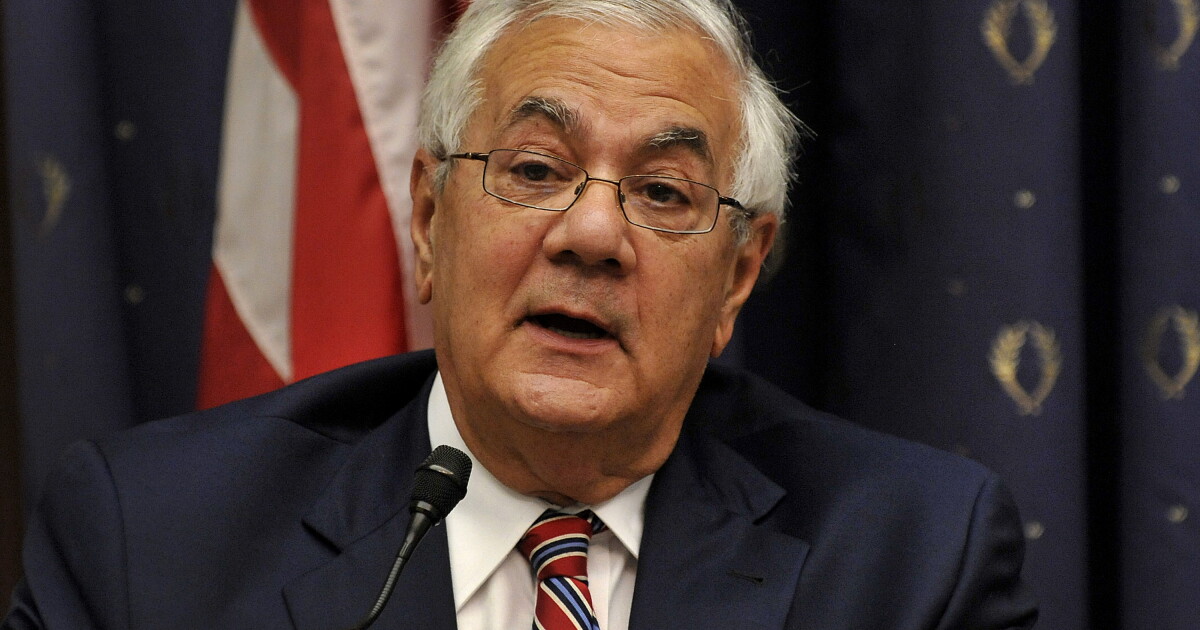
WASHINGTON — Barney Frank, the former longtime Democratic congressman from Massachusetts who helped usher in the most consequential financial reform since the Great Depression, has died. He was 86.
Frank's legendary career on Capitol Hill, representing large parts of the Boston suburbs for 32 years before
He's remembered on Capitol Hill for being a progressive champion and gay rights icon, fierce when he believed he needed to be, with a sharp wit and a staunch advocate for economic and social fairness. He was also skilled at working across the aisle and with bankers, which he did repeatedly in the thick of the financial crisis, including with former Rep. Mike Oxley and former Treasury Secretary Henry Paulson.
Frank was first elected to Congress in 1980, but rose to national prominence during the 2008 financial crisis when he served as chairman of the House Financial Services Committee and, along with Senate Banking Committee Chair Chris Dodd, D-Conn., ushered through the financial reform legislation that bears their names.
His legislation, the Dodd-Frank Act, still shapes the financial industry, applying capital buffers to the largest financial institutions, creating the Consumer Financial Protection Bureau and the Financial Stability Oversight Council, all with enormous, wide-reaching powers designed to avoid another housing or financial crisis.
Alongside then-Speaker of the House Nancy Pelosi, Frank was also critical to writing and passing the $700 billion Troubled Asset Relief Program, which helped bail out the largest financial institutions during the crisis. His work on TARP drew criticism from his own constituency — the progressive wing of the Democratic party — but ultimately played a key role in stabilizing the economy in the aftermath of the banking crisis.
Barney Frank was born in the largely working-class town of Bayonne, New Jersey, in 1940, one of four children. He graduated from Bayonne High School and later Harvard College in 1962. Two years later, he worked as a volunteer in Mississippi in 1964 during the Freedom Summer. The Civil Rights Movement of the '50s and '60s had a profound effect on him.
"I was outraged by racism, outraged about the interference with free speech. I feel strongly about ending discrimination and people being free to express themselves," he told American Banker in
Despite his convictions on social justice, he assumed that being gay and Jewish would preclude him becoming an elected official. He went to work in the office of Boston Mayor Kevin White, and later worked for Congressman Michael Harrington, D-Mass., in the 1970s. He studied under Henry Kissinger while getting a degree from Harvard Law School. He was later a Massachusetts state representative.
Frank was a sharp, fast-talking and driven closeted gay man who seemed to enjoy sharp debates and was passionate about defending his causes. During his time in the Massachusetts state House, he defended Boston's "Combat Zone," a high crime red-light district.
In 1987, after his election to the U.S. House of Representatives, he came out as gay, the first openly gay member of Congress. And he was progressive in a way that can be heard today in the rhetoric of politicians such as Bernie Sanders, Alexandria Ocasio-Cortez and Zohran Mamdani.
"I think there's a lot of very rich people out there whom we can tax at a point down the road and recover some of this money," Frank said in a
Frank made his name during that crisis, but it was his persona that perhaps served him best. He described his approach as unusual but effective.
"I'm not a great candidate," Frank told American Banker in his 2012 interview. "I'm a better inside politician than outside politician."
"I'm unconventional," he continued. "I'm gay, I'm Jewish, my diction is imperfect, I have a slight lisp. I grew up in an area with a very pronounced regional speech pattern and moved to an area with another one so I have an amalgam of Northern New Jersey-Massachusetts."
Even though he frequently clashed with the banking industry, he won the respect of many of the bankers he tried to reign in.
"The guy you see on TV is the same guy," JPMorganChase CEO Jamie Dimon told American Banker in 2012. "He's direct, thoughtful, responsive. He's tough. … He means what he says and he says what he means. It's a great virtue because you know when he says something he actually believes it."