The Trump administration's interest in regulatory capital reform could extend to the government-sponsored enterprises in ways that could build value for a new offering of shares, one investor says.
"The regulatory capital framework that the ERCF was aligned with is already on its way to being reduced. If these requirements are being reduced, it doesn't make sense to leave the ERCF," Bradford wrote in
His report predicts a quicker revival of moves toward the first post-conservatorship offering of Fannie Mae and Freddie Mac's stock than some others, which foresee the Federal Housing Finance Agency as likely to keep plans for one on hold
"The administration can deliver a significant housing policy win before the midterms of increasing the affordability of mortgage credit by having FHFA propose an update to its ERCF," Bradford wrote.
The FHFA, which serves as Fannie and Freddie's oversight agency, had not immediately responded to a question about whether it might revamp the enterprises' regulatory capital framework at the time of this writing.
Where capital stands and may be headed
Although Fannie and Freddie were forced into government conservatorship in 2008 by the Great Financial Crisis' housing crash, more recently they've had a long run of
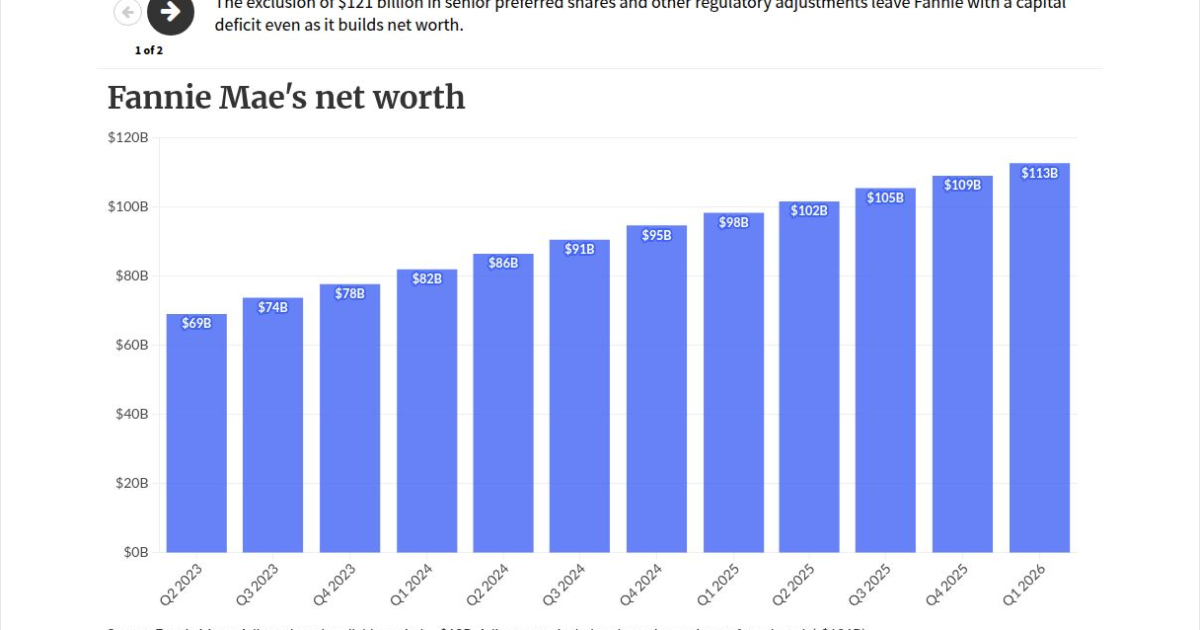
"Since January 2020, we have increased our net worth by $99 billion, including $52 billion since we began reporting our capital position under the enterprise regulatory capital framework for the fourth quarter of 2022," Fannie Mae CFO Chryssa Halley said in a recent earnings call.
However, the enterprises are still running a capital deficit under the current framework, largely because the government's senior preferred shares aren't counted toward regulatory capital. The ERCF also makes other adjustments.
Fannie's net worth was $113 billion in the first quarter, but its regulatory capital excludes $121 billion in senior preferred shares. Its adjusted total available capital was -$18 billion in the first quarter. Freddie's net worth is $70 billion but its regulatory capital excludes $73 billion in senior preferred shares. Its adjusted total regulatory capital was -$18 billion in the first quarter.
Analysts, investors and other pundits have varying views on how long it will take to rebuild capital, with many suggesting it could take several years.
However,
Also Rep. Scott Fitzgerald, R. Wisconsin, has introduced
Bradford notes that this bill, which also calls for "a determination with respect to necessary capital standards for each enterprise to exit conservatorship" within 90 days of enactments suggests policymakers "can move fast."
All this could mean what some refer to as "initial public offering" for a portion of the GSEs' shares, which currently trade in the pink sheets, could occur a lot faster than other analysts have estimated, according to Bradford.
"It looks like it may take anywhere from a few months to 2.5 years to IPO, where junior preferreds get made whole in that transaction. With warrant expiration a few months before the end of the Trump administration and the companies hitting pro forma statutory 2.5% capital requirements by then, they'll at least have a consent decree," he said.