

- Key Insight: Uncover how traditional banks dominated JD Power's latest mortgage origination satisfaction rankings.
- What's at Stake: Nonbank lenders fighting to retain market share against banks with pre-existing customer relationships.Overview bullets generated by AI with editorial review.
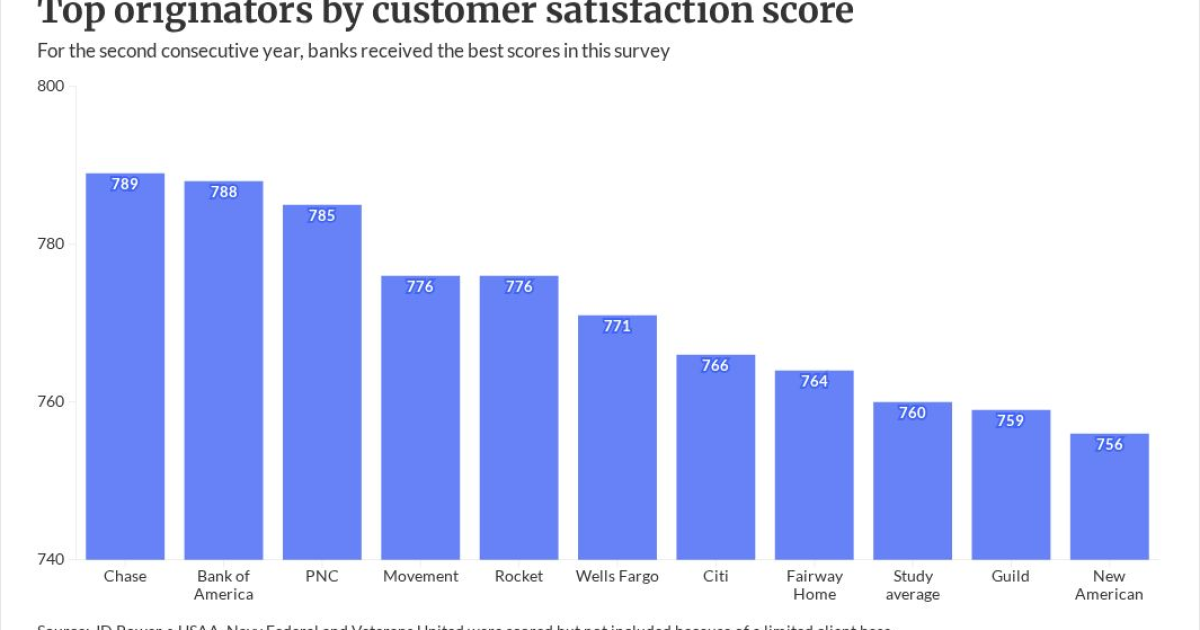
For the second consecutive year, banks occupied the top slots on JD Power's Mortgage Origination Satisfaction Study, benefitting from the importance of digital experiences to borrowers.The results reinforce findings in
A big part of the findings then was the banks had the advantage because of multiple product relationships.
This is the case in the originator survey as well, said Bruce Gehrke, senior director of wealth and lending intelligence at JD Power.
Customers looking for the trust factor
"Digital is such a big part of the experience now, but it's also relationship based," Gehrke said. This creates a trust component with the banks.
"I open up a checking and savings account or other accounts with a financial institution," he continued. "It takes a certain level of trust to do that, and it's not as big of a jump then to go for a loan as it would be to a completely unknown lender."
This comes out in the data JD Power has for younger borrowers. But across the board some respondents consider it riskier to go to someone new for a mortgage.
Originators that scored best in this year's survey
Chase was the top scorer this year, at 789; It is a gain of 18 points over last year's 771. It was the top scorer in
Bank of America remained No. 2, but its score fell to 788 from 792. The bank rounding out the three was PNC, at 785, a significant jump from 721 one year ago, when it was third from the bottom.
Tied for fourth at 776 were nonbanks Movement Mortgage and Rocket. Movement's score was unchanged from last year, where it was the top scoring independent mortgage bankers.
Rocket's score increased from 762 one year ago.
Citi, the only originator with a score over 800 last year at 802, was at 766 this year.
This year's Originator Satisfaction survey returned an industry average of 760,
What changed from the 2025 results
"I expected it to fall back a little, given the extra challenges we've seen this year, just financially certainly in the housing industry, and after such a large gain last year, where the majority of almost every lender was up and some really significantly," Gehrke said.
The survey noted some of the friction is coming out of the process.
For example, documents are now being sent directly to the lender from the source, rather than having to be emailed or copied.
The process improvement is likely a result of the lower volume, leaving lenders with more capacity to deal with such things.
"Some of the satisfaction indexes that we see in this study are higher than any other financial study that we have out there right now," said Gehrke. "So of all things in this environment, the mortgage origination process is really delivering."
Furthermore, the business remains highly competitive and "competition drives improvement," he said.
Which areas still can improve
Still, a few negatives abound in the data.
In particular, Power found 58% of those taking this year's survey said they received a same-day response for their lender, down 4 percentage points from 2025.
While still at a relatively healthy 88%, the share who said they had a main point of contact for their mortgage fell from 91%.
A larger share of borrowers experienced a problem after their loan was approved or when they went to closing.But what might give banks an advantage over nonbanks is those who had other financial products with the lender they applied to are more likely to trust that entity. This was to the point where they considered them a trusted advisor.
When it comes to a digital experience, two-thirds of Gen Y and Gen Z mortgage borrowers preferred self-service tools for getting a loan; but almost half of the cohort added they wished their representative had been more involved.
Gehrke pointed to other studies which show Chime opening more new checking accounts than the traditional banks, showing younger generations aren't necessarily tied to a relationship with those institutions that older demographics are.
Yet the results also show that while they want better digital interactions, they also are looking for someone to be available to guide them if needed.
Power added these borrowers are also significantly more likely to shop around, to the point where they
In the overall business environment, banks have multiple business streams and this diversification puts them in a better position. But at the same time, Gehrke said they are not as willing to commit to residential real estate finance as much as an independent mortgage banker where it is the company's primary or only business line.
But, he reiterated, competition drives better experiences for everybody and the data shows it bumping down the negatives in the housing industry right now.
How certain other lenders scored this year
Meanwhile, three lenders whose target market is veterans received scores but were not eligible to be ranked because they do not meet Power's criteria.
USAA scored 823 and Navy Federal was at 795, topping Chase, while Veterans United at 787 would have been behind B of A.
At the other end of the spectrum, Pennymac scored the lowest of the 17 originators listed this year, at 696; it was not ranked in 2025.
Freedom Mortgage, also not ranked last year, scored 706, while loanDepot received a 710 score, down from 722.
Mr. Cooper, last year's lowest scorer on the list of 25 originators at 697,