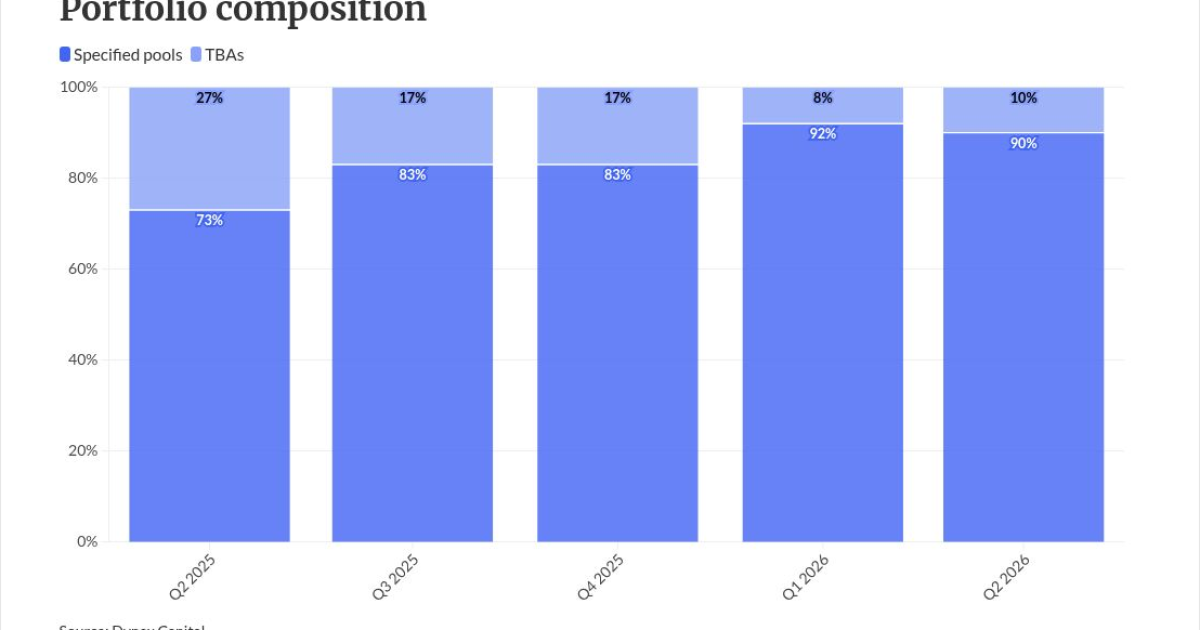
Dynex Capital has been increasingly investing in specified pools as part of a strategy that drove consensus-beating earnings to common shareholders in the second quarter, highlighting some broader trends related to prepayment protection.
The real-estate investment trust generated $178.4 million in net income to common shares during the period, beating the S&P Capital IQ consensus mean of $65.8 million and a loss the previous quarter that stemmed from one-time personnel costs. Earnings available for distribution, a key metric for REIT investors, also beat consensus at 36 cents per share as compared to 34 cents.
In response to questions about how the company has positioned itself in the current market as it has grown its total investment portfolio by 11%, Dynex executives it has been investing in spec pools of loan types historically resistant to refinancing pressures.
Specified pool dynamics
Dynex executives faced some questions about how and why they invested in prepayment-resistant pools typically sold at a premium relative to the more mainstream to-be-announced market at a time when rates are relatively high and housing turnover is low.
"I'm not sure the calculus is quite as simple as thinking about, 'oh, where will this pay-up be relative to TBA?' It's a very deep market," Chief Investment Officer T.J. Connelly said in response to analysts' questions during the company's earnings call.
Investors closely analyze individual differences in pools to distinguish their strategies and prepayment-protection may have more relevance in the future, Connelly said.
Also, while rates have been elevated recently, Connelly noted that Dynex seeks to be "prepared for all scenarios that are out there," including an eventual uptick in turnover that current demographics suggest will occur.
When asked in particular about a scenario in which
The executives additionally said that for the time being, risks around policy uncertainties that can impact rates look manageable, and even if new volatility does emerge, they forecast the market will keep bouncing back quickly as it has recently.
"The conditions for us to execute on growing the company, building resilience and scale, are very favorable," said Smriti Popenoe, co-CEO and president.
Analysts' outlook
While most of the company's earnings metrics beat consensus in the second quarter, book value of $12.90 came in below expectations that it would reach $13.14. It did, however, top the first quarter's $12.60 and that reported by some of its competitors to date.
"Though Dynex's book value performance was below our 2Q estimate, it is better than agency mREIT peers that have given book value already," Douglas Harter and Will Nasta, equity
Dynex's shares fell 1.2% initially on the trading day but had plateaued at the time of this writing Friday afternoon at levels around $13.17, in line with some equity researchers' expectations.
"With the shares at 1.03x reported book value, we would expect a fairly neutral reaction," Bose George and Frankie Labetti, analysts at Keefe, Bruyette & Woods, said in a research note.