

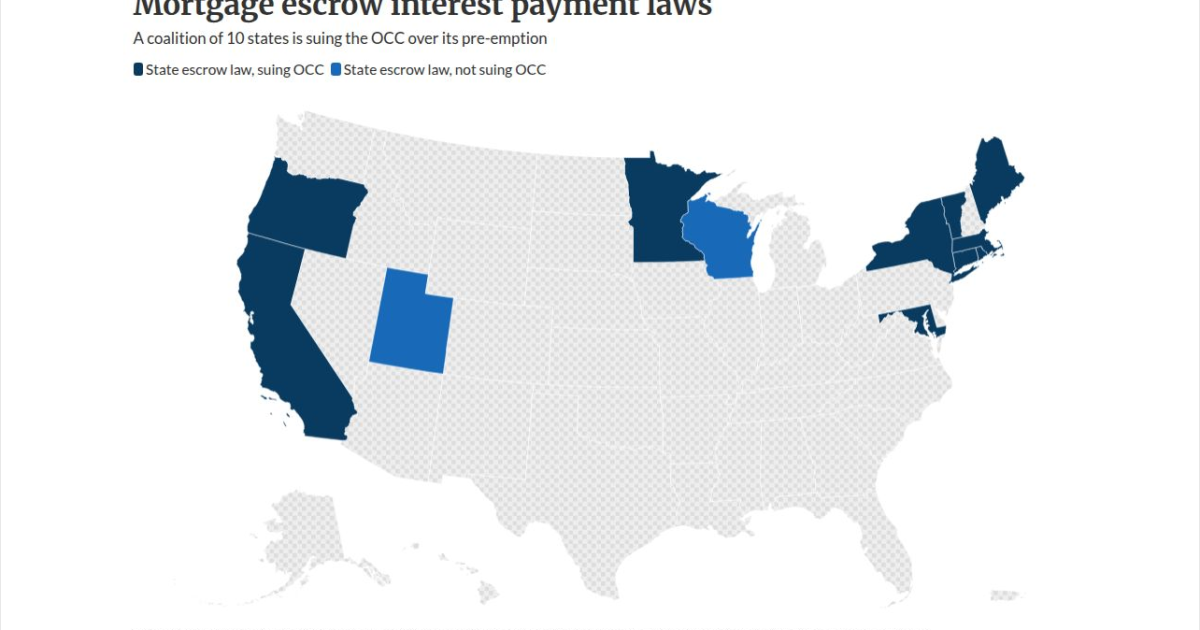
A group of state attorneys general, led by Oregon and New York, are suing the Office of the Comptroller of the Currency over its rule quashing laws requiring banks to pay interest on mortgage escrow accounts.
The suit was filed in the U.S. District Court in Oregon, seeking to prevent OCC from implementing its rules.
"Time and again, we've seen the Trump Administration hand out favors to insiders and corporate special interests at the expense of Oregonians," said Dan Rayfield, its attorney general, in a press release. "This is a case in point: The Administration wants to let big banks pad their profits with money that, by law, belongs to Oregon families."
The states have support from the Conference of State Bank Supervisors, who earlier this year
"This litigation is necessary to stop the OCC's brazen disregard for the letter and spirit of the National Bank Act and decades of judicial precedent," a statement from CSBS President and CEO Brandon Milhorn, said. "If allowed to stand, the OCC's rules would eviscerate any meaningful obligation of national banks to comply with state consumer financial laws."
The lawsuit also received support from the Americans for Financial Reform Education Fund, which said states have authority to put in place a wide range of consumer financial protection laws and limits exist on federal regulators ability to override them.
"This lawsuit protects borrowers rights on escrow funds and is a vitally important step towards preserving those laws," said Tom Feltner, associate director of consumer policy for the organization in a press release. "It will also block the OCC from granting blanket immunity from other commonsense protections, and pushing back against continued consolidation of Wall Street corporate power."
Those laws were upended in May when the OCC finalized a pair of rules which halted the practice, saying the National Banking Act applies in these cases.
What the OCC reacted to was industry dismay following the U.S. Supreme Court ruling in
But while it did not hear a similar case from the Ninth Circuit involving Flagstar, that court ruled California law must be complied with, which created a split in the circuits.
When it issued its decision in May 2024, the High Court
A split Second Circuit in the
Besides Oregon and New York, the other states in the filing are California, Connecticut, Maine, Maryland, Massachusetts, Minnesota, Rhode Island and Vermont. Not involved in this case, but with their own laws affected by the OCC rule are Utah and Wisconsin, along with Guam and the U.S. Virgin Islands.
Of the states on the list, Oregon and California are covered by the Ninth Circuit. New York, Connecticut and Vermont make up the Second Circuit.
The First Circuit, last September,
"Big banks and mortgage lenders should not be able to force homeowners to lock away significant amounts of money without paying interest," New York Attorney General Letitia James, a Trump Administration target, said in her own press release. "For decades, New York has prevented lenders from taking advantage of homeowners, and my office is taking action to defend our laws."
The suit argues that Dodd-Frank places strict limits on the OCC's ability to pre-empt state consumer protection laws, specifically only if it "substantially interferes" with a national bank's power. The states argue paying interest on mortgage escrow accounts does not meet this test.
"Homeownership is out of reach for too many families already and the last thing they need is another rule that helps big banks profit off their hard-earned money," William Tong, Connecticut's attorney general, said in a press release. "This new rule will put banks first, families last, and strip states of yet another tool put in place to help consumers."
National Mortgage News reached out to the OCC and the American Bankers Association for comment but has not received a response.