Even as the regulator for Fannie Mae and Freddie Mac floats new product ideas, the enterprises' overall footprint has stayed fairly steady. Still, some experts think more shifts could be ahead as they move closer to a public offering.
As is the case with many aspects of their business, a balance will need to be struck as Fannie and Freddie become more answerable to shareholders, the planning process for which is now "well down the road," Commerce Secretary Howard Lutnick told CNBC Wednesday.
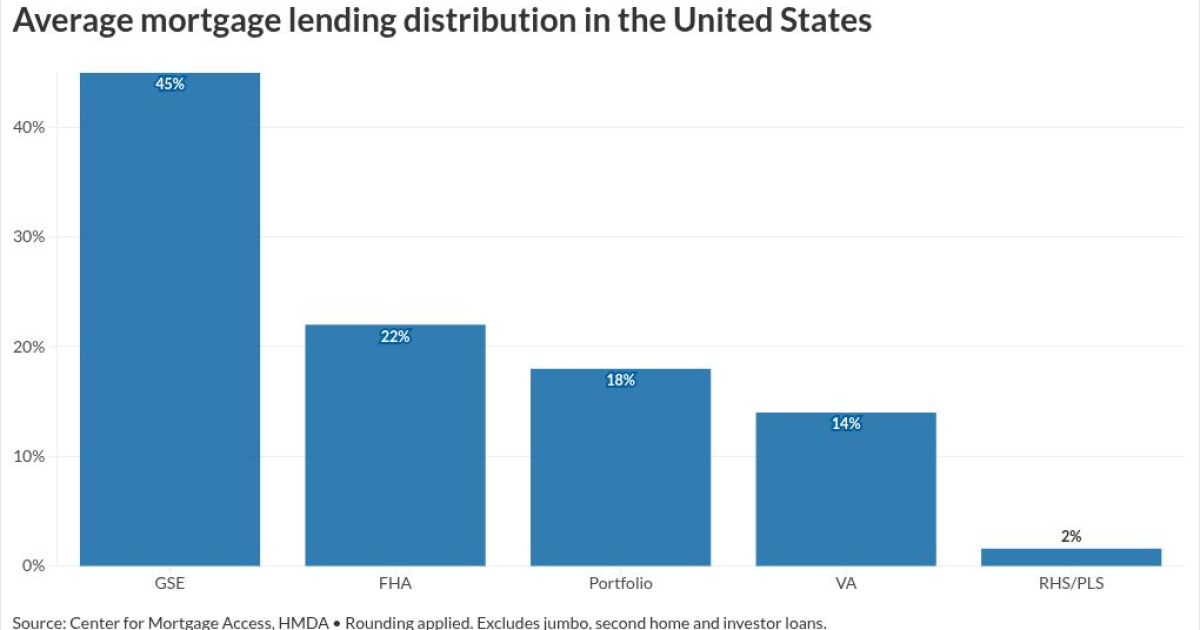
As they pursue a stock offering, the GSEs that back nearly half of core affordable U.S. housing loans for may need to pay closer attention to profitability, balancing that with goals such as avoiding pressure on the private market, managing risk and keeping housing costs within reach.
In light of that, the enterprises may consider increasing the number of more profitable loans. Their
Considerations related to whether to cede share to FHA
Although there are
So from a business perspective, the enterprises could give up some competition with an FHA sector more prone to delinquency risk and remain profitable, while still ensuring homeowners the latter serves have some government-related support.
However, reducing Fannie and Freddie's competition with the FHA could impact affordability and the amount borrowers pay in insurance premiums over time in some circumstances, which could be contrary to another one of their stated aims.
"FHA loans can be more costly," Scott Susin, founder of the center and a former senior economist for the Federal Housing Finance Agency, said during a press conference about his research last month.
Rumors of renewed interest in second home and investor loans
In terms of what types of mortgages the GSEs might lean more into to spur profitability, some said they've heard rumblings that the enterprises are considering greater involvement in lending outside of the owner-occupied market for homes borrowers use as their primary residences.
With growth in the private non-qualified mortgage market outpacing that of the GSEs' more mainstream business and the importance of their profitability growing, some think the enterprises could move back into some loan segments they previously backed away from when they were more focused on their public mission as conservatorship entities.
"At some point they can't give up the 'good' business that subsidizes the 'bad' business, which is going to be a real challenge for them. They're going to have to figure out whether they tightened too much on something like investor lending, which is a high-profit business," said Jonathan Lawless, head of homeownership at Bilt Rewards and a former vice president at Fannie.
Fannie and Freddie have essentially priced themselves out of the second, second home and investment property business, but it is within the scope of the loans they're authorized to make, said Larry Goldstone, president of capital markets and lending at BSI Financial Services.
"They're not prohibited from doing those loans, but the pricing is not very competitive. That's a business, I suspect, that Fannie and Freddie would like to have back, if they could," he said.
Lower-rate financing for the second-home market could benefit affordability buyers who save up over their lifetimes to purchase vacation houses and both that and owning investment properties helps them build wealth, said Kimber White, president of the National Association of Mortgage Brokers.
"Those are things that would give them equity and make them able to invest back into communities, and those are the types of things that are not happening," he said.
The GSEs might hesitate to make aggressive changes to pricing for these loans as they balance the need for profitability with the need for stability, but the topic is one of the many that's come up as their oversight agency has asked for feedback on many plans for them, White said.
"I don't think they'll make a lot of changes. There were discussions. Was this one of the reasons? I don't know. Maybe there'll be more discussion now over it," he said.
Possible expanded involvement with construction loans
President Trump and the current director of the rebranded FHFA, Bill Pulte, have shown interest in having
Speculation around how the GSEs could do more to help fund construction loans for new homes has arisen in response.
Lawless is aligned with others who have suggested Fannie could bring back a construction-to-permanent loan product that can immediately be securitized, similar to one the Rural Housing Service has. He also suggested the enterprises could look at second lien construction loans for accessory dwelling units.
He additionally recommends in a recent report that Fannie and Freddie add an option where the lender would not be responsible for the construction risk by having the GSEs manage a list or lists of pre-approved builders and leveraging technology to manage them.
"We all understand construction and renovation are imperfect processes. The question is how do we manage that risk? Putting the burden on lenders seems inefficient to me." Lawless said.
Both an immediately securitizable single-close loan and second-lien construction loans for ADUs could encourage home affordability, Lawless said.
Involvement in these markets wouldn't necessarily be long term and there is some historical precedent for that, which could address concerns about crowding out private capital.
"The GSEs have always been this tool to step in in the time of emergency and then leave. We have a real crisis in construction lending now and they should step in. When the crisis is over they could leave," Lawless said.
Where other product expansions that have been floated stand
Pulte has run a few other loan innovations up the flagpole that have gotten a mixed reception on the whole.
One of the best known is a GSE version of a
Some critics have cited research from sources
"That's what a lot of people are missing," said Phil Crescenzo, branch manager at Nation One Mortgage Corp. "There is a lot of interest that it can accrue and all that, but it does seem like that there's some upsides. As the payment could be smaller, maybe you would get somebody into a home with it."
White said he would be cautious about a 50-year mortgage's impact on the balance between buyers and sellers and make sure there was no other option that might lower the payment enough, such as a hybrid loan that could offer a lower starting rate if it was appropriate.
"If you're doing a 50, isn't it also going to increase demand in a market that is already tight in some areas?" White said.
Pulte also has considered allowing a version of the FHA's
An idea that's been floated for portable mortgages, a concept more often found in other countries where it's typically used to refer to a loan that can move to a new property, could be even more of a challenge, Crescenzo said.
"A mortgage is secured by the property. A lot of the terms are set based on that. So how can you take the same parameters and apply it to another home?" He asked, noting that the GSEs would have to solve for this in order to move the idea forward.
Pulte's interest in expanding manufactured housing financing also brings back a perennial question: whether he might rethink the idea of letting the GSEs move beyond small pilots for chattel loans, which aren't secured by real estate and come with a lower price point. This also is an area the FHA has been more involved in than Fannie or Freddie, but even that fully government-backed agency has had limited involvement with those loans.
"A lot of manufactured housing loans are chattel," Susin said. "That's a big issue in some parts of the country."