Mortgage rates enter the Memorial Day weekend at levels not seen since last Labor Day with the bond market in a tizzy this past week.
News over inflation and the Iran conflict influenced investors and as a result, the 10-year Treasury reached its highest point in 52 weeks.
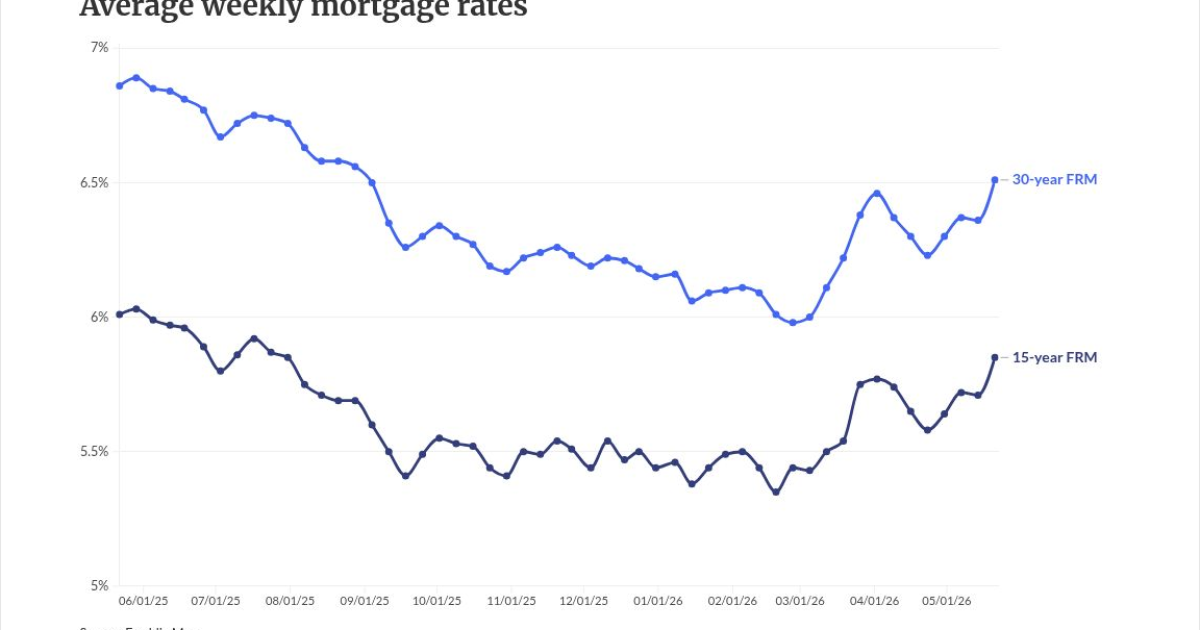
For the week of May 21, the 30-year fixed rate mortgage averaged 6.51%,
But there was a small bit of good news: this was 35 basis points lower than the 6.86% average for
Meanwhile, the 15-year FRM rose 14 basis points week-to-week, to an average of 5.85%. A year ago, it was 16 basis points higher at 6.01%.
The week of Sept. 4, 2025, just after Labor Day,
What happened in the Treasury market
The 10-year Treasury yield stopped just shy of 4.6% last Friday, but burst through this ceiling on Monday. At one point on Tuesday, it was close to 4.69%, but on the following day backed off a bit to 4.57%.
The good news was short-lived. The on-going geopolitical situation with Iran pushed the 10-year back up to 4.62% as of 11 a.m. today, 16 basis points higher than its end of day price last Thursday.
The last time the 10-year was over 4.6% was on May 22, 2025.
The past week was tough in the bond market on multiple levels, added Kate Wood, lending expert at NerdWallet, in a Thursday morning statement.
"One, we've gone from inflation fears to data that
Finally, U.S. government debt does not carry the same clout in the investor market it used to have, as traders are demanding higher yields and mortgage rates are following along, Wood stated.
What other rate trackers are showing
Data on the Optimal Blue website for May 20 showed an inversion between conforming and jumbo rates at 6.579% and 6.545% respectively. The day before, they were at 6.631% and 6.638%.
On May 14, Optimal Blue had the 30-year conforming at 6.381%.
The Mortgage Bankers Association's Weekly Application Survey, which covers the period ended May 15, found
"Higher Treasury yields continued to push mortgage rates higher last week, weighing on affordability and overall application activity," MBA President and CEO Bob Broeksmit said in a Thursday morning statement. "An increase in applications for adjustable-rate mortgages to the highest level since October 2025 signals that prospective buyers are seeking lower monthly payments as rates remain elevated."
What will happen at the Fed?
Following the release of inflation data last week, Melissa Cohn, regional vice president of William Raveis Mortgage, noted it is becoming more likely the next move out of the Federal Open Market Committee is to be a hike in short-term rates.
While it doesn't directly affect mortgage rates, it is a sign of pessimism that is being seen in the long-term bond market.
"The
The MBA's economists announced at the recent Secondary and Capital Markets Conference
The most recent Wolters Kluwer Blue Chip Economic Indicators report found 73% of its panelists think the next Fed action will come later than the September meeting.
For
Selma Hepp, chief economist at Cotality, in a recent meeting with the National Mortgage News staff, said the Fed is likely to sit still for a while. She also does not foresee an increase now since Kevin Warsh has been installed as chair, because how this could play out with his "indirect boss," Pres. Trump.
In the near-term, Cohn is not seeing good news for the mortgage market.
"As long as oil prices remain elevated, mortgage rates will be as well," she said. "With no end in sight to the war, higher rates are here to stay for the foreseeable future."