
The tortuous, but ultimately successful, path to passage of the recent housing bill brought with it a noticeable slowdown in build-to-rent construction this year.
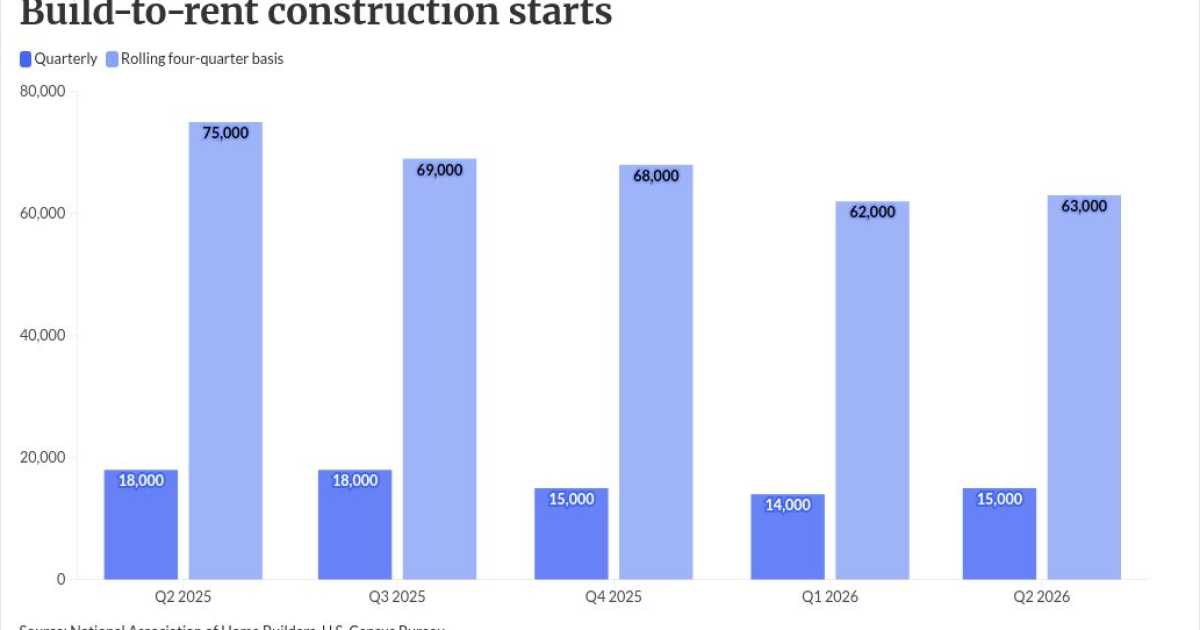
The latest number improved from first-quarter's 14,000 starts but represented a continuation of the pullback in year-over-year volume seen at the beginning of 2026, as various iterations of a federal housing proposal left builders questioning the future business prospects of BTR construction.
"Fortunately, changes by the House of Representatives addressed a harmful Senate proposal," wrote NAHB Chief Economist Robert Dietz.
An earlier Senate revision of the
Restrictions on institutional purchases received the backing of President Trump, who has issued statements
With the new housing legislation now official policy, the construction market should see BTR starts recover in the near future, Dietz noted.
"The housing legislation, as enacted into law, does not include a prohibition against institutional capital financing BTR housing. Stabilization for BTR housing should be reached in the coming months," he said.
BTR now takes a 7% share of the market
Along with the uncertainty coming from Congressional circles, BTR development also slowed in the second quarter due to higher financing costs and increased competition from the multifamily sector, NAHB said.
The effects of dampened enthusiasm among builders was apparent in the reported start volumes over the past 12 months. Construction began on approximately 63,000 build-to-rent homes from mid-2025 to mid-2026 on a rolling four-quarter basis. Compared to the same corresponding period a year ago, volume decreased from an estimated 75,000 starts.
BTR homes account for just under 7% of the housing market, although numbers include only properties specifically developed and held for rental purposes by builders. New homes sold to third parties with the intent to turn their purchases into rental properties may represent as much as an additional 5% of starts, according to NAHB estimates.
Despite their relatively small portion of the market, the 7% number today represents a larger slice of housing inventory compared to the pre-Great Recession era between 1992 and 2012, when BTR units accounted for 2.7%.
With affordability still an obstacle for potential home buyers, BTR is likely to maintain its current market share, Dietz wrote. Construction growth, though, is likely to be sluggish given lingering housing market and policy pressure.