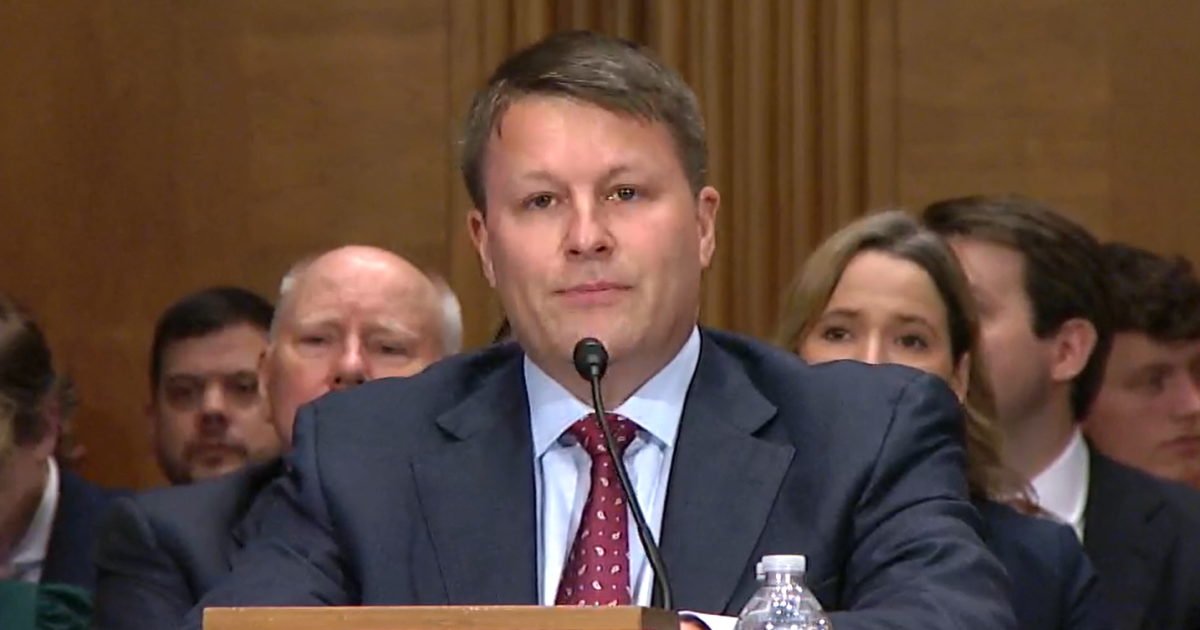
- Key insight: Johnson, the former No. 2 at the CFPB in the first Trump administration, dodged direct questions about whether he would pursue drastic staff cuts as his acting predecessor has. What's at stake: He claimed that he keeps an "open mind" about staffing levels and deflected questions from Sen. Elizabeth Warren, D-Mass., about allegedly blatant pay-to-play schemes in which the bureau dropped 42 major enforcement cases against presidential donors.
- Forward look: "I have an open mind about staffing levels for offices, and my understanding of the state of litigation is that I'll have the opportunity to make those judgments." —Brian Johnson, CFPB director-desigate
Brian Johnson, President Trump's nominee to lead the Consumer Financial Protection Bureau, managed to evade questions from Democratic senators during his confirmation hearing Thursday morning, but nonetheless said he would keep an "open mind" about job cuts at the beleaguered agency.
At a Senate Banking Committee
Sen. Elizabeth Warren, D-Mass., the ranking member of the committee and original architect of the CFPB, raised questions about Johnson's current employer, Capital One Financial, pointing out that the CFPB dropped a major lawsuit against Capital One shortly after the credit card issuer gave a $1 million campaign donation to the president's inauguration. Johnson recently signed an ethics pledge to recuse himself for two years from matters involving Capital One.
Warren noted that the CFPB has dropped 42 cases including several companies in addition to Capital One that were major donors to Trump including Apple, Bank of America, JPMorganChase, Toyota, Walmart, and Meta. Warren alleged a pay-to-play pattern, saying at the hearing that financial firms that donate "get actions from the CFPB against them dropped."
She pressed Johnson on whether he would commit to fully cooperating with Congress and the inspector general.
"Will you agree to notify us if you get a call about a political donor from the Trump family [about a company that] is under investigation?" Warren asked.
Johnson replied: "With respect, I dispute the premise of the question."
"Your answer indicates you're just going to keep that machine humming," Warren responded.
Several Democratic senators also asked Johnson if he planned major cuts to the CFPB's staff and if agreed with his predecessor, acting CFPB Director Russell Vought, that CFPB examiners should be cut from 350 to just 77. He replied that the staffing plan is subject to litigation and refused to outline more specific plans about further staffing cuts.
Read more:
Four factors that drove banks' blowout 2Q performance Banks face a dilemma: More loan growth or better margins? The top-performing 20 public banks with under $2B of assets in 2025 Will banks get in on the prediction market gold rush ?
"I have an open mind about staffing levels for offices, and my understanding of the state of litigation is that I'll have the opportunity to make those judgments," Johnson said in response to questioning from Sen. Rubén Gallego, D-Ariz.
Johnson also declined an invitation to identify any actions taken by Vought that he disagreed with. If confirmed, he is expected to largely hew to the path established by Vought, steering the CFPB away from aggressive enforcement of the Biden administration and rolling back Biden-era regulations. Johnson previously served as the CFPB's deputy director during Trump's first term and most recently worked as a vice president of U.S. card compliance at Capital One.
Sen. Chris Van Hollen, D-Md., asked Johnson if he "would like to eliminate the CFPB," to which Johnson replied: "That's not my intention. The CFPB is a creature of statute."
Johnson also testified that "the CFPB is capable of great good. However, I think there are deficiencies in the current legislative structure, and I have advocated in the past for changes to the CFPB's authority and structure to ensure that it's better able to execute its mission."
In one brief but surprising exchange, Sen. Bernie Moreno, R-Ohio, asked Johnson if he would investigate the online auto platform Carvana, based in Tempe, Ariz., that allows users to buy, sell and finance both used and new cars.
Moreno is a former Cleveland car dealer who built one of the largest Mercedes-Benz dealership networks. He called the auto business "something that's near and dear to my heart."
"The company called Carvana has an approval rating of credit for their customers of nearly 100%," Morena said to Johnson. "Having been in the car business for a long time, that doesn't exist. There's no scenario in which you approve 100% of your clients."
"We just want you to work with me to see what's going on, what they're doing, and I personally believe they need to be investigated," Moreno said.
To which Johnson replied: "Senator, if confirmed, I'd be happy to take a look."
Johnson's gamely response is surprising because the CFPB notably lacks direct supervisory authority over automotive dealers. The Dodd-Frank Act specifically excluded most auto dealers from the bureau's direct oversight.
Moreover, Republican lawmakers and administration officials have consistently expressed opposition to CFPB oversight of auto lenders and dealerships, often taking legislative and regulatory steps to curtail the bureau's authority in the auto sector.