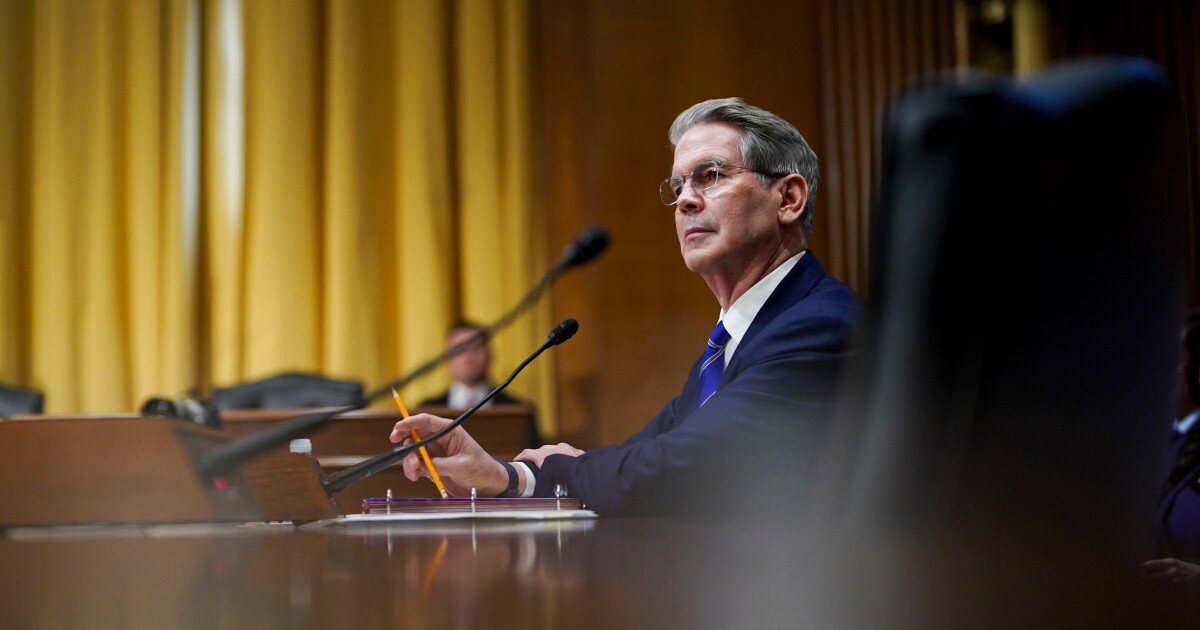
The Financial Stability Oversight Council's take on its guiding principles is shifting, according to statements by Treasury Secretary Scott Bessent on Thursday.
Bessent said in the open part of the group's meeting that the council needs to ensure its original focus on regulation to control risks associated with the 2008 financial crisis isn't stifling the economy.
"Little thought was given to the harms of regulation," Bessent said. "Our administration is changing that."
Examples of the new balance include FSOC's new artificial intelligence group, which aims to ensure there is innovation in AI while also monitoring its risks. He also pointed to the recent
Risks FSOC has indicated it will persist in monitoring include cybersecurity and treasury bond market disruptions, which can impact mortgage rates.
Reactions to FSOC's shift
The broader proposal for a change in FSOC's focus drew some support for its potential to open up opportunity in the financial sector so long as appropriate risk management remains in place long-term across regulatory bodies. However, there also was concern risk management could falter.
The Conference of State Bank Supervisors stressed the importance of managing systemic risks around online breaches and cryptocurrency through measures such as
"In these areas — cybersecurity, GENIUS Act implementation, and AI — the strength of our system depends on our ability to work collaboratively across federal and state lines and implement regulatory frameworks that are durable," said FSOC State Banking Supervisor Representative Lisa Kruse.
Graham Steele, an academic fellow at the Rock Center for Corporate Governance and a former assistant secretary of financial institutions at Treasury, acknowledged that the council remained partly focused on risk management but worried the scale could tilt too far toward deregulation.
"I think the reason this body was created was not to think about how to remove regulation. It was to actually spot areas where the regulation isn't vigorous enough," he said, noting FSOC's legal basis is rooted in preventing the failure of systemically important financial institutions.
What the new direction could mean for the GSEs
Advocates of moving the two influential government-sponsored enterprises away from the conservatorship had broadly anticipated that the FSOC meeting would be pertinent to efforts to change those entities' status. The financial crisis forced the GSEs into conservatorship in 2008.
FSOC's increased stress on deregulation could make a move away from conservatorship more likely.
"To the extent that the message here is, 'everyone, dial back your oversight' I think that just under status quo there will be less pressure on the FHFA to regulate all participants in the mortgage markets. That includes mortgage servicers, and it also includes the GSEs," he said.
That could lead to a focus on how to handle the adequacy of supervision if the GSEs do move away from conservatorship, reducing the FHFA's powers, he added.
"If the GSEs are, in fact, privatized, there's been a lot of talk about why the GSEs have not been designated by FSOC to be treated as systemically important nonbanks for oversight under this process," Steele said.
The council called on Congress to take action to ensure Fannie and Freddie's oversight agency, the Federal Housing Finance Agency, has sufficient oversight power during the meeting.
FHFA Director Bill Pulte said Fannie Mae has cut operating expenses by hundreds of millions of dollars and the safety and soundness of both GSEs are strong with narrower risk-related spreads between mortgage and treasury bonds contributing to lower mortgage rates.
Other recent moves at the government-sponsored enterprises have mirrored FSOC's aims.
Fannie announced recently it would
Lower initial rates that adjust upward later in a loan's life contributed to risks during the crisis but ARM performance risk generally is considered lower for seven- and 10-year products than shorter-term ones, which still have the prohibition.
In addition, Freddie Mac recently announced