
The government-backed Home Equity Conversion Mortgage is seeing proprietary products noticeably eat into its share of the reverse lending market, with the latter now providing much of the business momentum, according to new analysis.
Both HECM endorsements and secondary market issuances contracted on a year-over-year basis in July. New endorsements declined to 2,034,
Meanwhile, new applications, which precede endorsements, came in at just under 3,000 in June, "the first time we've seen that since January, likely pointing to proprietary reverse mortgages continuing to siphon volume away from the HECM product," RMI said.
At the same time, issuances of new HECM mortgage-backed securities finished at $463 million last month, according to a separate analysis from New View Advisors. While the number inched upward by 1.5% from June's $456 million, it was 14.4% lower from $541 million a year ago.
Lenders issued 59 new pools in July, with 17 composed of first participations, 41 consisting of tails and one combining both. The number grew by two, with last month's issuances the second lowest for any July since 2009.
How individual companies performed
The active lender count declined month to month with eight fewer originators posting endorsement activity in July, RMI also reported.
The usual leaders were found at the top of the list,
In secondary market activity, HMBS issuances are also dominated by the same three players, New View said. Finance of America issued $177 million in HMBS, $2 million less than the prior month's $179 million, at the same time totals at Longbridge increased. The latter saw its volume rise by $9 million month to month, with July issuances climbing to $141 million. Mutual of Omaha followed with $86 million, down $7 million from June.
How proprietary liens have changed the reverse market
What may appear to be lean times for HECM activity belies overall growth among reverse lenders, whose products are geared toward
Proprietary liens are being credited for providing much of their recent momentum. By the first half of 2026, proprietary liens had grown to a majority of all reverse originations at 54%.
"The growth in proprietary reverse mortgages is one of the most significant developments in our industry in recent years," New View Advisors co-founder Michael McCully said in a press release.
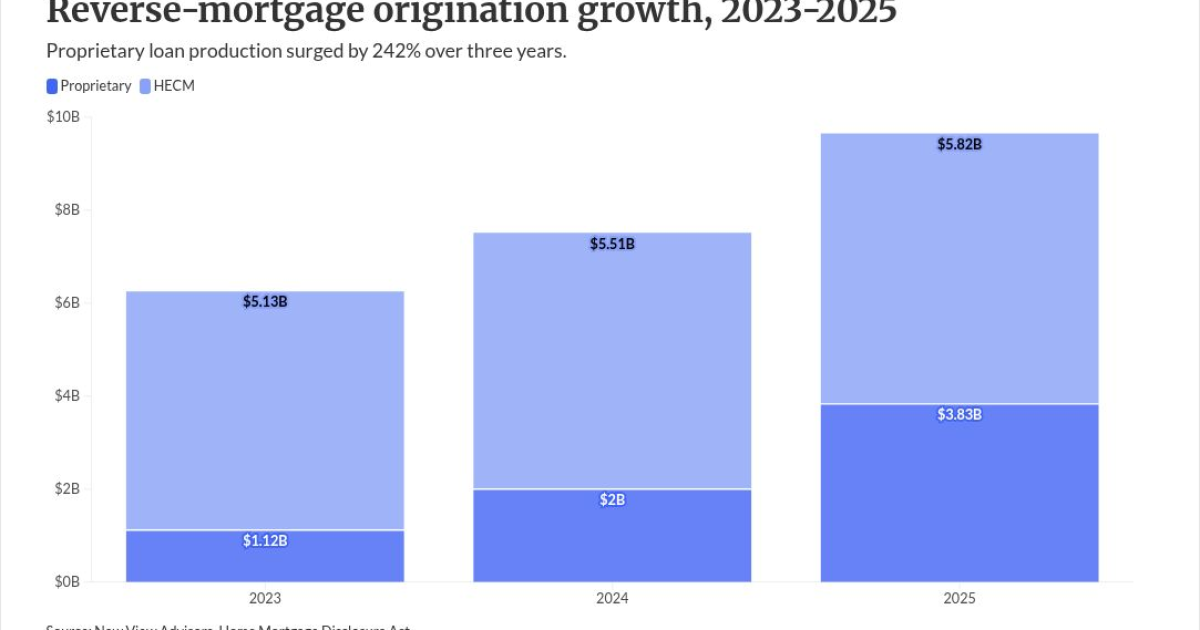
Total activity across reverse lending, inclusive of both private company offerings and HECMs, surged 28.5% year over year in 2025 to $9.65 billion, New View said in a recent analysis of Home Mortgage Disclosure Act data. Production accelerated from $7.51 billion the year before and $6.25 billion in 2023.
"We estimate proprietary reverse mortgage production for Q2 2026 at $1.2 billion, and 1st half 2026 production at just under $2.2 billion," according to New View's market index. This year's first-half activity jumped from $1.5 billion over the same six months in 2025.
By comparison, HECMs, which are insured by the Federal Housing Administration, came in at just about $950 million between April and June, and $1.8 billion over the first six months of the year.
Still, when looking at unit count, HECMs continue to make up the overwhelming majority of originations, despite the notable pick-up in lenders' own products this decade.
"HECM units increased only about 6% from 2023 to 2025, while proprietary units nearly quadrupled," New View noted.
Proprietary-market loans increased to 6,979 in 2025, up from 3,212 and 1,774 over the two years prior. On the other hand, HECM activity moved sluggishly, rising to 24,850 for full-year 2025. In 2024 and 2023, volume came in at 24,648 and 23,358 units, respectively.
How interest rates may factor into 2026 reverse lending
Rising rates look likely to have a more severe effect on HECM activity, though, as the FHA-backed liens mandate the purchase of mortgage insurance. The premiums are set as a percentage of the total loan amount.
Higher rates limit how much accrued equity borrowers can draw from, which some in the industry have noted as a reason why clients may opt for a proprietary product.