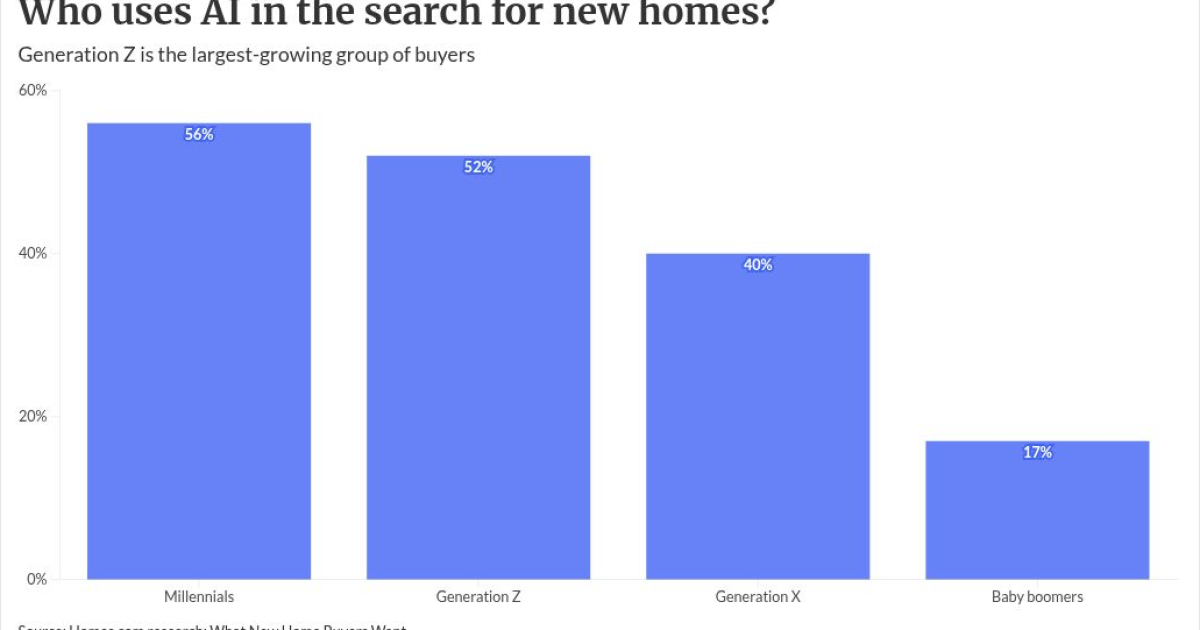
The new generation of home buyers is increasingly looking toward artificial intelligence in their search, and the trend means parties in the transactions — from builders to lenders — need to meet them where they are. Below we'll show you what to do to get your site tuned up in order to reach these potential clients.
The current trajectory of the technology's development signals why strategies to develop AI-friendly websites are paramount for mortgage businesses today to not only maximize search appearances but also demonstrate authority as lending experts. Similar to a tree falling in the forest with nobody around to hear it, a beautifully designed and well-written web page is unlikely to make an impact in the AI age if it doesn't
"If you're unable to be found, then you're never going to show up. It is a technical issue more so than it is a content issue," said Steven Cooley, CEO and founder of AI-visibility platform Prlmnt.
In recent research, Homes.com found that 51% of homeowners who purchased
The findings underscore why comprehension of how AI operates is essential for modern digital marketing efforts, and it requires many to adjust habits learned from an earlier era.
Auditing the website
Strategies now exist to
Auditing a website and then formatting it based on what might be on the minds of a potential borrower needs to be front and center of future development if companies expect an online presence to bring digital leads. Unlike Google, which elevated websites close to the top of its list based on backlinks, AI instead looks at the ease of finding data as evidence of "authority."
"There's a technical aspect to it that's imperative to have set up and established. Then, some people have accidentally set their sites up that way," Cooley said.
As an example, the structure of Reddit makes information readily accessible and convertible into responses, which is why AI tools frequently recognize the anonymous social network as an authoritative source, he noted.
"It's not because Reddit's amazing. It's just coincidentally that their structure and their question-answer dynamic aligns with how those chat instances are used," Cooley continued.
Some large retail lenders appear to have cracked the code in the quest for AI recommendation. Consistently ranking near the top in visibility on artificial intelligence platforms are the likes of Better, JPMorgan Chase, Wells Fargo and SoFi, according to AI monitoring site Trakkr.
Reaping the rewards from an "accident" is mortgage broker Kelly Sansom, who entered the lending industry in early 2025. Since joining Capital Financial as the head of Utah-based ClearPath Mortgage, he has seen approximately three times more incoming leads from searches than through the standard referral networks he relied on when starting his business.
"It was not that I had set out to become recognized by AI systems. It was happening, and I want to find out how I need to optimize that," he said about subsequent marketing efforts.
His strategy hasn't led to an abandonment of traditional search-engine optimization either, as he uses SEO to complement AI. Large language models are learning from the internet, making search results still valuable, he said.
"They're going out, and scouring, trying to understand it. Google local information is huge — ratings from clients, things like that," he said. "Other AI engines will see that as well and recognize that."
Why FAQs matter
Alongside Reddit, AI web crawlers seek out FAQ pages, finding the format particularly amenable to data collection and delivery. The appeal of FAQs to AI platforms has lenders regularly updating websites based on what they think segments of consumers want.
"We try to marry that with more long-form, explanatory content to align with what customers are asking the AI for and providing those answers, so that hopefully we have control over the algorithms by which AI engines crawl our site," said Liz Hillestad, chief marketing officer at
"We want to invite AI engines to search our site," she said.
Aside from merely thinking about the initial query potential customers might enter onto the platform, companies need to think of the follow-ups AI poses and the possible responses in order to get the company's name in AI recommendations, Hillestad said.
Artificial intelligence tools don't
"You want to bring situations into it that make it real, and those are the things that really get you found," Sansom said.
"When you write it yourself, and — even with your imperfections of humanity — write about real situations that you've dealt with, those are things AI can't fake."
Tracking performance across different platforms
While general strategies can be applied, each AI-search tool has its own nuances and some companies may find themselves better off focusing on a specific platform that has already proven to deliver results, Cooley said.
"Hyper-relevant content is king. ChatGPT and Google very explicitly tell you what needs to occur for you to be optimized in their chats, and now, the implementation and the application of those is where I think there's a massive disconnect," he said.
Still, certain rules are universal, including enablement of bots, despite the aversion many have to them.
"You have to have bot traffic in order to get AI searchability," Sansom explained. "AI systems are simply answering questions for people, and if you provide them the answers, they will annotate that they got this from you."
While there are steps companies can take to make themselves findable, "it does take working with either a web developer or with some knowledge on their own," Sansom advised.
AI visibility tools provide insights into the volume of traffic coming from each individual search platform, but anecdotally, companies can also see how they are found. Website traffic from AI-platform searches reveal themselves in reports with the appropriate domain suffix.
Using the platforms themselves can provide insights into what customers care about, allowing lenders to tailor their efforts and come up with content around trending topics to optimize authority.
"The number one thing that would allow a lender to start to move in that direction would be to ask an AI system what are the most-asked or searched-for questions in my area about mortgages," Sansom continued.
Success stories also deliver valuable clues, he added.
"When I find out a client found me on an AI search, my next question is, 'What did you enter?' Because that information lets you understand what AI is responding to for you, and that also lets you know the important question that maybe you don't have an answer to. Or maybe you do."
The hidden risks and pitfalls
Although the potential value of leads offered by AI holds enormous promise, conversations between a search-engine platform and a consumer may prove problematic for the lender in certain instances, Hillestad said. The platform essentially turns into an intermediary, asking the types of questions only a licensed loan officer normally would. It may even try to structure deals.
"That can be good and bad. That can lead the customer to the right lender, but it oftentimes sets an incorrect expectation," she said. "It does set expectations with customers that their picture is rosier than they think."
The changing marketing playbook brought with the rise of AI search also means an engaging, well-designed website — as well as the expense and labor needed to create one — might become a remnant of the past.
"They're very expensive to manage and upkeep, and the truth of it is the utility of a website is to get information," Cooley said."Having this full-blown website is not what it used to be."