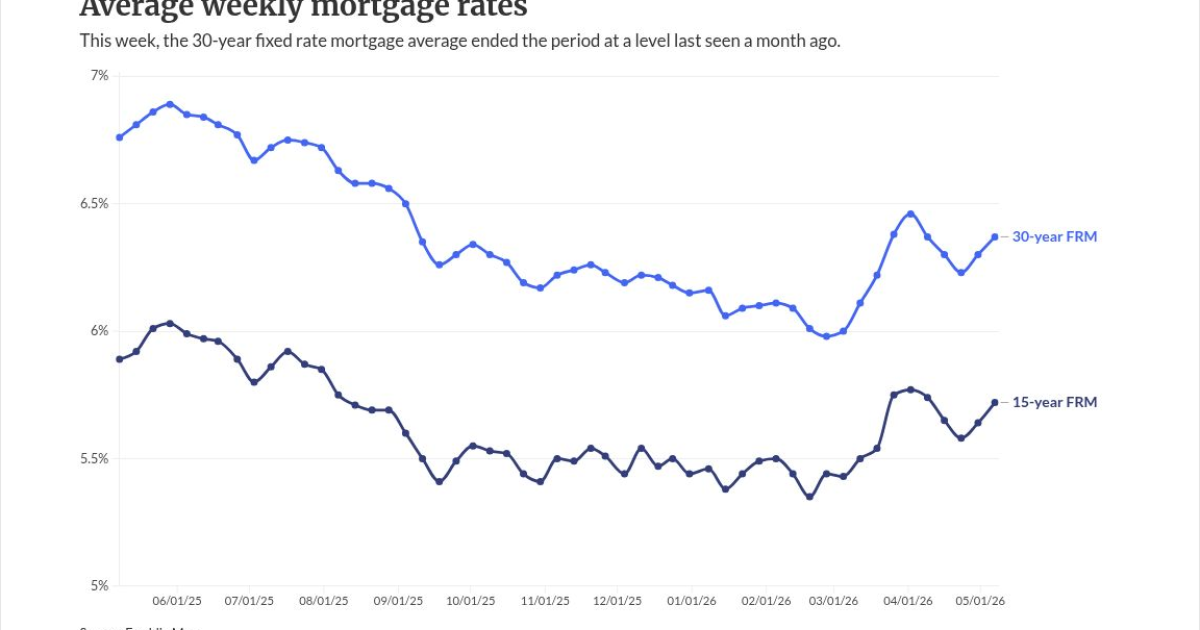
The 30-year fixed rate mortgage gained another 7 basis points this week, Freddie Mac reported, but the point-to-point movements do not tell the whole story.
Even as the 30-year FRM averaged 6.37% for the period ended May 7, the Freddie Mac Primary Mortgage Market Survey reported, observers noted rates trended lower the last few days. Still this was up from last week
Meanwhile the 15-year FRM rose 8 basis points to 5.72% from 5.64% the prior week. For
"Recent data points to slightly better conditions for buyers with
The point-to-point data does not tell the story
The week started off with rates on the rise as President Trump's plans to guide ships through the Strait of Hormuz made investors skittish.
On Monday, the 10-year Treasury yield hit an intraday high of 4.46%, but has trended lower since then as the markets reacted to the latest news regarding the Iran conflict.
On Wednesday, it closed at 4.36%. By 11 a.m. eastern time on Thursday it fell another 2 basis points.
While mortgage rates have moved significantly lower in the last few days since earlier this week, it's not enough to erase earlier gains, said Kate Wood, NerdWallet's home and mortgage expert.
"That makes it a confusing moment for potential buyers or refinancers trying to follow mortgage rates, since where rates are depends on your timeframe," Wood said in a Thursday statement. "Mortgage rates are lower today, but higher this week, which could make for some conflicting headlines."
Lender Price data on the National Mortgage News website had the 30-year FRM at 6.508% late Thursday morning; this compared with 6.525% one week ago.
Mortgage application volume declines
Loan application volume fell 4.4% for the week ended May 1, the Mortgage Bankers Association's Weekly Application Survey said.
The 30-year conforming mortgage averaged 6.45% for the period, up 8 basis points from the prior week. The 15-year fixed rose 6 basis points to 5.83%.
The highest mortgage rates in a month is why demand for both purchase and refinance loans dropped, said Bob Broeksmit, MBA president and CEO.
"At $467,300, the purchase application loan size is the highest in MBA's survey dating back to 1990," Broeksmit said in a Thursday morning statement. "These rising loan sizes highlight persistent affordability pressures and a market increasingly skewed toward higher-income borrowers."